Serabit el-Khadim, on top of a mountain plateau in the south-west of the Sinai Peninsula, in Egypt, preserves the ruins of a temple of Hathor, the "Lady of Turquoise". For centuries, in the Middle and then the New Kingdom, the pharaohs sent expeditions here to extract turquoise from the nearby mines. Semitic-speaking workers carved the Proto-Sinaitic inscriptions here, one of the earliest witnesses to alphabetic writing and a distant ancestor of the Hebrew, Greek and Latin alphabets.
Let us be clear: no archaeological evidence connects Serabit el-Khadim with Moses or the Hebrews, and the Bible does not mention the place. It is a context site, showing what the Egyptian presence in the Sinai desert looked like and how the Semitic groups employed by Egypt lived. Theories that see traces of Moses here circulate widely; they are presented below, together with the view of specialists.
Type of siteEgyptian temple and mining district (turquoise)
OccupationFrom the Middle Kingdom (20th century BC) to the end of the New Kingdom (12th century BC)
Major discoveryAbout thirty Proto-Sinaitic inscriptions
Biblical linkNone direct; context of the Sinai desert
⏱ Visit: about 300 minUpdated
Serabit el-Khadim and the Exodus story
The setting of the story, not a location
After the crossing of the sea, the book of Exodus leads the people into the desert, towards Sinai. The following verse does not speak of Serabit el-Khadim: it is quoted here as the setting of the story, to recall the kind of arid landscape in which the wilderness narratives unfold.
"So Moses brought Israel from the Red sea, and they went out into the wilderness of Shur; and they went three days in the wilderness, and found no water."
The route of the Exodus depends on where Mount Sinai was, which is itself debated. If one follows the Christian tradition that places it at Jebel Musa, near St Catherine's Monastery, the route crosses the south-west of the peninsula, not far from the Egyptian mining districts. Some Bible atlases thus place the station of Dophkah (Numbers 33:12) near Wadi Maghara, another Egyptian mining site close to Serabit: this is a hypothesis that nothing allows us to verify.
"And they took their journey out of the wilderness of Sin, and encamped in Dophkah."
Numbers 33:12 (KJV)
וַיִּסְעוּ מִמִּדְבַּר־סִין וַיַּחֲנוּ בְּדָפְקָה
במדבר לג, יב
What the site brings to our understanding of the story
Serabit el-Khadim shows that Sinai was not an empty desert: Egypt organised seasonal expeditions there, with soldiers, scribes, miners and interpreters. Workers from Canaan encountered Egyptian religion and adapted its signs to write their own language. This world, on the border between Egypt and Asia, is the backdrop to the story of Israel in Egypt. For the whole narrative, see the period page The Exodus and the conquest of Canaan.
The Temple of Hathor, Lady of Turquoise
A sanctuary that grew from a cave
The temple was founded under Senusret I (12th Dynasty, 20th century BC) around two sacred caves cut into the rock: one dedicated to Hathor, the other to Sopdu, god of Egypt's eastern borderlands. In the Middle Kingdom, Amenemhat III sent expedition after expedition: dozens of texts from his reign are known in Sinai, and Egyptologists count between eighteen and twenty expeditions to Serabit under this king alone. He had a hall known as the "Shrine of the Kings" built, completed under Amenemhat IV.
In the New Kingdom, the temple was extended by a succession of rooms and courts, to a length of about 70 metres. The names of Thutmose III, Amenhotep III and the Ramesside kings appear there; Ramesses VI is the last New Kingdom king whose name is attested in the temple, in the 12th century BC. The site was then abandoned.
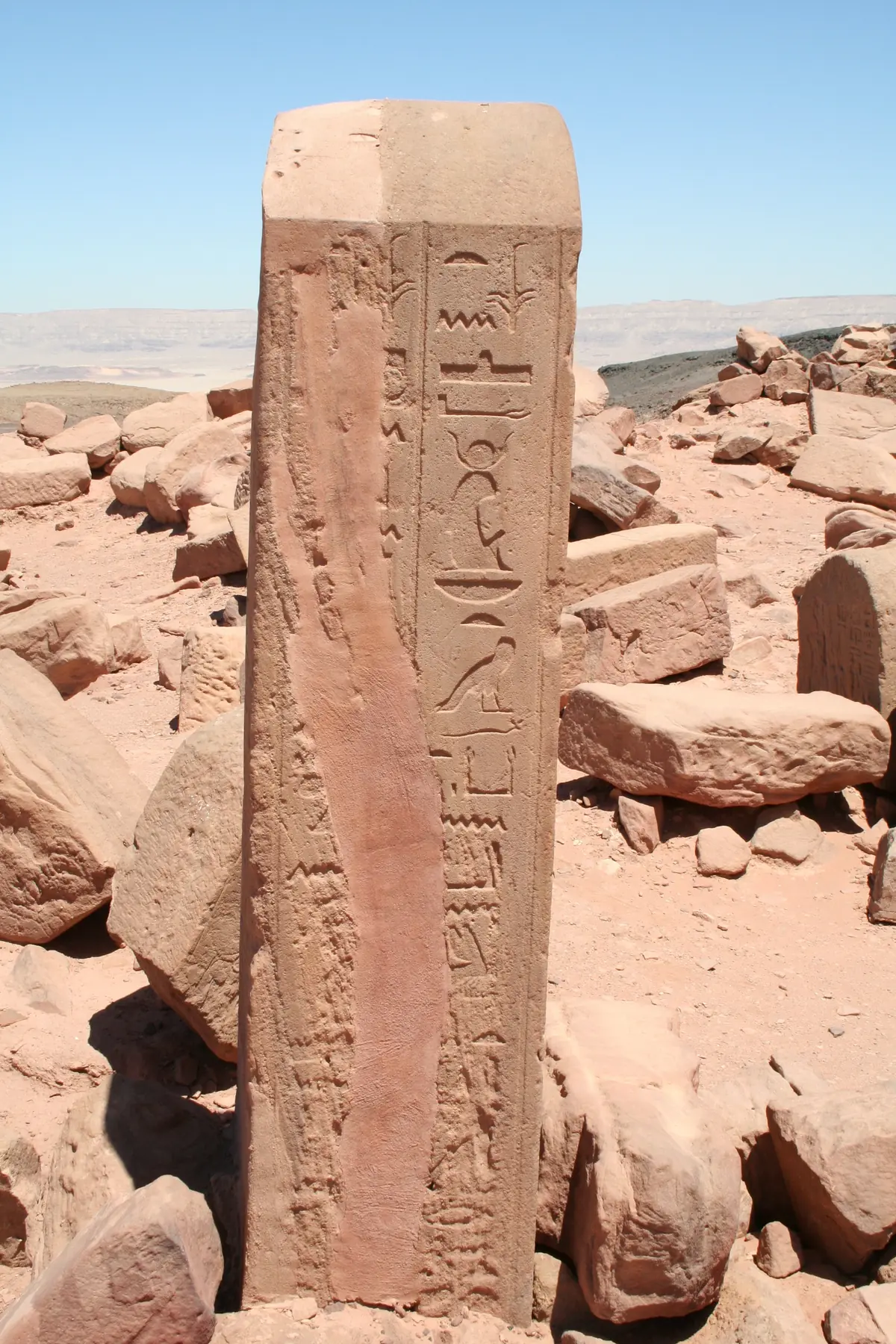
Inscribed Egyptian stela in the Temple of Hathor at Serabit el-KhadimCredit: Einsamer Schütze · CC BY-SA 3.0 · Wikimedia Commons
A forest of stelae
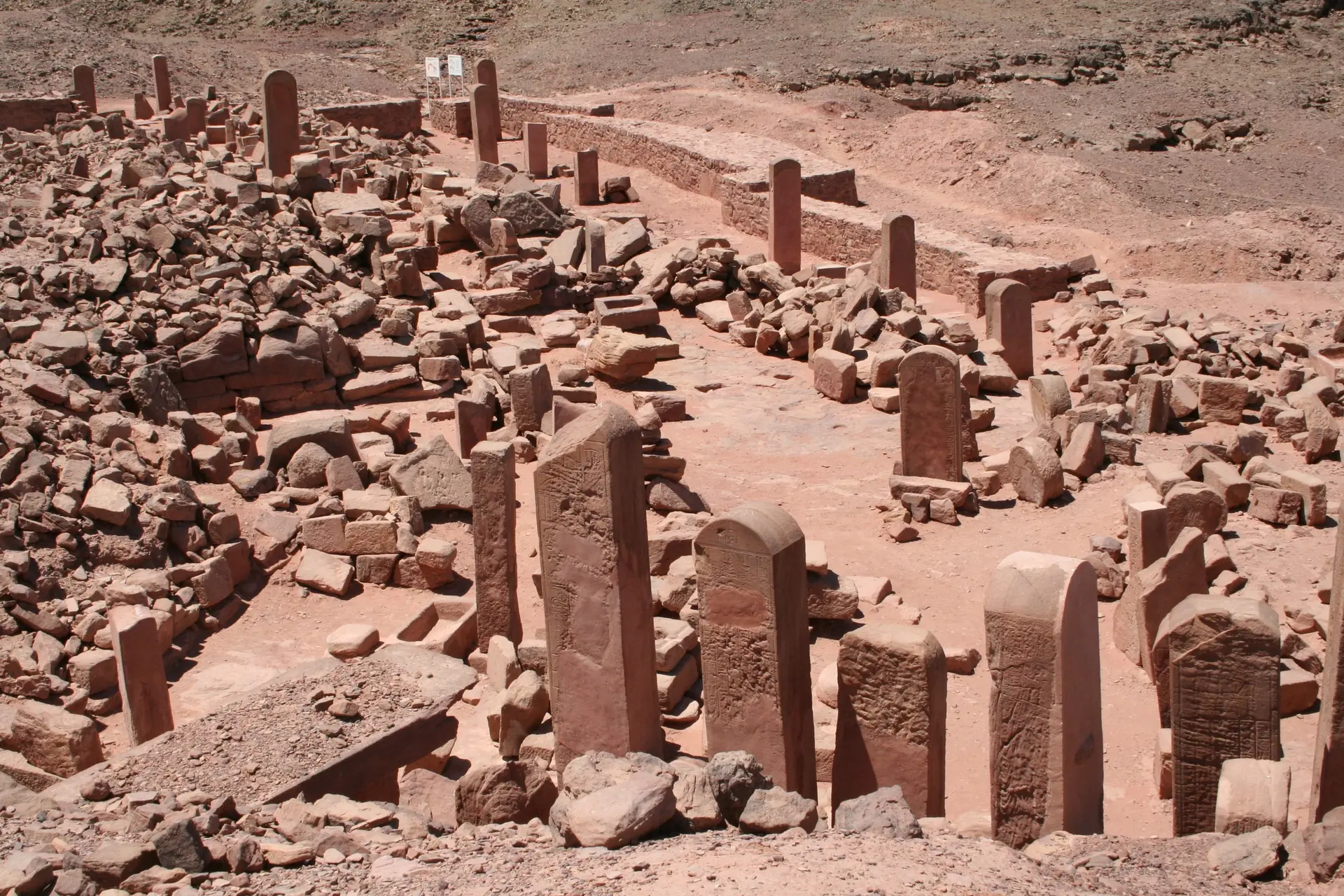
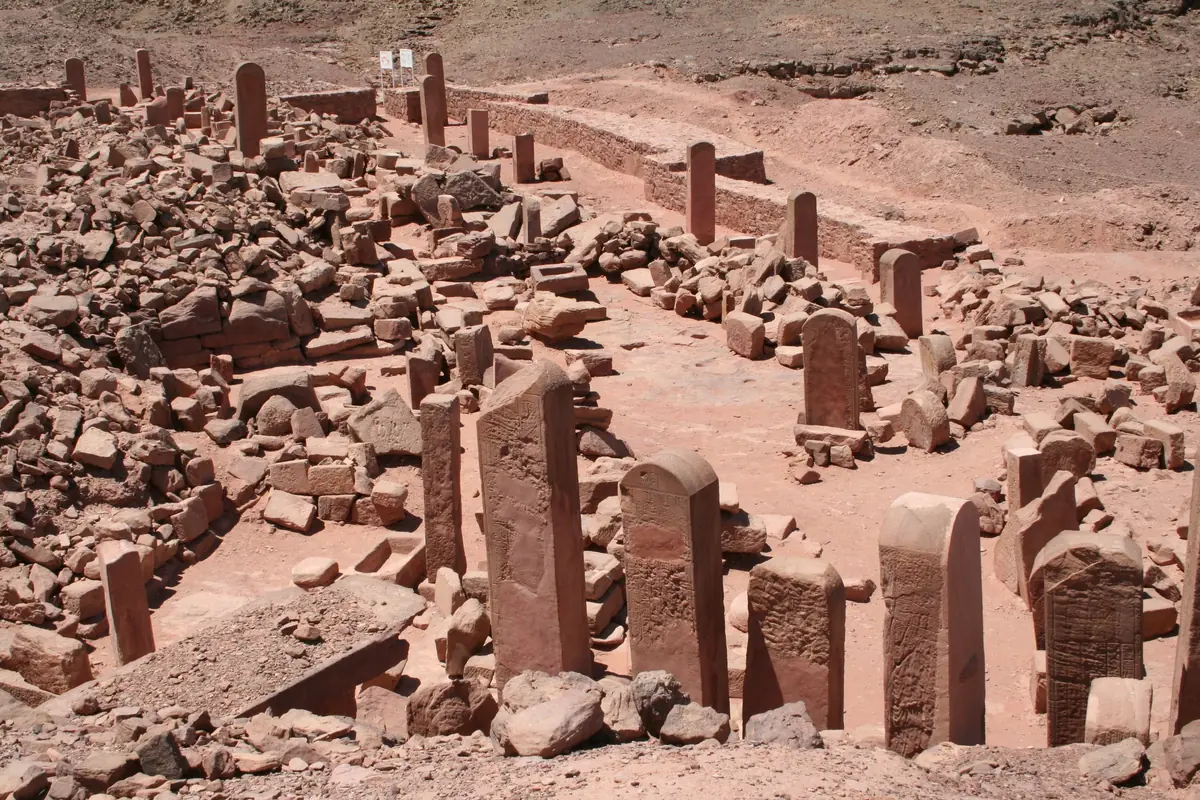
The most striking sight is the sandstone stelae standing along the temple's processional ways. Expedition leaders recorded the date, the king's name, the members of the mission and sometimes the hardships they faced: one stela, from year 6 of Amenemhat III, reports an exceptional expedition carried out in summer, whereas missions usually set out in winter. Hathor bears the epithet "Lady of Turquoise" on them.
Petrie and the excavations
The site has been known to travellers since the 19th century; the painter David Roberts drew it in 1839. The first comprehensive excavation was carried out by Flinders Petrie in the winter of 1904-1905 and published in 1906 (Researches in Sinai). Among the finds is a small head of Queen Tiye, wife of Amenhotep III, now in Cairo. The hieroglyphic inscriptions were edited by Alan Gardiner and Eric Peet.
The Proto-Sinaitic inscriptions and the origins of the alphabet
A new kind of writing
In the temple and near the mines, excavations revealed about thirty inscriptions carved in signs that look like hieroglyphs, but in a very small number. In 1916, the Egyptologist Alan Gardiner proposed the key: each sign borrows an Egyptian image and stands for the first sound of the Semitic word for it. The ox head (alef) stands for "a", the house (bet) for "b", and so on. This is the principle of the alphabet.
On several objects Gardiner read the sequence l-b-ʿ-l-t, "to Baalat", meaning "the Lady": the Semitic name the workers gave to the goddess the Egyptians called Hathor. This reading is now widely accepted; the rest of the texts, often short and damaged, remain largely debated.
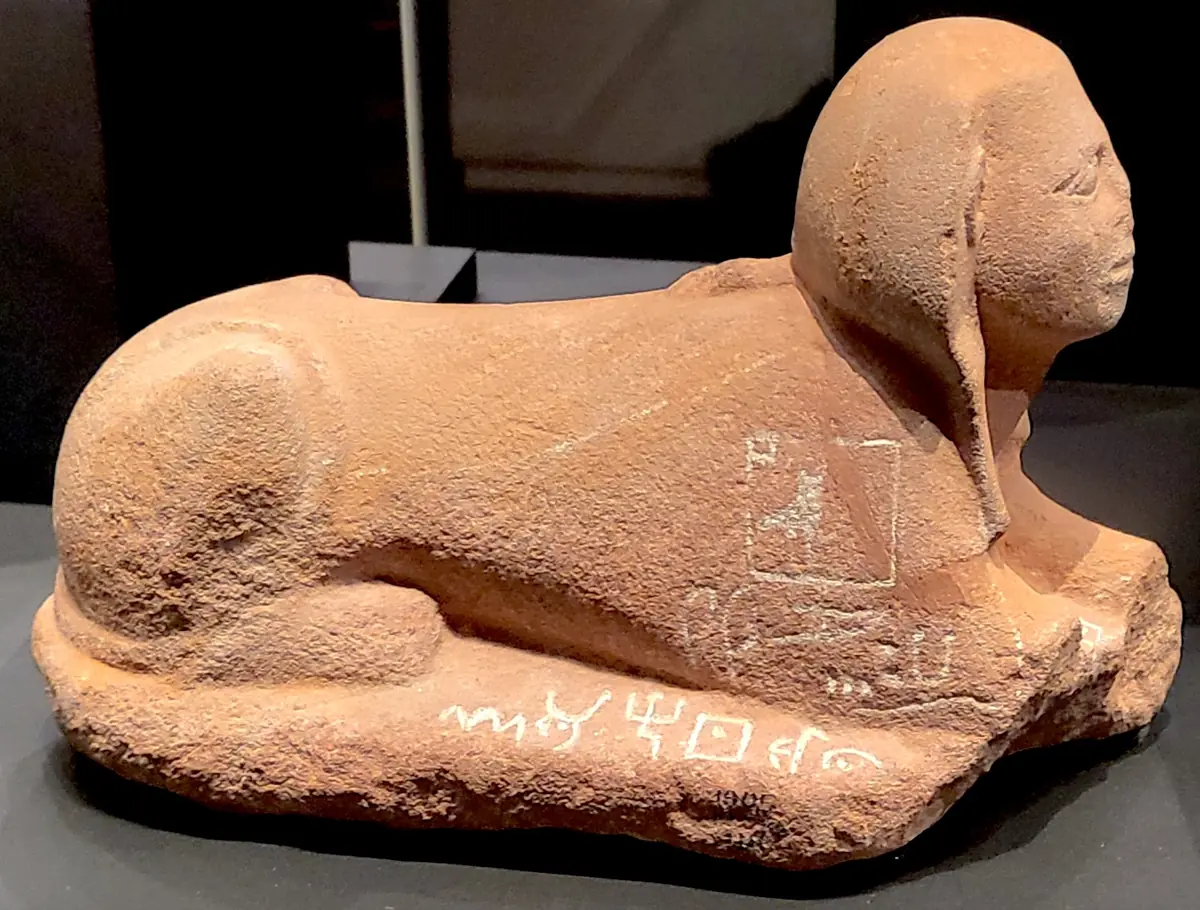
The "Sinai 345" sphinx, with hieroglyphic and Proto-Sinaitic inscriptions (British Museum, EA 41748)Credit: Onceinawhile · CC BY-SA 4.0 · Wikimedia Commons
The "Sinai 345" sphinx in the British Museum
The most famous of these objects is a small sandstone sphinx found by Petrie in the temple and kept in the British Museum (EA 41748). It bears a hieroglyphic inscription naming Hathor and, on its side and base, a Proto-Sinaitic inscription in which Gardiner recognised "Baalat". This "bilingual" text played a decisive role in the decipherment.
A date still under debate
Specialists hesitate between two ranges: the Middle Kingdom (c. 1900-1800 BC), supported in particular by comparison with the Wadi el-Hol inscriptions in Upper Egypt, and the New Kingdom (c. 1500 BC). Either way, these graffiti were made by Canaanite workers or other Semitic speakers employed by the Egyptian expeditions. Their system, simplified over the centuries, led to the Phoenician alphabet, then to Paleo-Hebrew script and to the Greek and Latin alphabets.
🔎 A note
Other missions added to the corpus: the Harvard and Catholic University of America expeditions (1927-1935) discovered new inscriptions, published in particular by Romain Butin. The numbering "Sinai 345" onwards follows Gardiner's catalogue.
Moses at Serabit el-Khadim? What the sources say
The link between these inscriptions and the Bible has long fuelled popular theories. Some authors have proposed reading the Proto-Sinaitic texts as Hebrew and recognising biblical figures in them: this is the case of Douglas Petrovich (The World's Oldest Alphabet, 2016). In 2025, Michael Bar-Ron proposed reading in two inscriptions (Sinai 357 and 361) the words "this is from Moses" and "a saying of Moses".
These readings are rejected by most epigraphers and Egyptologists, who dispute the identification of the signs, often very worn, and the method of reconstruction. Several scholars also point out that "Mose" was a common element in Egyptian names: even a correct reading would not necessarily refer to the biblical Moses.
⚠️ In short
No inscription, object or archaeological layer at Serabit el-Khadim attests the presence of Moses or the Hebrews. The site sheds light on the world in which the Exodus story took shape: Egyptian expeditions, Semitic workers and the birth of the alphabet later used to write Hebrew.
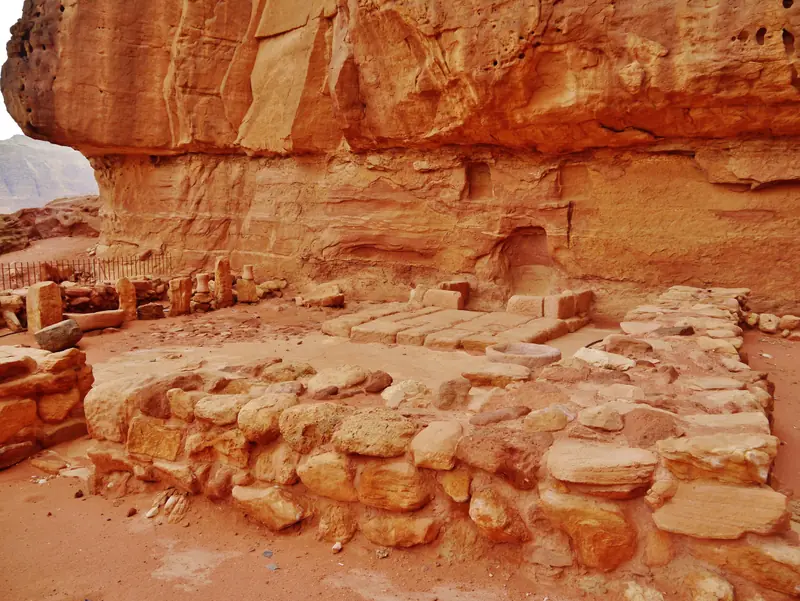
A comparable Hathor shrine, linked to copper mines, can be visited on the Israeli side at Timna, in the Arava.
Visiting Serabit el-Khadim today
The ruins and stelae of the Temple of Hathor at Serabit el-KhadimCredit: Einsamer Schütze · CC BY-SA 3.0 · Wikimedia Commons
A field excursion
Serabit el-Khadim is not a site laid out like an open-air museum. The temple stands on top of a plateau, inland, about forty kilometres east of Abu Zenima on the Gulf of Suez coast. Access is by a track and then a climb on foot: a steep path of about an hour and a half, or a gentler route fitted with steps on the western side. Recent travel accounts describe a base camp where Bedouin guides can be found.
In practice, the visit is organised with an agency or a local guide, from Abu Zenima, the St Catherine area or the South Sinai resorts, with the permits required by the Egyptian authorities. No official opening hours or reliable prices are published online: ask a local organiser and, for the site itself, the Egyptian antiquities authorities. The traditional Mount Sinai lies in the same region.
⚠️ Travel advice (as of 29 September 2026)
The UK Foreign Office (FCDO) advises against all but essential travel to the northern part of the South Sinai Governorate, beyond the St Catherine-Nuweiba road, except for the coastal areas: Serabit el-Khadim, inland north-west of St Catherine, appears to fall within this area. France formally advises against the part of Sinai north of a Suez-Taba line and warns of poorly marked no-go desert zones. Israel maintains a level 4 warning, its highest, for Sinai. Check your own government's official advice before planning a trip.
Serabit el-Khadim: the Temple of Hathor and the origins of the alphabet Serabit el-Khadim, plateau in south-western Sinai (South Sinai Governorate), about forty kilometres east of Abu Zenima
A full day: drive along a track, a climb of about an hour and a half depending on the route, the temple visit and the descent.
Guide & permits
The excursion must be arranged with a Bedouin guide or a local agency, with the permits required by the Egyptian authorities. Check with them before setting out.
Opening hours & fees
No reliable official information is published: ask the local organiser.
Best seasons
October to April. In summer the heat makes the climb hard and dangerous.
Equipment
Walking shoes, plenty of water, sun protection and warm clothing for the early morning.
Accessibility
Not accessible: climb on foot over rocky ground.
⚠️ Safety
Inland South Sinai area subject to restrictions and unfavourable travel advice (UK FCDO; Israeli level 4 warning for Sinai). Check your government's official advice at the time of travel.
Suggested itineraries
Traditional Sinai (depending on security conditions)
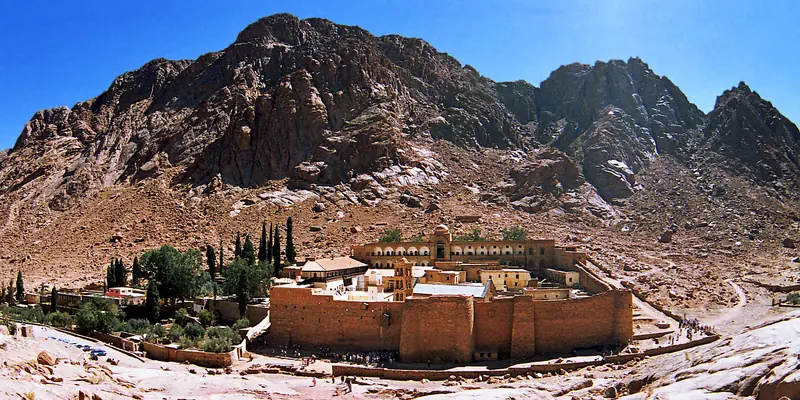
In the heart of the South Sinai mountains, a Christian tradition sixteen centuries old places the burning bush and the giving of the Law here. Yet the identification of biblical Sinai is still debated.
In the Arava Valley, a red sandstone landscape where the Egypt of the Ramesside pharaohs mined copper: a context site for understanding the desert of the Exodus story.
View site →
Frequently asked questions
Did Moses pass through Serabit el-Khadim?
Nothing allows us to say so. The Bible does not mention the place, and no inscription or remain there attests the presence of Moses or the Hebrews. The site only sheds light on the Egyptian and mining context of Sinai.
What are the Proto-Sinaitic inscriptions?
About thirty short inscriptions carved by Semitic-speaking workers using signs borrowed from hieroglyphs. Each sign stands for the first sound of the word it depicts: this is the principle of the alphabet, from which Phoenician, ancient Hebrew, Greek and Latin descend.
Who deciphered the Serabit el-Khadim inscriptions?
Alan Gardiner, in 1916, understood the principle of the system and read the sequence l-b-ʿ-l-t, "to Baalat", the Semitic name of the goddess equated with Hathor. Much of the text remains debated.
Where can I see the Sinai 345 sphinx?
In the British Museum, London (inventory number EA 41748). It bears both a hieroglyphic inscription naming Hathor and a Proto-Sinaitic inscription.
Do the inscriptions mention Moses?
Readings along these lines have been proposed, notably in 2025, but most specialists reject them, disputing the identification of the signs. "Mose" was also a common element in Egyptian names.
Why is there a temple of Hathor in Sinai?
Hathor protected distant lands and miners; in Sinai she bore the title "Lady of Turquoise". The royal expeditions that came for turquoise dedicated stelae and offerings to her.
Can Serabit el-Khadim be visited today?
The site is visited as a field excursion, with a Bedouin guide and permits, and requires a climb on foot. Current travel advice is unfavourable for the interior of northern South Sinai: check it before any plans.