
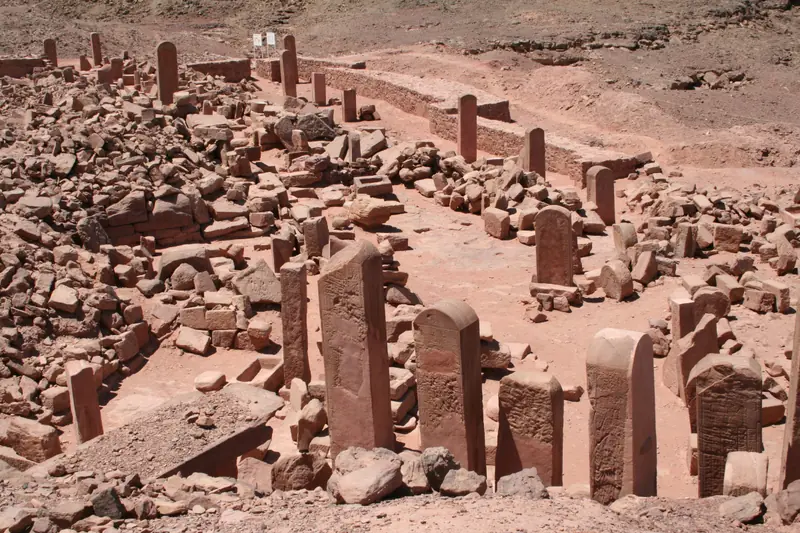
Serabit el-Khadim: the Temple of Hathor and the origins of the alphabet
On a plateau in south-western Sinai, a shrine of Egyptian miners where Semitic workers left some of the oldest known alphabetic inscriptions.
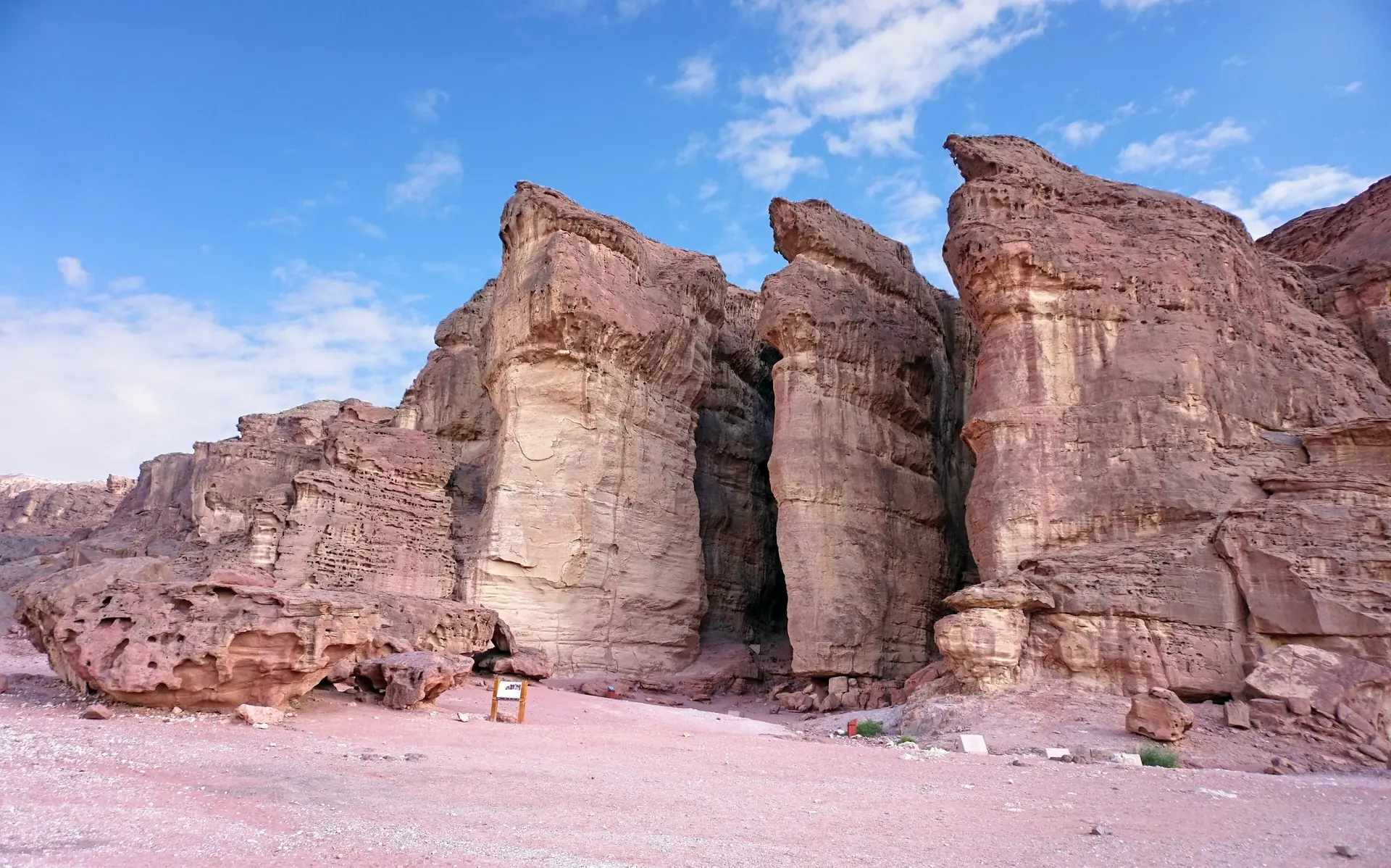
1500–1200 BCE
In the Arava Valley, a red sandstone landscape where the Egypt of the Ramesside pharaohs mined copper: a context site for understanding the desert of the Exodus story.
Credit: Tiia Monto · CC BY-SA 3.0 · Wikimedia Commons
Timna Park, in the Arava Valley about twenty kilometres north of Eilat, protects one of the oldest mining districts in the world. Copper has been extracted here for thousands of years, and pharaonic Egypt sent expeditions to the valley at the end of the Bronze Age, the very period to which tradition assigns the Exodus. At the foot of the famous Solomon's Pillars, archaeologists uncovered a small temple of the goddess Hathor, later turned into a tent shrine where a copper serpent with a gilded head was found.
Let us be clear from the outset: Timna is not a stage of the Exodus identified by the biblical text, and no remains here attest a camp of Moses or the Israelites. It is a context site: it shows, on the ground, the southern desert, the Egyptian presence, the local peoples and the copper metallurgy that form the backdrop of the wilderness stories. The large Tabernacle tent visitors see in the park is a modern reconstruction, not an ancient remain.
After Aaron's death, the book of Numbers has the people go around the land of Edom by the way of the Red Sea: this is where the episode of the fiery serpents takes place. The text does not name Timna and the exact route remains unknown, but the Arava Valley, between the Dead Sea and the Gulf of Eilat, clearly belongs to these borderlands of Edom.
"And they journeyed from mount Hor by the way of the Red sea, to compass the land of Edom: and the soul of the people was much discouraged because of the way."
Numbers 21:4 (KJV)
וַיִּסְעוּ מֵהֹר הָהָר דֶּרֶךְ יַם־סוּף לִסְבֹב אֶת־אֶרֶץ אֱדוֹם וַתִּקְצַר נֶפֶשׁ־הָעָם בַּדָּרֶךְ
במדבר כא, ד
The list of stations in Numbers 33 also mentions Punon (Numbers 33:42-43), usually identified with Feinan, the other great copper district of the Arava, on the Jordanian side.
The Exodus story has Moses stay in Midian, where he marries the daughter of Jethro, "the priest of Midian" (Exodus 2:16-21). The excavations at Timna yielded a distinctive painted pottery known as "Midianite", made in north-western Arabia (the Qurayyah area), and a cult phase that archaeologist Beno Rothenberg attributed to Midianites. The comparison is suggestive, but it proves no direct link with Jethro or Moses: it only shows that groups from Arabia frequented the region at the end of the Bronze Age.
"Now Moses kept the flock of Jethro his father in law, the priest of Midian: and he led the flock to the backside of the desert, and came to the mountain of God, even to Horeb."
Exodus 3:1 (KJV)
וּמֹשֶׁה הָיָה רֹעֶה אֶת־צֹאן יִתְרוֹ חֹתְנוֹ כֹּהֵן מִדְיָן וַיִּנְהַג אֶת־הַצֹּאן אַחַר הַמִּדְבָּר וַיָּבֹא אֶל־הַר הָאֱלֹהִים חֹרֵבָה
שמות ג, א
To place Timna within the whole story, from Egypt to Canaan, see the period page The Exodus and the conquest of Canaan.
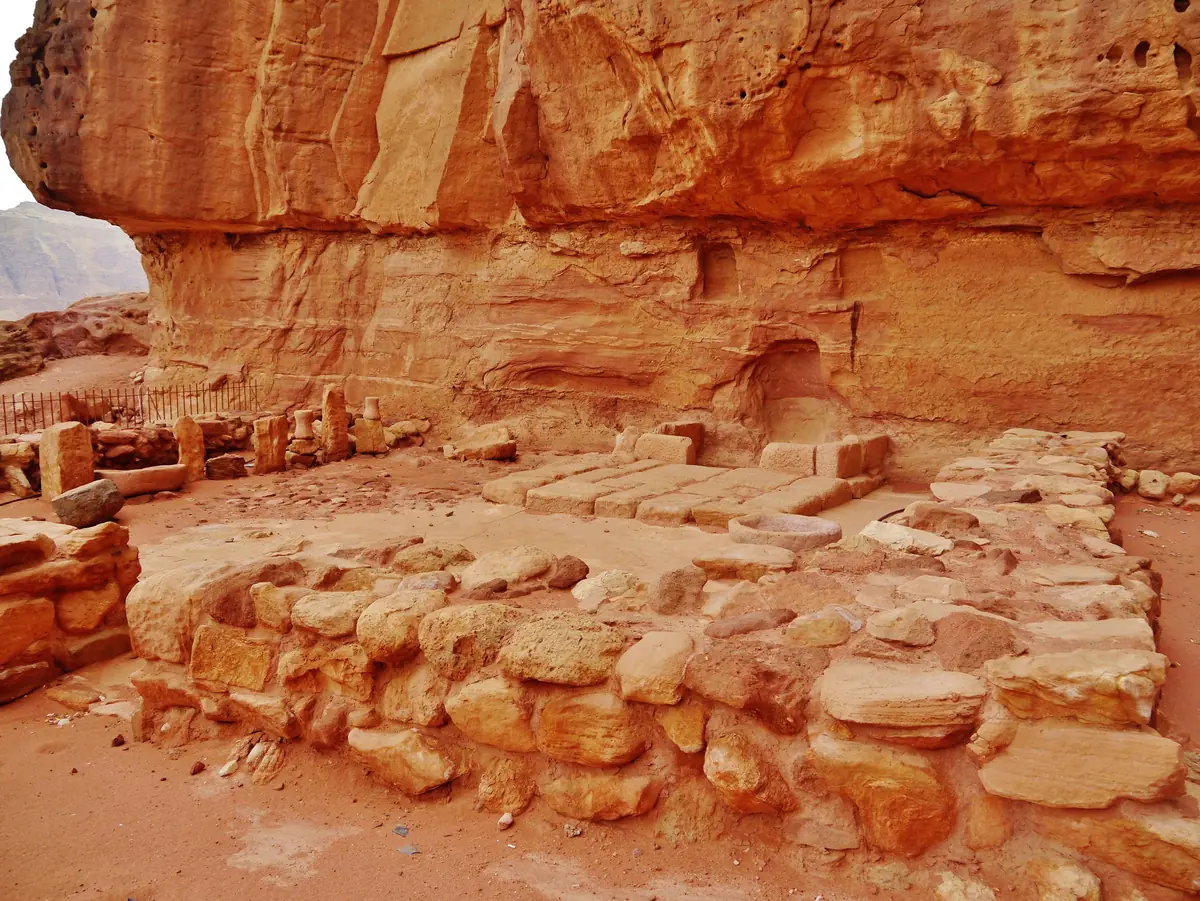
Set against the cliff of Solomon's Pillars, a small shrine dedicated to Hathor, protector of miners and "Lady of Turquoise", was located by Beno Rothenberg's Arabah Expedition and excavated in 1969. Objects inscribed with the names of pharaohs, from Seti I or Ramesses II down to Ramesses V, date its Egyptian use to the Ramesside period, roughly 1300-1150 BC. The excavators recovered several thousand objects. On the rock face nearby, a carved relief shows Ramesses III making an offering to the goddess.
The temple visible today consists of low stone walls outlining a courtyard and a niche at the foot of the rock. It was a miners' chapel, not a great temple of the Nile Valley. The same kind of sanctuary exists on a larger scale at Serabit el-Khadim, in Sinai, where Egypt mined turquoise.
After the Egyptians left, in the 12th century BC, the cult place was remodelled. According to Rothenberg's interpretation, its new users, whom he identified as Midianites, defaced the images of Hathor, set up standing stones and stretched a large tent over the courtyard: remains of woollen cloth were found along the walls. It was in this context that a small copper serpent with a gilded head was discovered.
A metal serpent in a tent shrine, deep in the desert of Edom, inevitably recalls the bronze serpent of Moses. The biblical story says that, to heal the people bitten by "fiery serpents", Moses made a serpent of brass and set it on a pole.
"And the LORD said unto Moses, Make thee a fiery serpent, and set it upon a pole: and it shall come to pass, that every one that is bitten, when he looketh upon it, shall live. And Moses made a serpent of brass, and put it upon a pole, and it came to pass, that if a serpent had bitten any man, when he beheld the serpent of brass, he lived."
Numbers 21:8-9 (KJV)
וַיֹּאמֶר יְהוָה אֶל־מֹשֶׁה עֲשֵׂה לְךָ שָׂרָף וְשִׂים אֹתוֹ עַל־נֵס וְהָיָה כָּל־הַנָּשׁוּךְ וְרָאָה אֹתוֹ וָחָי וַיַּעַשׂ מֹשֶׁה נְחַשׁ נְחֹשֶׁת וַיְשִׂמֵהוּ עַל־הַנֵּס וְהָיָה אִם־נָשַׁךְ הַנָּחָשׁ אֶת־אִישׁ וְהִבִּיט אֶל־נְחַשׁ הַנְּחֹשֶׁת וָחָי
במדבר כא, ח-ט
The bronze serpent long remained an object of worship in Israel: the book of Kings relates that King Hezekiah broke it in pieces, because incense was offered to it under the name Nehushtan (2 Kings 18:4).
🔎 What can and cannot be said
The Timna serpent shows that metal serpents had a religious function in the southern desert at the end of the Bronze Age and the beginning of the Iron Age. It proves neither that the story of Numbers 21 took place at Timna nor that it is the serpent of Moses. Attributing the tent phase to Midianites is itself an interpretation, debated by specialists.
In the 1930s, the American archaeologist Nelson Glueck attributed the slag and furnaces of the valley to King Solomon: the phrase "King Solomon's Mines" and the name "Solomon's Pillars" date from that time. From 1959, the Arabah Expedition led by Beno Rothenberg recorded thousands of mine shafts, smelting camps and rock drawings. The discovery of the Temple of Hathor in 1969 led Rothenberg to assign most of the mining to the Egyptian New Kingdom, which seemed to rule out the Solomonic hypothesis for a long time.
Since 2012, Tel Aviv University excavations directed by Erez Ben-Yosef have re-examined the large smelting camps, especially "Slaves' Hill" (Site 34) and Site 30. Radiocarbon dates show that copper production peaked in the 11th-10th centuries BC, after the Egyptians had left. The name "Slaves' Hill" is misleading: food remains and fine textiles, including fibres dyed with purple and dated to around 1000 BC, point to skilled, well-supplied smelters.
For Ben-Yosef, this industry was run by a local population, most probably Edomite, organised as a partly nomadic society yet able to coordinate large-scale production. The chronology thus matches the one the Bible assigns to David and Solomon, but the excavations do not point to Solomon as the operator: the link with "King Solomon's Mines" remains an open debate. This context is developed in the period of the Judges and the Kings.
📅 The remains and the Exodus chronology
Timna's Egyptian phase (c. 1300-1150 BC) overlaps the end of the traditional Exodus range; the "Midianite" phase and the Edomite production peak are later. No remains at Timna relate directly to the biblical story.
Solomon's Pillars are a natural formation: erosion has carved the red sandstone cliff into giant columns. The name is modern and has no historical link with the king. The Temple of Hathor lies at their foot, a few minutes' walk from the car park; look for the relief of Ramesses III on the nearby rock face.
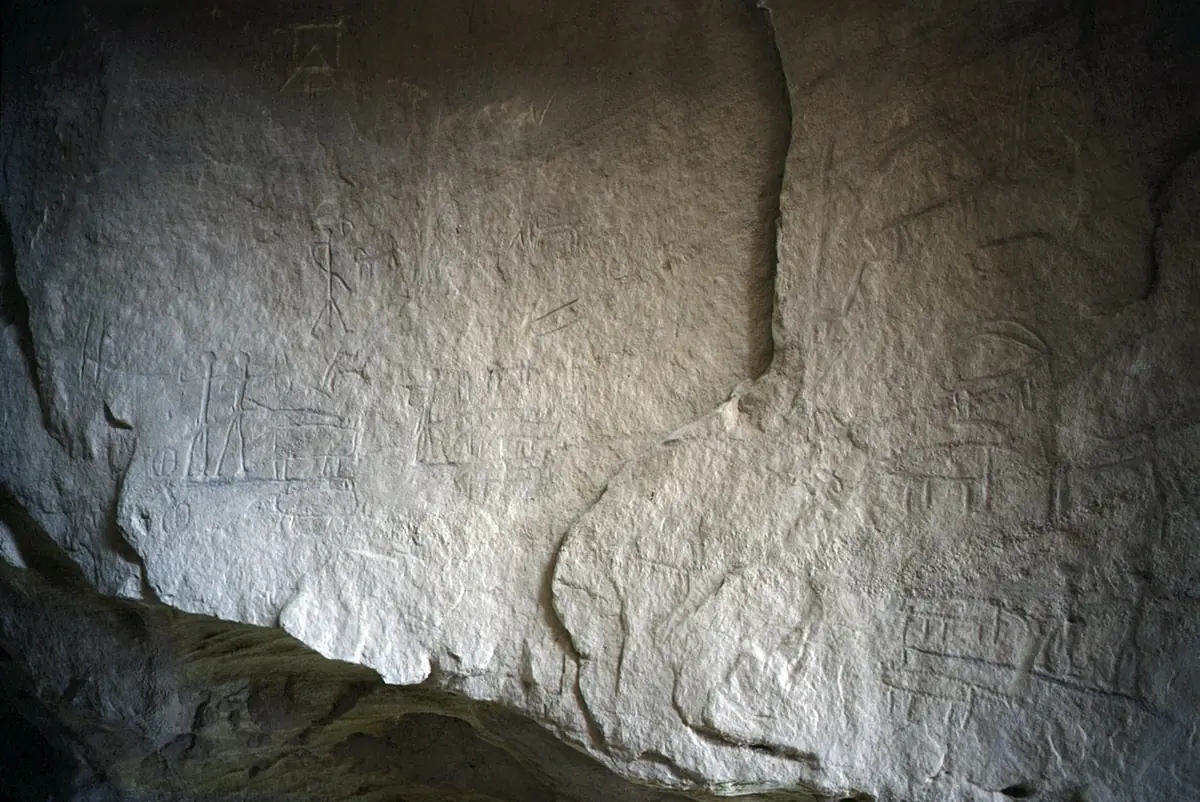
On a sheltered rock face, rock carvings show horse-drawn chariots, warriors with axes and shields, and hunting scenes. The park assigns them to the Egyptian period (14th-12th centuries BC). They are shallow: the low-angled light of early morning or late afternoon helps to read them.
The Mushroom, a sandstone block balanced on a narrow stem, stands next to an Egyptian-period smelting site. The arches trails pass ancient mine shafts, some fitted with ladders: these shafts and the slag heaps are direct witnesses of mining activity.
Near the artificial lake, a life-size reconstruction of the Tabernacle (the Mishkan) presents the courtyard, the altar, the menorah and the Ark of the Covenant according to the description in the book of Exodus. It is visited on a guided tour booked in advance with the park.
"And let them make me a sanctuary; that I may dwell among them. According to all that I shew thee, after the pattern of the tabernacle, and the pattern of all the instruments thereof, even so shall ye make it."
Exodus 25:8-9 (KJV)
וְעָשׂוּ לִי מִקְדָּשׁ וְשָׁכַנְתִּי בְּתוֹכָם כְּכֹל אֲשֶׁר אֲנִי מַרְאֶה אוֹתְךָ אֵת תַּבְנִית הַמִּשְׁכָּן וְאֵת תַּבְנִית כָּל־כֵּלָיו וְכֵן תַּעֲשׂוּ
שמות כה, ח-ט
⚠️ An educational reconstruction
The Timna Tabernacle is a modern model built for teaching purposes, without the precious materials described in the Bible. It was not discovered on site and does not mark a location of the sanctuary of Moses. It simply helps visitors picture the text of Exodus 25-40.
To continue the desert journey, see also the traditional Mount Sinai.
Timna Park: copper mines, the Temple of Hathor and the Exodus desert
Timna Park, Route 90, near Kibbutz Elifaz (about twenty kilometres north of Eilat)
GPS coordinates : 29.7874, 34.9888
Start navigation with:
On a plateau in south-western Sinai, a shrine of Egyptian miners where Semitic workers left some of the oldest known alphabetic inscriptions.
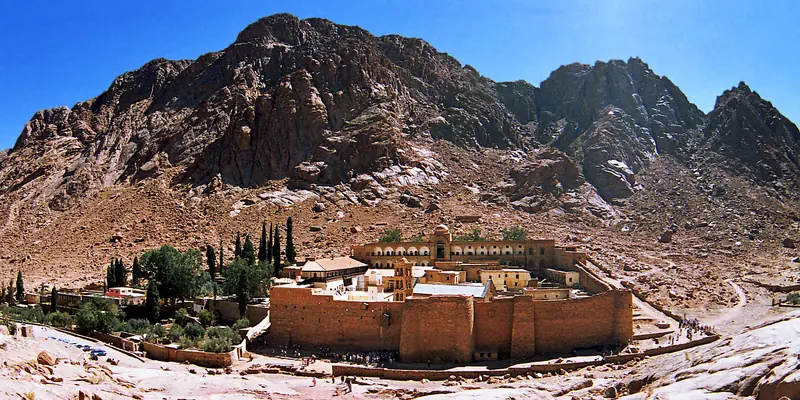
In the heart of the South Sinai mountains, a Christian tradition sixteen centuries old places the burning bush and the giving of the Law here. Yet the identification of biblical Sinai is still debated.
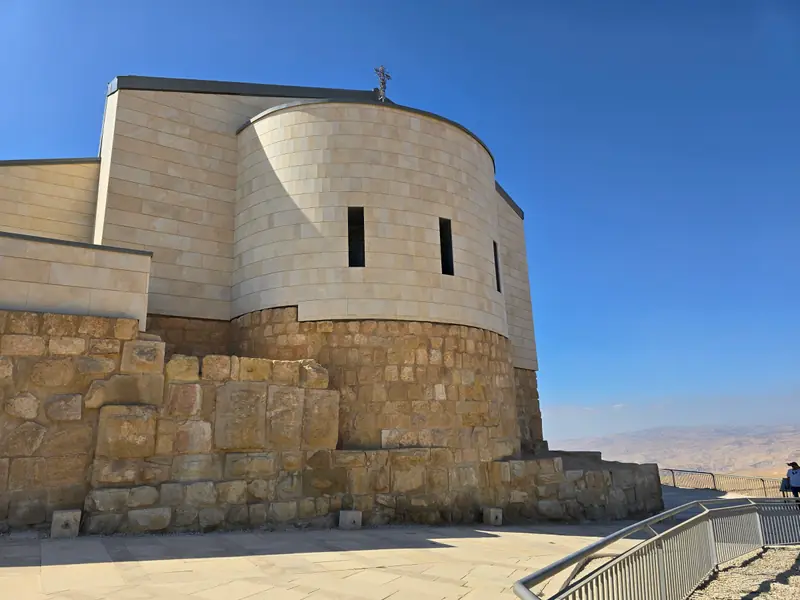
On a spur of the mountains of Moab, Deuteronomy has Moses gaze at the land he will never enter. Since the 4th century, a Christian sanctuary has kept that memory alive.
No, not in the sense of an identified stage. The biblical text does not name Timna, and no remains there attest a camp of Moses or the Israelites. The site sheds light on the context of the story: the southern desert, the Egyptian presence, the Midianites and copper metallurgy.
Nothing allows us to say so. This small copper serpent with a gilded head, found in the shrine remodelled as a tent, shows that metal serpents had a religious role in the region. The link with Numbers 21:8-9 is a comparison, not an identification.
No. It is a modern life-size reconstruction, built for educational purposes following the description in Exodus 25-40, without the original materials. It does not mark a historical location of the sanctuary.
The phrase goes back to Nelson Glueck in the 1930s. Rothenberg later attributed the mines to Egypt; Erez Ben-Yosef's excavations have shown a production peak in the 11th-10th centuries BC, probably in Edomite hands. The period matches Solomon's, but any role he may have played remains debated.
No, they are natural sandstone formations carved by erosion. Their name is modern. The Temple of Hathor, on the other hand, is an archaeological remain built at their foot.
Half a day for the main sites by car; a full day with a hike, the arches or the guided Tabernacle tour.
From October to April, when temperatures are bearable. In summer, start very early, carry at least 3 litres of water per person and check opening hours with Timna Park.
Eilat and its gulf, the Negev (Beersheba, Tel Arad) and, for the Egyptian context, the Temple of Hathor at Serabit el-Khadim in Sinai, subject to security conditions and permits.