
From Creation to Babel
Biblical Origins: From Creation to Babel
Adam and Eve, Cain and Abel, Noah and the Tower of Babel: what the first eleven chapters of Genesis tell, and what can be said about them today.
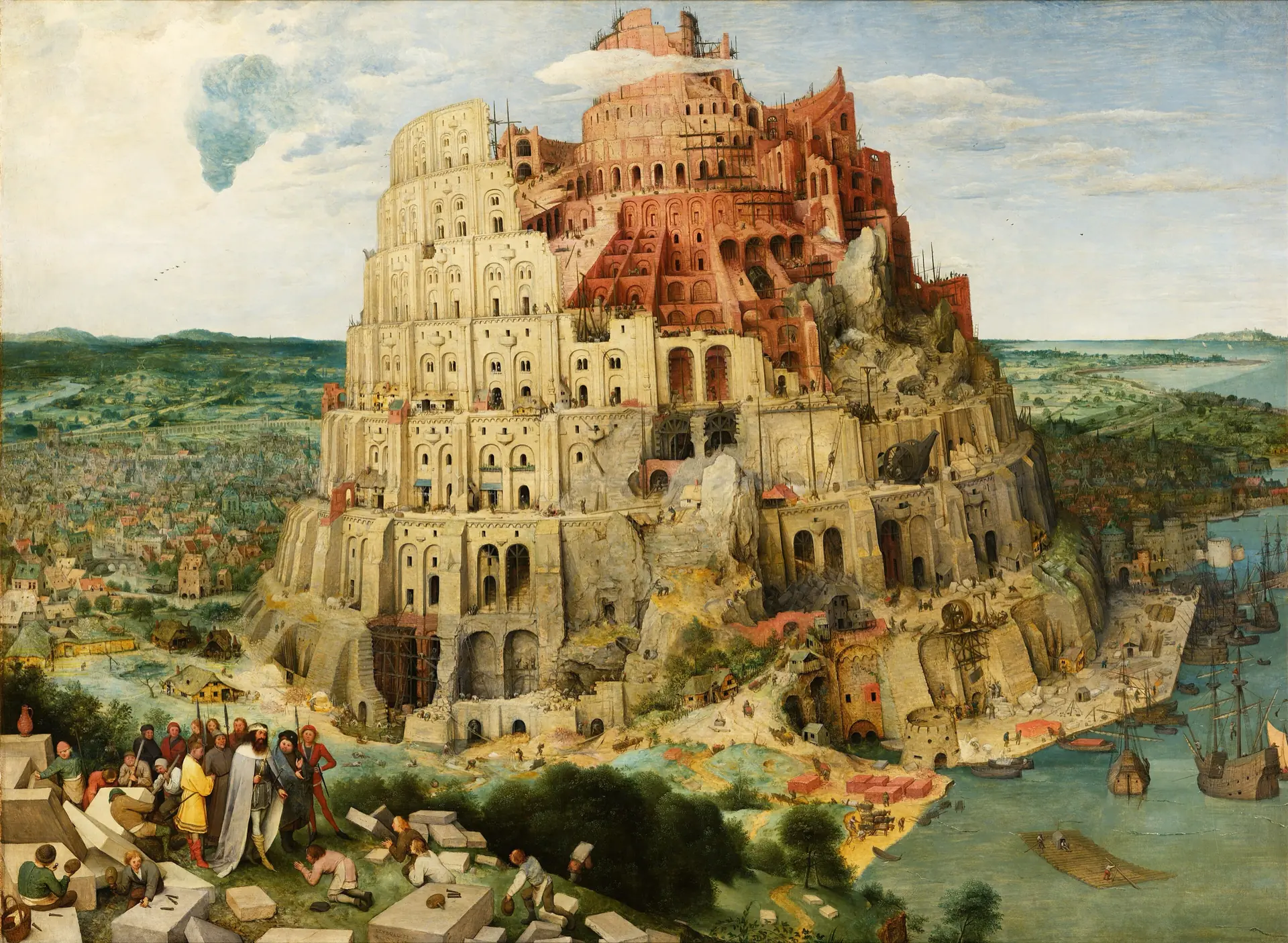
Credit: Pieter Bruegel the Elder · public domain · Wikimedia Commons
From the Creation to the Tower of Babel, the first chapters of Genesis tell the origins of the world and of humankind. Discover these founding stories, their characters and their geographical setting, before the story of Abraham and the patriarchs.
These biblical origins cover Genesis 1 to 11: the Creation and the Garden of Eden, Cain and Abel, Noah and the Flood, and the scattering of the nations at Babel. For each story we set out separately what the text says, what the Jewish, Christian and Muslim traditions made of it, and what historical and archaeological research can tell us.
🔎 A period without dates
Unlike the other periods on this site, this one carries no dates. The origin stories do not describe events that could be placed on a historical timeline: they answer, in narrative form, the great questions about the world, humankind, evil and the diversity of peoples. Neither the location of the Garden of Eden nor that of Noah's ark has ever been established.
"In the beginning God created the heaven and the earth."
Genesis 1:1
The Creation and the Garden of Eden: Adam and Eve
Genesis opens with two creation stories that follow and complement each other (Genesis 1–3). The first sets the world in order in seven days; the second, closer to the ground, tells of the forming of the first man, the Garden of Eden and the break that drives Adam and Eve out of it.
In the Bible (Genesis 1–3)
The first account (Genesis 1:1–2:3) describes a step-by-step ordering: light, the sky, dry land and plants, the heavenly lights, the animals, and finally the human being, created "in the image of God", male and female. On the seventh day God rests: this is the biblical foundation of the Sabbath.
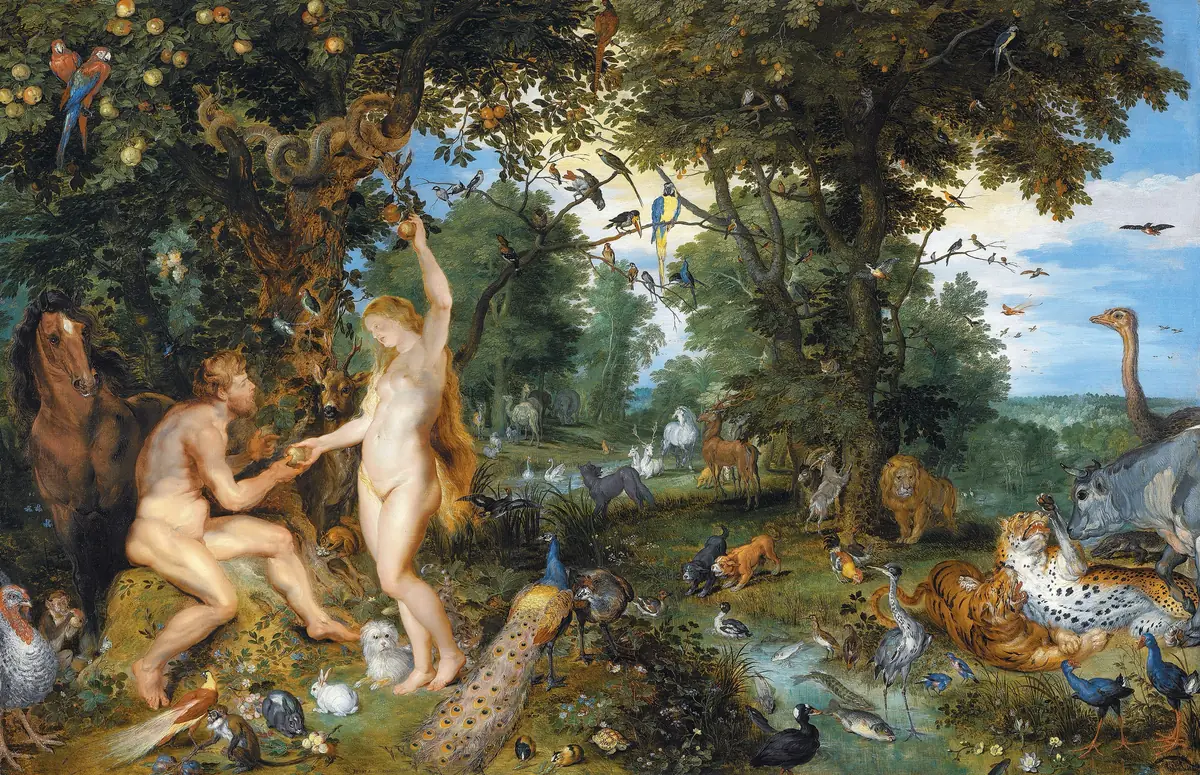
The second account (Genesis 2:4–3:24) changes tone. The LORD God shapes the man (adam) from the dust of the ground (adamah) and breathes life into him, then plants a garden in Eden. The woman is formed from the man's side. The serpent leads them to eat the fruit of the tree of the knowledge of good and evil, the one thing forbidden; Adam and Eve are sent out of the garden, whose entrance, to the east, is now guarded by cherubim.
"And the LORD God planted a garden eastward in Eden; and there he put the man whom he had formed."
Genesis 2:8 (KJV)
וַיִּטַּע יְהוָה אֱלֹהִים גַּן־בְּעֵדֶן מִקֶּדֶם וַיָּשֶׂם שָׁם אֶת־הָאָדָם אֲשֶׁר יָצָר
בראשית ב, ח
The geographical setting
The text gives what looks like a precise geography: a river flows out of Eden and divides into four branches, the Pishon, the Gihon, the Hiddekel and the Euphrates (Genesis 2:10-14). The Hiddekel is the Tigris and the Euphrates is well known, so the story looks towards Mesopotamia. The Pishon and the Gihon have never been convincingly identified; Gihon is also the name of the spring that supplies Jerusalem (1 Kings 1:33).
🔎 Where was Eden?
Suggestions include southern Mesopotamia, the Persian Gulf, the mountains of Armenia and East Africa. None of these is established, and many readers, Jewish and Christian alike, see the garden as a symbolic place rather than a point on the map. The Hebrew word eden suggests "delight".
Traditions
Several traditions link Adam to the Land of Israel. According to the Talmud (Eruvin 53a), Hebron is called Kiryat Arba, the "city of the four", because four couples are said to rest in the Cave of Machpelah: Adam and Eve, then Abraham and Sarah, Isaac and Rebecca, Jacob and Leah (see our page on Hebron and the Tomb of the Patriarchs). Another Jewish tradition, recorded by Maimonides, holds that Adam was formed from the earth of the site of the Temple altar, on Mount Moriah. Christian tradition, for its part, places Adam's burial beneath Golgotha, where a Chapel of Adam stands inside the Church of the Holy Sepulchre.
What research says
Biblical scholars generally attribute the two accounts to different traditions, written down in the first millennium BCE. They point out common ground with Mesopotamian texts: in the Babylonian poem Enuma Elish the world emerges from primeval waters, like the tehom, the "deep", of Genesis 1:2; in the Atrahasis epic, humans are shaped from clay. The differences are just as clear: a single God, no battle between deities, and humankind placed at the summit of creation.
Archaeology can neither locate Eden nor date the Creation: these stories belong to another register. In Israel, the caves of Mount Carmel (Nahal Me'arot, a UNESCO World Heritage Site) and Qafzeh cave near Nazareth have yielded some of the oldest Homo sapiens remains found outside Africa, about 100,000 years old. They tell the scientific story of humankind, with no link to the biblical account.
Cain and Abel and the First Generations
Outside the garden, human history begins with a tragedy between two brothers, then unfolds in genealogies that lead down to Noah (Genesis 4–5). In a few lines, these chapters also tell of the appearance of cities, herding, music and metalworking.
In the Bible (Genesis 4)
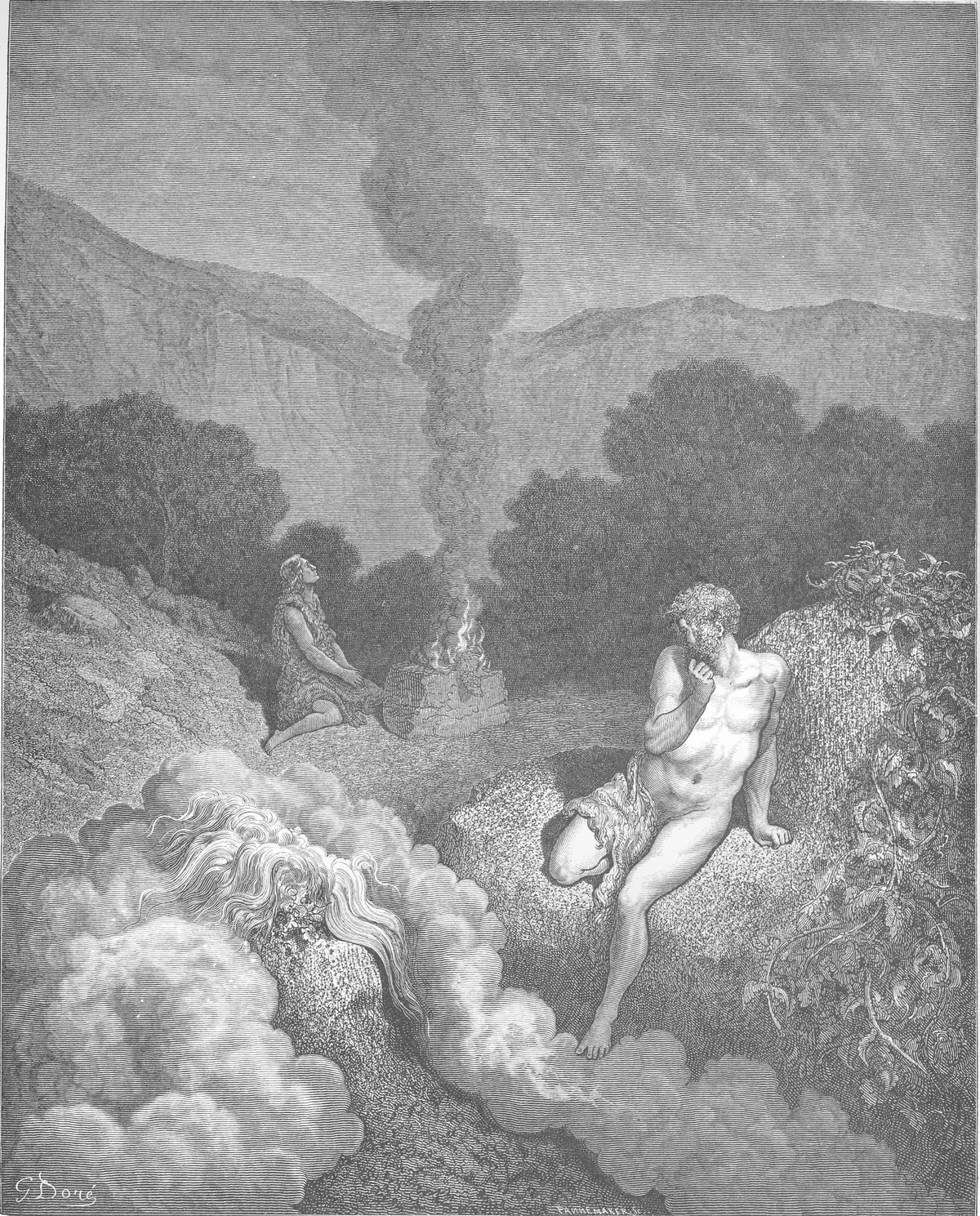
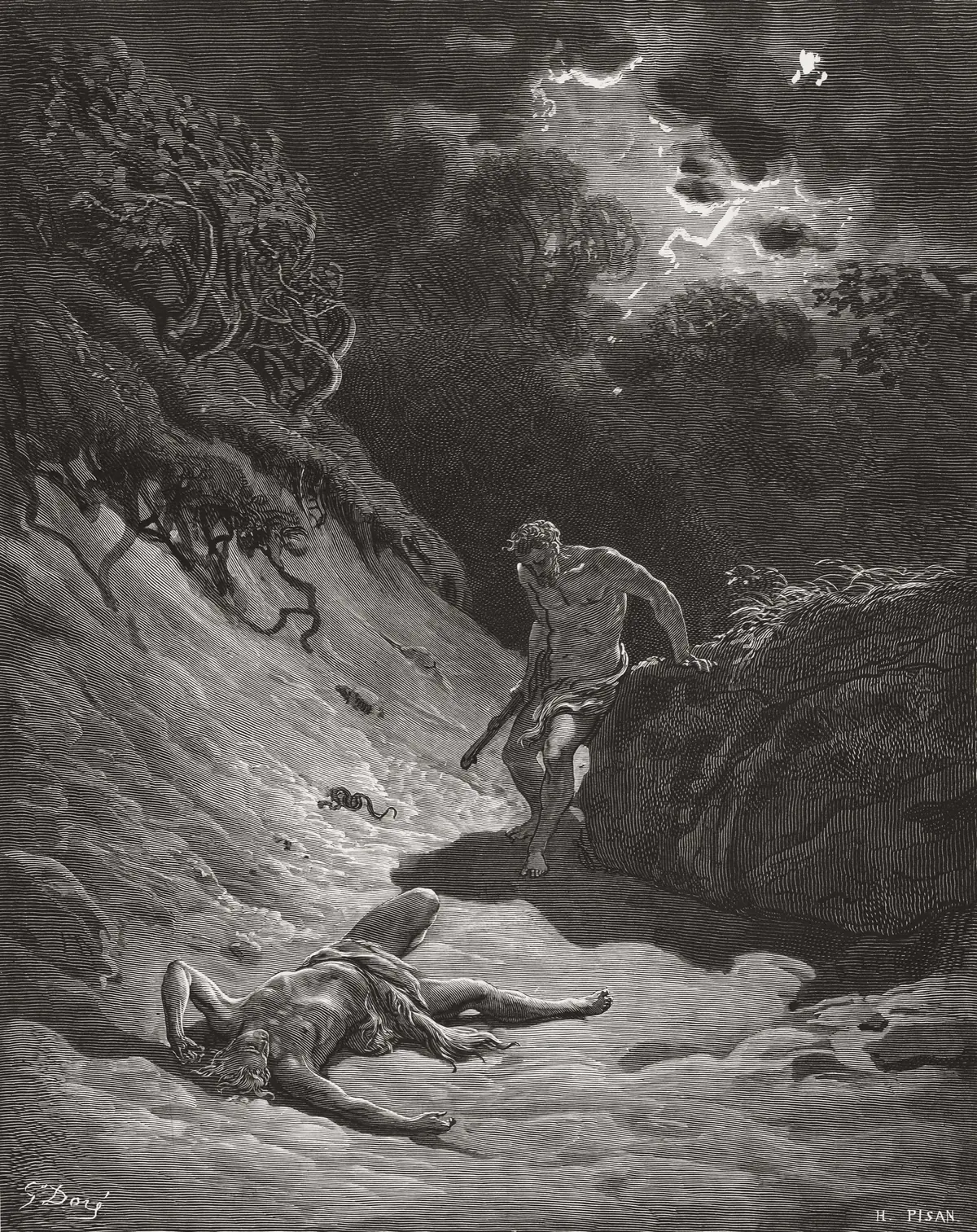
Abel is a shepherd, Cain tills the ground. Both bring an offering; Abel's is accepted, Cain's is not. Jealous, Cain kills his brother in the field. Questioned by God, he answers with a question that has become famous. Sentenced to wander, he nevertheless receives a mark that protects him, and settles in the land of Nod, east of Eden.
"And the LORD said unto Cain, Where is Abel thy brother? And he said, I know not: Am I my brother's keeper?"
Genesis 4:9 (KJV)
וַיֹּאמֶר יְהוָה אֶל־קַיִן אֵי הֶבֶל אָחִיךָ וַיֹּאמֶר לֹא יָדַעְתִּי הֲשֹׁמֵר אָחִי אָנֹכִי
בראשית ד, ט
Cain then builds a city and names it Enoch, after his son (Genesis 4:17). Among his descendants, Jabal is "the father of such as dwell in tents, and of such as have cattle", Jubal the father of musicians, and Tubal-cain works bronze and iron (Genesis 4:20-22). Adam and Eve finally have a third son, Seth.
The first generations (Genesis 5)
A genealogy links Adam to Noah in ten generations, with extraordinary lifespans: Methuselah lives 969 years (Genesis 5:27). Enoch, seventh from Adam, "walked with God: and he was not; for God took him" (Genesis 5:24). The numbers actually differ between the ancient versions of the text: the Hebrew Masoretic text, the Greek Septuagint and the Samaritan Pentateuch do not give the same ages.
Traditions
Jewish tradition sees Seth as the ancestor of all humankind after Abel's death; the apocryphal writings attributed to Enoch fed an abundant literature. A local tradition places Abel's tomb at the shrine of Nabi Habil, in the mountains west of Damascus.
What research says
The Sumerian King Lists also record a series of rulers "before the Flood" with reigns of tens of thousands of years: the lifespans of Genesis 5 belong to this literary genre. Moreover, the steps the story compresses into a single generation (farming, herding, the first towns, metalworking) match real developments, but ones spread over millennia. The Levant is one of the regions where farming and herding were born; Jericho (Tell es-Sultan) is among the oldest known settlements; and the Nahal Mishmar hoard, on display at the Israel Museum in Jerusalem, shows highly skilled copper metallurgy in the fourth millennium BCE. These finds shed light on the world the story portrays; they cannot date Cain or Abel.
Noah, the Flood and the Covenant
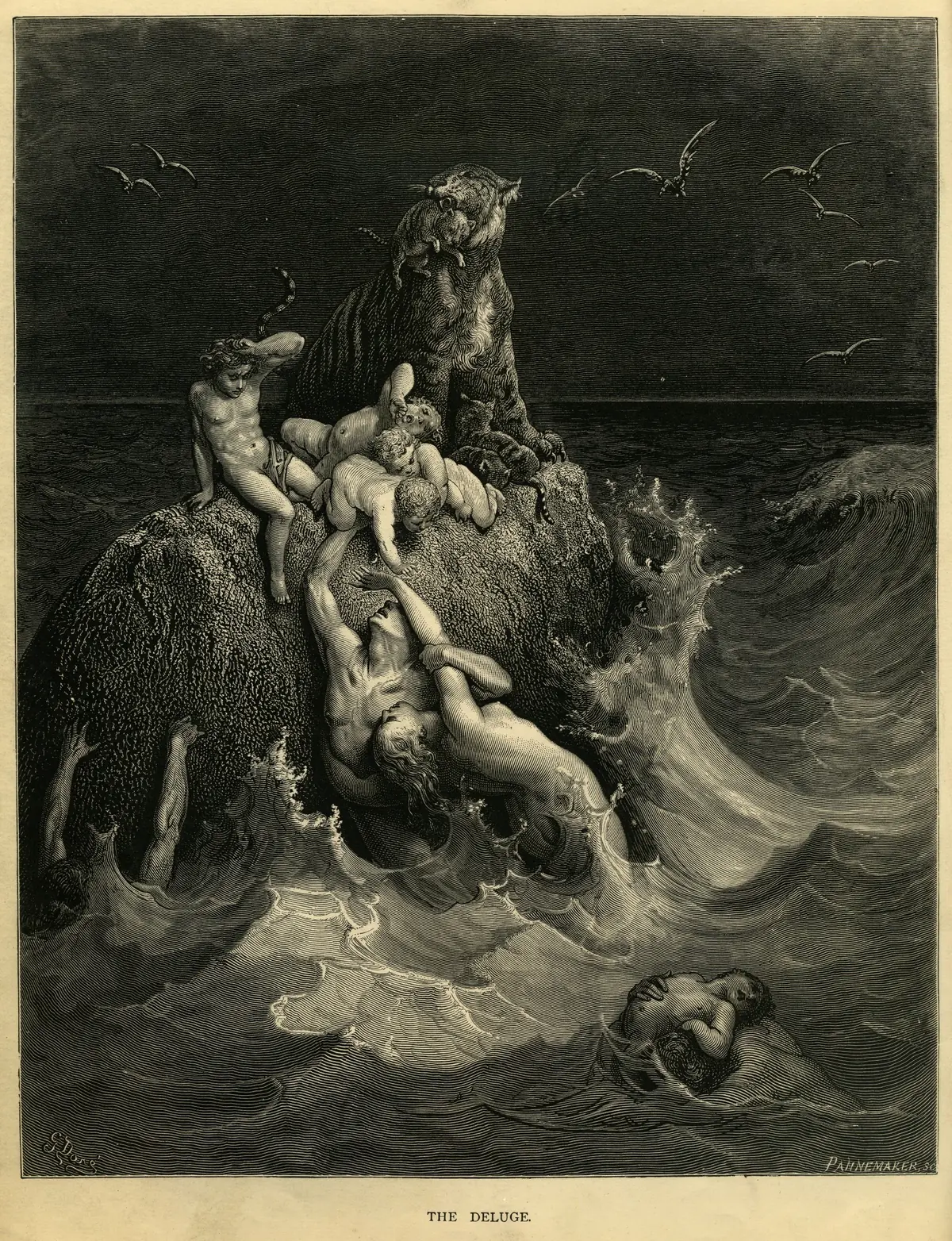
The Flood story (Genesis 6–9) is one of the best-known in the Bible, and one with the oldest parallels. It tells of a world swallowed by the waters, then of a new beginning sealed by a covenant between God and all creation.
In the Bible (Genesis 6–9)
Seeing the violence that fills the earth, God decides to destroy it by water, but spares Noah, "a just man and perfect in his generations". Noah builds an ark three hundred cubits long, fifty wide and thirty high (Genesis 6:15), and brings his family and the animals aboard. The waters rise, then fall; the ark comes to rest "upon the mountains of Ararat". Noah sends out a raven, then a dove, which returns with an olive leaf (Genesis 8:11). When he comes out, he builds an altar; God then makes a covenant with Noah, his descendants and every living creature, and gives a sign of it.
"I do set my bow in the cloud, and it shall be for a token of a covenant between me and the earth."
Genesis 9:13 (KJV)
אֶת־קַשְׁתִּי נָתַתִּי בֶּעָנָן וְהָיְתָה לְאוֹת בְּרִית בֵּינִי וּבֵין הָאָרֶץ
בראשית ט, יג
Traditions
Jewish tradition draws from Genesis 9 the seven Noahide laws, a moral foundation meant for all humankind (Talmud, Sanhedrin 56a), and provides a blessing to be said on seeing a rainbow. According to Maimonides, Noah built his altar on the very spot of the future Temple altar, on Mount Moriah. Where the ark came to rest varies between traditions: Mount Ararat in Turkey for the Armenian and Western tradition; Mount Judi, further south, for the Aramaic translation of Onkelos, Syriac tradition and the Quran (sura 11:44).
What research says
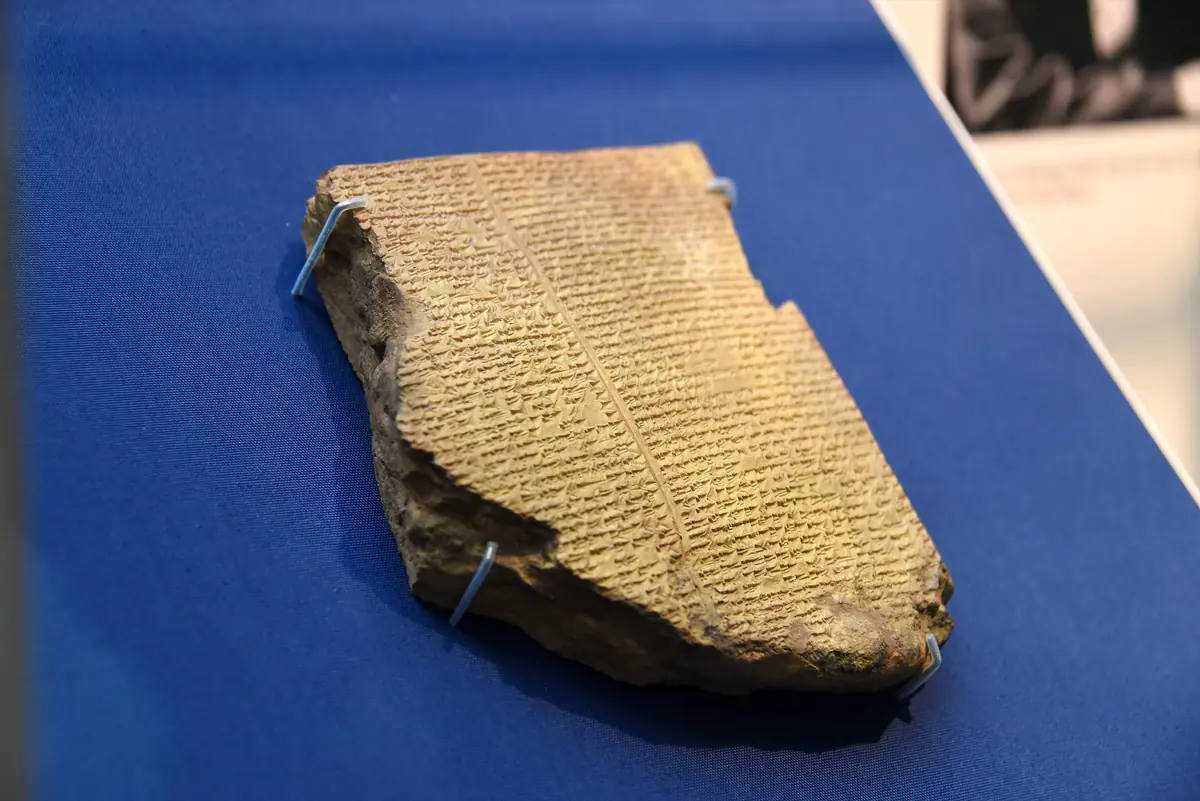
Older stories. Mesopotamia knew several flood stories long before Genesis was written down: the Sumerian story of Ziusudra, the Atrahasis epic (copies from the 17th century BCE) and the eleventh tablet of the Epic of Gilgamesh. On this tablet, deciphered in 1872 by George Smith at the British Museum, the hero Uta-napishti builds a boat, takes animals aboard and releases a dove, a swallow and a raven. The kinship with Genesis is obvious; the meaning of the story is not the same.
Local floods. At Ur, in 1929, Leonard Woolley uncovered a thick layer of clay that he linked to the Flood. Similar deposits were found at Kish and Shuruppak, but at different dates: they bear witness to major floods of the Tigris and Euphrates, not to a single event. No geological evidence points to a flood that covered the whole earth.
The ark. In the Bible, "Ararat" refers to a region, the Urartu of Assyrian texts, around Lake Van, not to a specific peak. Expeditions have explored Mount Ararat, and the Durupınar formation in Turkey is sometimes presented as the imprint of the ark; geologists regard it as a natural formation. No remains of the ark have been authenticated.
The Nations and the Tower of Babel
After the Flood, Genesis describes how the nations spread across the earth (Genesis 10), then tells how a humankind that spoke a single language was scattered at Babel (Genesis 11:1-9). The genealogy that follows leads straight to Abraham.
The Table of Nations (Genesis 10)
The descendants of Noah's three sons, Shem, Ham and Japheth, give rise to the peoples of the biblical world: Jewish tradition counts seventy. Many of these names match well-attested peoples and regions: Mizraim (Egypt), Cush (ancient Sudan), Canaan, Asshur (Assyria), Elam, Aram, Madai (the Medes) and Javan (the Ionians, that is, the Greeks). Nimrod, "a mighty hunter before the LORD", rules over Babel, Erech and Akkad in the land of Shinar, then builds Nineveh (Genesis 10:8-12): Erech is Uruk, and Nineveh has been extensively excavated. Nimrod himself, however, has never been identified with any known king.
In the Bible (Genesis 11:1-9)
Settled on a plain in the land of Shinar, people decide to build a city and a tower. God confounds their language and scatters them over the whole earth; the city is named Babel, linked to the Hebrew verb balal, "to mix, to confuse".
"And they said, Go to, let us build us a city and a tower, whose top may reach unto heaven; and let us make us a name, lest we be scattered abroad upon the face of the whole earth."
Genesis 11:4 (KJV)
וַיֹּאמְרוּ הָבָה נִבְנֶה־לָּנוּ עִיר וּמִגְדָּל וְרֹאשׁוֹ בַשָּׁמַיִם וְנַעֲשֶׂה־לָּנוּ שֵׁם פֶּן־נָפוּץ עַל־פְּנֵי כָל־הָאָרֶץ
בראשית יא, ד
What research says
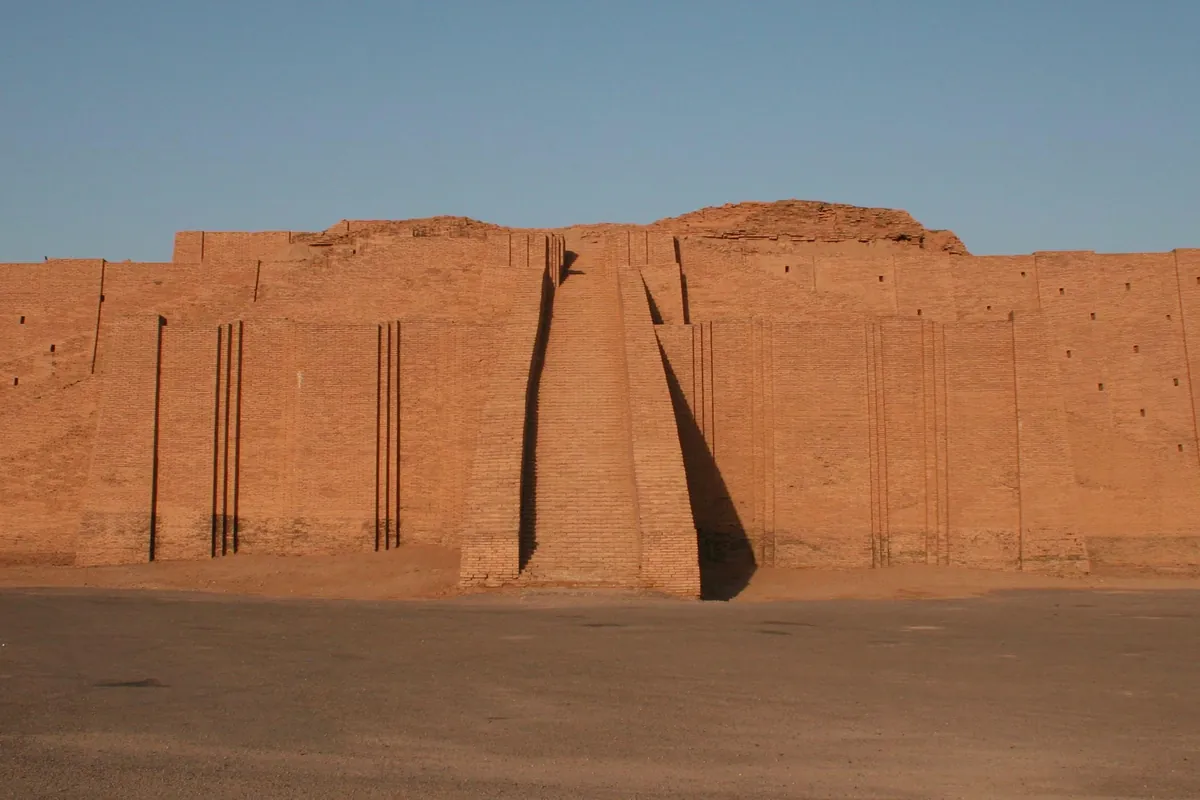
This time the story is set against a real backdrop. Shinar means Babylonia, and the text notes that people there built with fired brick bound with bitumen "for stone" (Genesis 11:3): this is exactly the Mesopotamian technique, whereas Canaan built in stone. Mesopotamian cities were dominated by ziggurats, stepped towers topped by a temple, like the one at Ur, built around 2100 BCE. In Babylon, the ziggurat Etemenanki, the "house of the foundation of heaven and earth", dedicated to the god Marduk, was rebuilt by Nabopolassar and Nebuchadnezzar II in the 7th–6th centuries BCE; Robert Koldewey's German excavations (1899-1917) found only its foundations. For many historians, the Babel story echoes this tower, which Judeans deported to Babylon may have seen (see our page on the Babylonian Exile). The Babylonian name of the city, Bāb-ili, means "gate of the god".
The diversity of languages is far older than any ziggurat: the Babel story explains it in its own way, without any possibility of dating it. The tower described in Genesis has not been identified as such.
From Shem to Abraham (Genesis 11:10-32)
A final genealogy links Shem to Terah, the father of Abram, in ten generations. The family lives in Ur of the Chaldees, then leaves for Haran: at this point the story turns from humankind as a whole to follow a single family, that of Abraham.
Story, Traditions and Archaeology at a Glance
For each of the four stories, here is what belongs to the biblical text, to the traditions and to current knowledge.
| Story | What the Bible says | Traditions | What we know |
|---|---|---|---|
| Creation and Eden | Two creation accounts; a garden watered by four rivers (Genesis 1–3) | Adam and Eve at Hebron (Talmud); Adam formed on Mount Moriah; Adam at Golgotha | Mesopotamian parallels; Eden not located; no dating possible |
| Cain and Abel | The first murder, the first city, the first crafts (Genesis 4–5) | Abel's tomb at Nabi Habil (Syria) | Farming, towns and metalworking appear in the Levant over millennia |
| Noah and the Flood | The ark, the mountains of Ararat, the covenant and the rainbow (Genesis 6–9) | Mount Ararat or Mount Judi; Noah's altar on Mount Moriah | Older Mesopotamian stories; local floods; no authenticated trace of the ark |
| Babel | The Table of Nations, the tower and the scattering (Genesis 10–11) | Seventy nations | Mesopotamian brick and bitumen; the Etemenanki ziggurat of Babylon |
What to see in Israel
No site lets you "visit" the origin stories, but several places preserve their memory or shed light on their background: the Tomb of the Patriarchs in Hebron, where tradition places the burial of Adam and Eve; the Temple Mount in Jerusalem, linked by tradition to Adam and Noah; the Israel Museum, which displays the Nahal Mishmar hoard; and the prehistoric caves of Mount Carmel.
Sources and further reading
- Claus Westermann, Genesis 1–11: A Commentary, Minneapolis, 1984.
- W. G. Lambert and A. R. Millard, Atra-ḫasīs: The Babylonian Story of the Flood, Oxford, 1969.
- Andrew R. George, The Babylonian Gilgamesh Epic, Oxford, 2003.
- Irving Finkel, The Ark Before Noah, London, 2014.
- Jean-Louis Ska, Introduction to Reading the Pentateuch, Winona Lake, 2006.
Continue with the Patriarchs
With Abraham, Genesis moves from the story of humankind to that of one family, and from stories with no precise place to sites you can visit: Shechem, Bethel, Hebron, Beersheba. This is where the next period begins.
Frequently asked questions
Where was the Garden of Eden?
Nobody knows. Genesis names four rivers, including the Tigris and the Euphrates, which points towards Mesopotamia, but the other two (Pishon and Gihon) have never been identified. There are many hypotheses and none is established; many readers see Eden as a symbolic place.
Has Noah's ark been found?
No. The Bible speaks of "the mountains of Ararat", a region (ancient Urartu) rather than a specific peak. Expeditions have explored Mount Ararat and the Durupınar formation has sometimes been presented as the ark, but geologists regard it as a natural formation. No remains have been authenticated.
Did the Flood leave archaeological traces?
Clay layers left by major floods have been found at Ur, Kish and Shuruppak in Mesopotamia, but at different dates: they reflect local floods. No geological evidence supports a universal flood. Mesopotamian flood stories, such as the one in Gilgamesh, are older than the writing of Genesis.
Did the Tower of Babel exist?
The tower of the story has not been identified as such. But the setting is real: fired brick and bitumen, and ziggurats, the stepped towers of Mesopotamian cities. Many historians connect the story with Etemenanki, Babylon's great ziggurat, of which only the foundations survive.
Can the Creation or the life of Adam and Eve be dated?
No. The origin stories do not lend themselves to historical dating, which is why this period carries no dates on our site. The Hebrew calendar counts years from Creation according to a traditional calculation; it is a religious convention, not a scientific date.
Why does Genesis contain two creation accounts?
Genesis 1 describes creation in seven days, Genesis 2 the forming of man and the Garden of Eden. Scholars see two different traditions brought together by the editors; traditional Jewish and Christian readings take them as two complementary views of the same act of creation.
What can be seen in Israel in connection with the origin stories?
The Tomb of the Patriarchs in Hebron, where tradition places the burial of Adam and Eve; the Temple Mount in Jerusalem, which tradition links to Adam and to Noah's altar; the Israel Museum and the Nahal Mishmar hoard; and the prehistoric caves of Mount Carmel, a World Heritage Site.