
Nazareth, the Town of Jesus: Annunciation, Excavations and Visit
The Galilean village where the Gospels place the Annunciation and the childhood of Jesus, today Israel's largest Arab city: shrines, excavations and visiting tips.
c. 7 BC – c. AD 27
The town of Ruth and David, where the Gospels place the birth of Jesus: a cave venerated since the 2nd century, beneath one of the oldest churches in the world still in use.
Credit: Bukvoed · CC BY 4.0 · Wikimedia Commons
About ten kilometres south of Jerusalem, on a ridge of the Judean Hills, Bethlehem (Hebrew Beit Lehem, "house of bread") is one of the most frequently mentioned towns in the Bible. It is the home of Ruth and David, the place where Genesis sets the death of Rachel, and above all the town where the Gospels of Matthew and Luke place the birth of Jesus. In the heart of the old town, the Church of the Nativity stands over the Grotto of the Nativity, venerated as the birthplace of Christ since at least the 2nd century.
Built by Constantine and rebuilt by Justinian, the Church of the Nativity is one of the oldest Christian churches still in use. Listed as a UNESCO World Heritage Site in 2012, it recovered its Crusader-era mosaics during a major restoration (2013-2019). This guide separates what the biblical text says, what history and archaeology add, and how to plan a visit, from the grotto to Shepherds' Field.
Bethlehem first appears in Genesis under its other name, Ephrath. Rachel, Jacob's beloved wife, dies there giving birth to Benjamin and is "buried in the way to Ephrath, which is Beth-lehem" (Genesis 35:19). The place tradition associates with her tomb is described below.
The Book of Ruth takes place almost entirely in Bethlehem. Naomi returns there from Moab with her daughter-in-law Ruth "in the beginning of barley harvest" (Ruth 1:22); Ruth gleans in the field of Boaz, who eventually marries her. Their son Obed "is the father of Jesse, the father of David" (Ruth 4:17). Bethlehem thus becomes the town of the Davidic dynasty: it is here that the prophet Samuel anoints the young shepherd David, the youngest of Jesse's sons (1 Samuel 16:1-13).
In the 8th century BC, the prophet Micah announces that a ruler of Israel will come from this small town of Judah. The verse is quoted in the Gospel of Matthew (Matthew 2:5-6).
"But thou, Beth-lehem Ephratah, though thou be little among the thousands of Judah, yet out of thee shall he come forth unto me that is to be ruler in Israel; whose goings forth have been from of old, from everlasting."
Micah 5:2 (KJV)
Both infancy narratives place the birth of Jesus in Bethlehem, through different stories. In Luke, Joseph and Mary, who live in Nazareth, travel to Bethlehem for a census, "because he was of the house and lineage of David" (Luke 2:4).
"And so it was, that, while they were there, the days were accomplished that she should be delivered. And she brought forth her firstborn son, and wrapped him in swaddling clothes, and laid him in a manger; because there was no room for them in the inn."
Luke 2:6-7 (KJV)
Shepherds keeping watch over their flocks in the nearby fields hear an angel announce: "unto you is born this day in the city of David a Saviour" (Luke 2:11). Matthew, for his part, tells of the wise men guided by a star, then of the massacre of the children of Bethlehem ordered by Herod (Matthew 2:1-16) and the flight into Egypt. For the wider context of these accounts, see the period of the birth and childhood of Jesus.
One of the Amarna letters (14th century BC), written by Abdi-Heba, king of Jerusalem, may mention a town called "Bit-Lahmi", but the reading is debated. The firmest evidence comes from Jerusalem: in 2012 the Israel Antiquities Authority published a small clay bulla found in the City of David, dated to the 8th-7th centuries BC, that bears the name of Bethlehem.
In the time of Jesus, Bethlehem was a small farming village, with a population estimated at a few hundred. It lay a few kilometres from the Herodium, Herod's palace-fortress, and from the aqueduct that carried water from the so-called Pools of Solomon to Jerusalem. As in many villages of the limestone hills, houses were built against caves used as stables or storerooms: Luke's Greek word rendered "inn" (kataluma) can also mean a guest room, which fits the tradition of a birth in an adjoining cave.
Around AD 150-160, Justin Martyr, a native of the region, writes that Jesus was born in a cave near the village (Dialogue with Trypho, 78). In the 3rd century, Origen reports that the cave and the manger are shown in Bethlehem (Against Celsus, I.51). Saint Jerome, who settled in Bethlehem at the end of the 4th century, states that the place had been overshadowed by a grove of Adonis under the emperor Hadrian: if true, this would suggest an earlier Christian cult that someone wanted to erase.
Soundings by William Harvey and the British Mandate authorities in 1932-1934 uncovered, beneath the present floor, the mosaics of the first church and the foundations of an octagon built over the grotto. From the 1940s to the 1960s, the Franciscan Bellarmino Bagatti studied the neighbouring caves, in use in the Roman and Byzantine periods.
🔎 Is the grotto the real birthplace?
No archaeological evidence can prove that a particular birth took place in this cave. What is established is the age of the tradition: it is recorded in writing little more than a century after the events, by an author from the region, and it was strong enough for an emperor to build a basilica over it. Some historians see the birth in Bethlehem mainly as a theological statement linked to David and Micah; others consider it plausible. The date also raises a difficulty: Matthew places the birth under Herod (who died in 4 BC), whereas the census of Quirinius mentioned by Luke is dated to AD 6 by the historian Josephus.
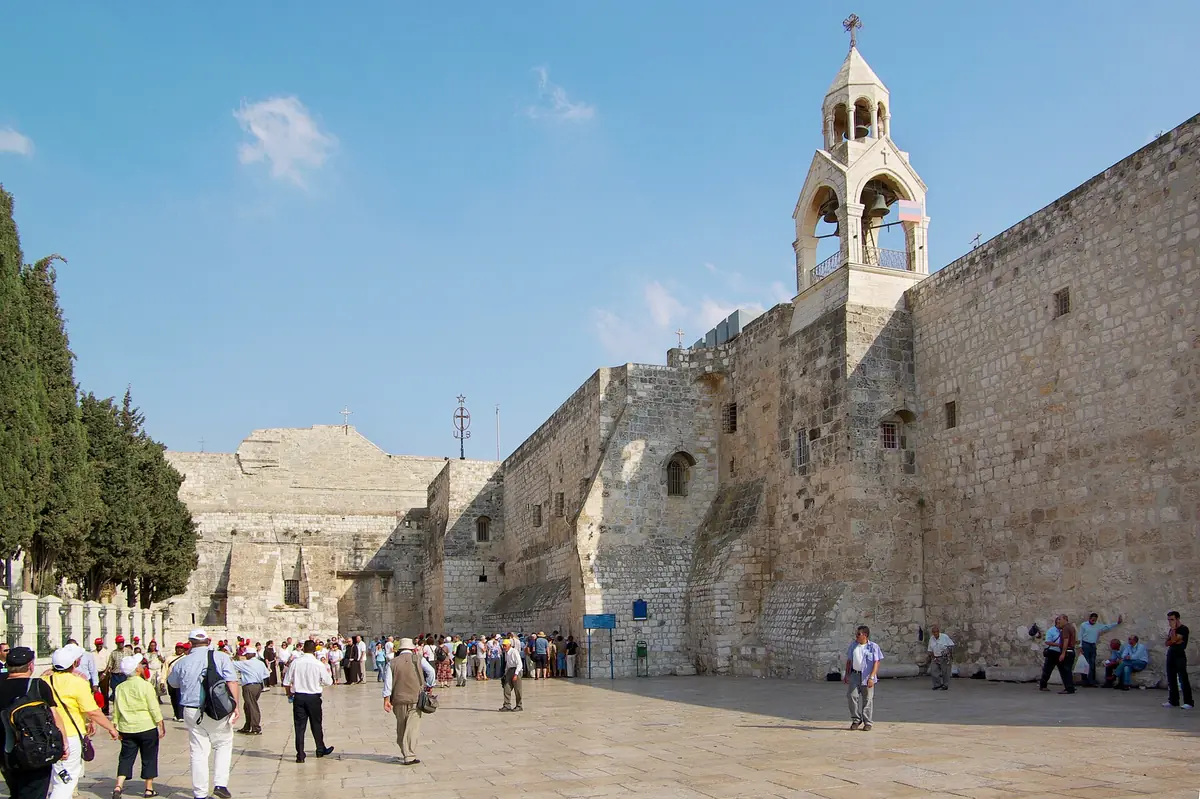
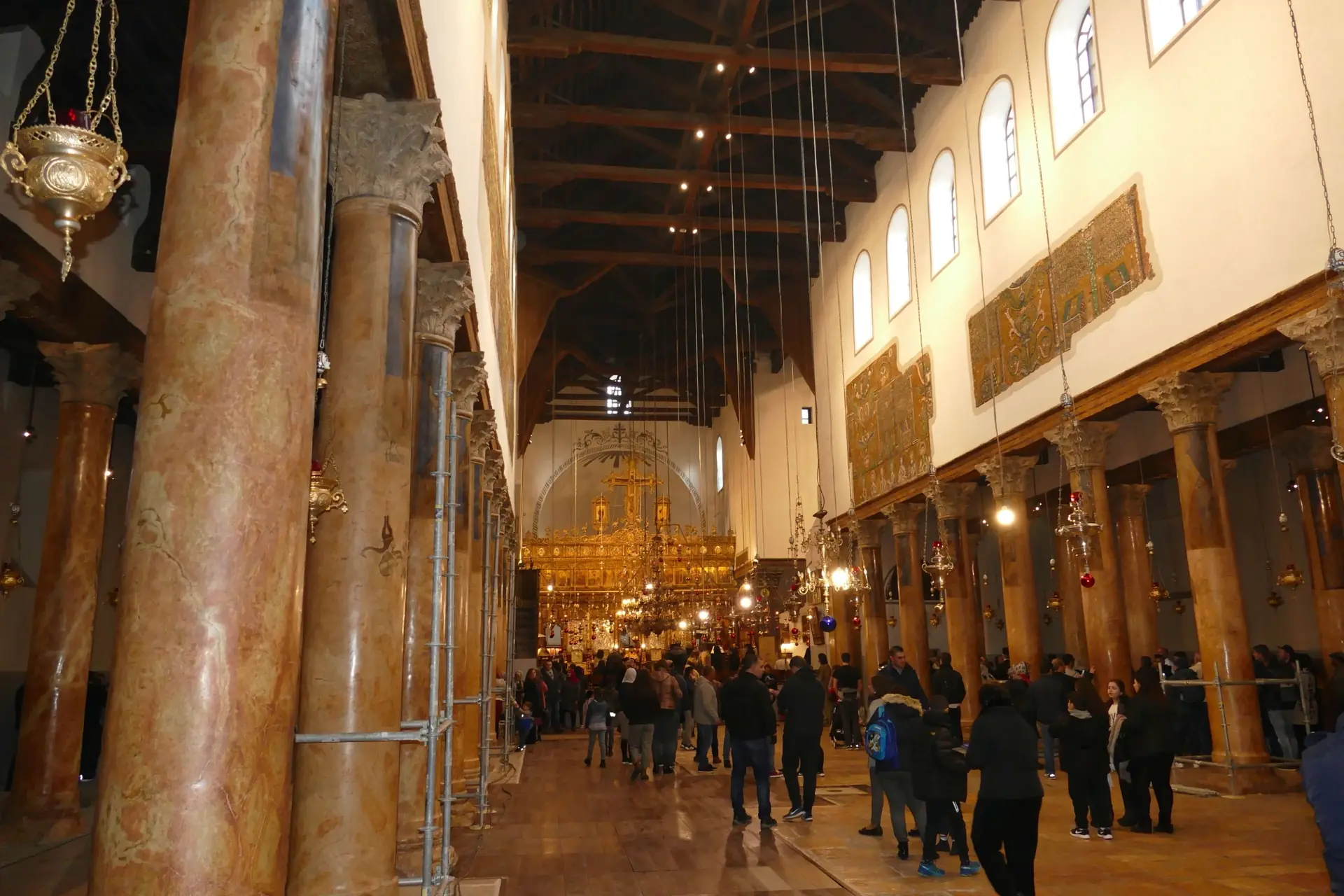
The Church of the Nativity was commissioned by the emperor Constantine, encouraged by his mother Helena, and completed in the 330s. The present building, a five-aisled basilica ending in three apses arranged in a trefoil, is essentially that of the emperor Justinian, rebuilt in the 6th century after damage usually attributed to the Samaritan revolt of 529.
Under the Ottoman Status Quo, the basilica is administered by the Greek Orthodox Patriarchate of Jerusalem (which holds the nave and the choir), the Franciscan Custody of the Holy Land (the adjoining Church of St Catherine) and the Armenian Patriarchate. The three communities celebrate Christmas on different dates: 25 December for Catholics, 7 January for the Orthodox and 19 January for the Armenians of the Holy Land.
Launched by the Palestinian Authority after water leaks threatened the timber roof, the restoration was carried out mainly by the Italian firm Piacenti. It replaced the lead roofing and some of the beams, recreated the windows and cleaned the 12th-century mosaics, which depict the ancestors of Christ, the councils of the Church and a procession of angels. In 2016 a seventh angel, hidden under plaster, was detected by thermography. This work allowed UNESCO to remove the site, "Birthplace of Jesus: Church of the Nativity and the Pilgrimage Route, Bethlehem", from the List of World Heritage in Danger in 2019.
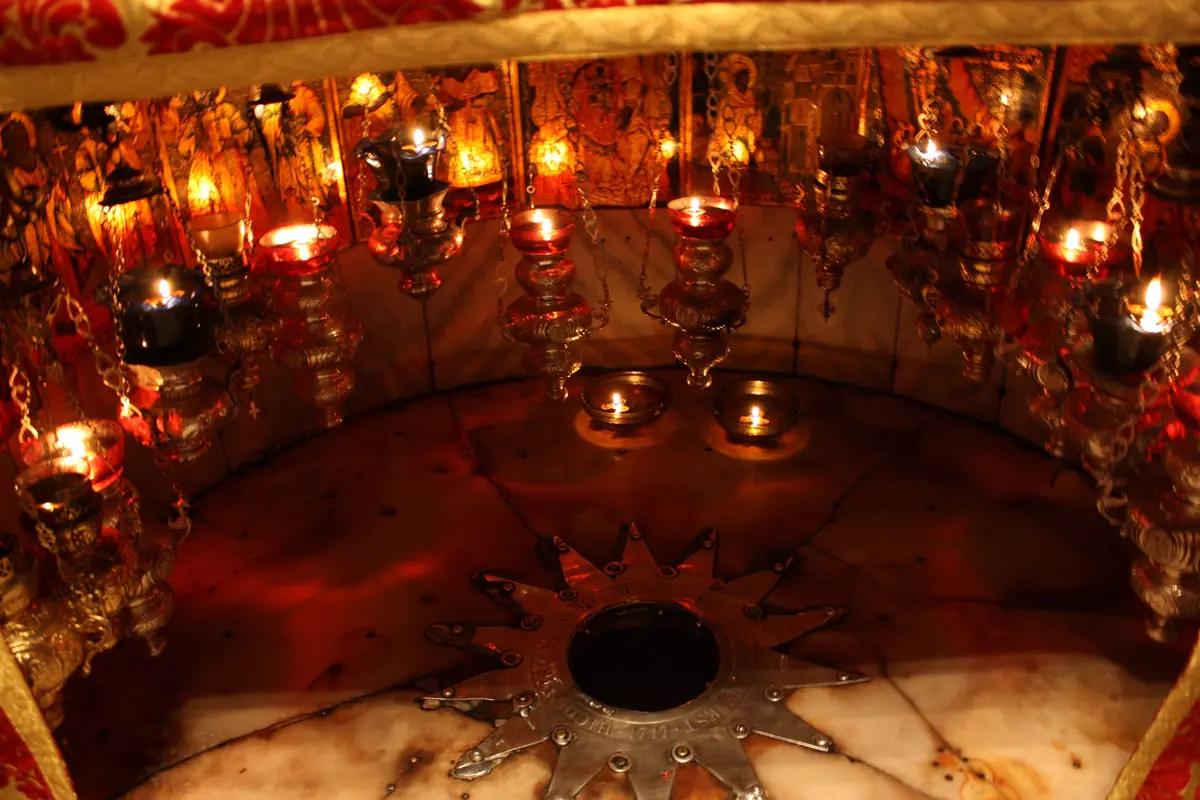
You enter the basilica through the Door of Humility and cross the nave, where wooden hatches reveal the Constantinian floor mosaics. Two stairways on either side of the choir lead down into the Grotto of the Nativity, a lamp-lit cave about 12 m long. Beneath an altar, a fourteen-pointed silver star bears the Latin inscription Hic de Virgine Maria Jesus Christus natus est ("Here Jesus Christ was born of the Virgin Mary"). A few steps lower, the Chapel of the Manger, in Catholic care, commemorates the manger. Expect a long queue in high season.
Adjoining the basilica, the Franciscan Church of St Catherine hosts the Midnight Mass broadcast around the world. From its cloister, steps lead down into caves connected to the Grotto of the Nativity: tradition places here the cell of St Jerome, who translated the Bible into Latin in Bethlehem, as well as a chapel of the Holy Innocents. A few minutes' walk away, the Milk Grotto, cut into white rock, is linked to a tradition of the flight into Egypt.
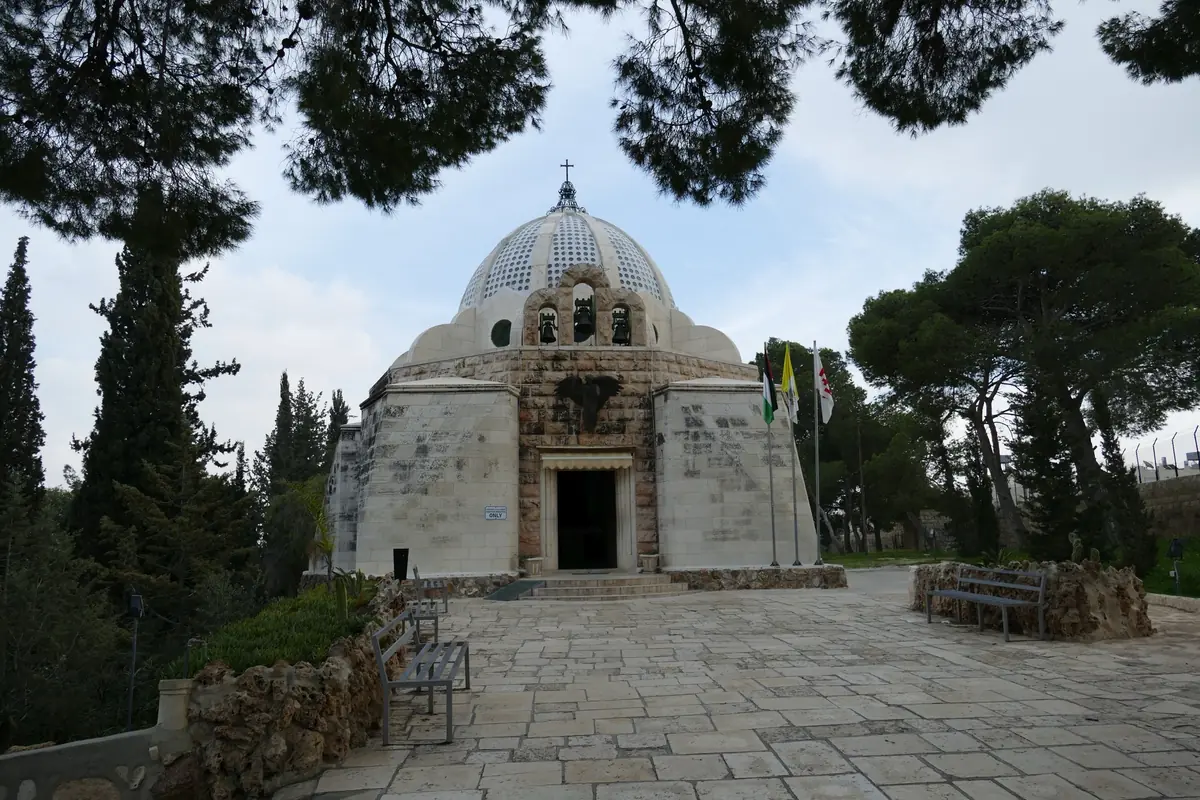
About 2 km to the east, the town of Beit Sahour preserves the memory of the shepherds of Luke 2. Two sites share the tradition. The Franciscan site of Khirbet Siyar al-Ghanam ("ruins of the sheepfold") was excavated by Virgilio Corbo, who found caves inhabited in the Roman period and a Byzantine monastery destroyed in 614; a tent-shaped chapel by the architect Antonio Barluzzi was built there in 1953-1954. The Greek Orthodox site of Deir er-Ruwat preserves a cave church and the remains of several churches of the 5th-7th centuries. Neither can be identified with the exact field of the story: they are places of remembrance.
To follow the footsteps of Jesus further, the Nazareth page covers the town of his childhood, and the Holy Sepulchre page the traditional place of his death and resurrection.
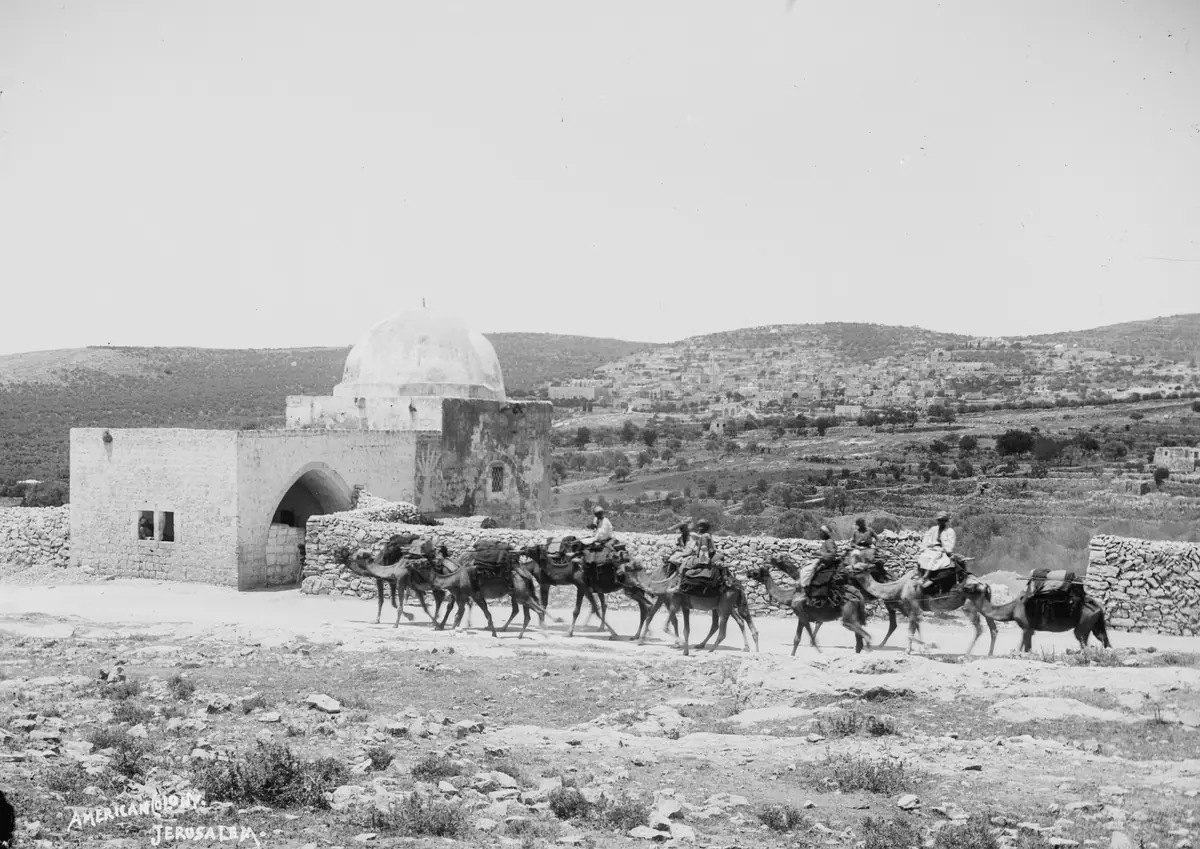
According to Genesis, Rachel dies in childbirth on the road to Bethlehem, and Jacob sets up a pillar on her grave.
"And Rachel died, and was buried in the way to Ephrath, which is Beth-lehem. And Jacob set a pillar upon her grave: that is the pillar of Rachel's grave unto this day."
Genesis 35:19-20 (KJV)
Other passages seem to place the tomb further north, on the border of Benjamin (1 Samuel 10:2; Jeremiah 31:15, where Rachel is heard weeping for her children in Ramah), and scholars debate its original location. The tradition placing it at the northern entrance to Bethlehem is old: pilgrims record it from the Byzantine period. The small domed building seen today dates from the Ottoman period; in 1841 Moses Montefiore added an antechamber. Rachel is the only matriarch not buried in the Cave of the Patriarchs in Hebron.
A much-visited Jewish pilgrimage site, also revered by Christians and Muslims (who associate it with a Bilal ibn Rabah mosque), the tomb lies less than 2 km north of the basilica, but it is enclosed by the Israeli separation barrier and can only be reached from the Jerusalem side, under Israeli control. It cannot be reached on foot from central Bethlehem.
Bethlehem, town of the Nativity: Bible, excavations and visiting
Manger Square, old town of Bethlehem, ≈ 10 km south of Jerusalem
GPS coordinates : 31.7043, 35.2076
Start navigation with:
The Galilean village where the Gospels place the Annunciation and the childhood of Jesus, today Israel's largest Arab city: shrines, excavations and visiting tips.
A sacred site venerated by the three monotheistic religions, the traditional burial place of Abraham, Isaac and Jacob.
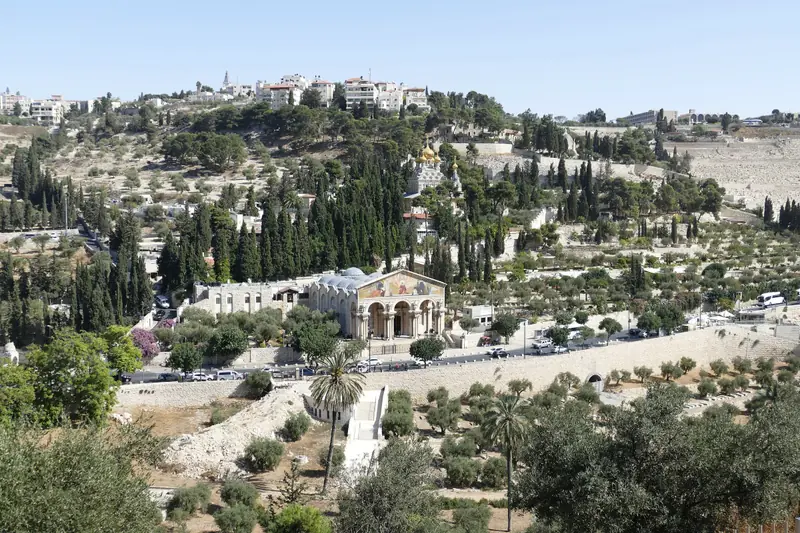
From David's flight to the agony of Jesus, the hill facing the Temple Mount holds three thousand years of Jewish and Christian memory.
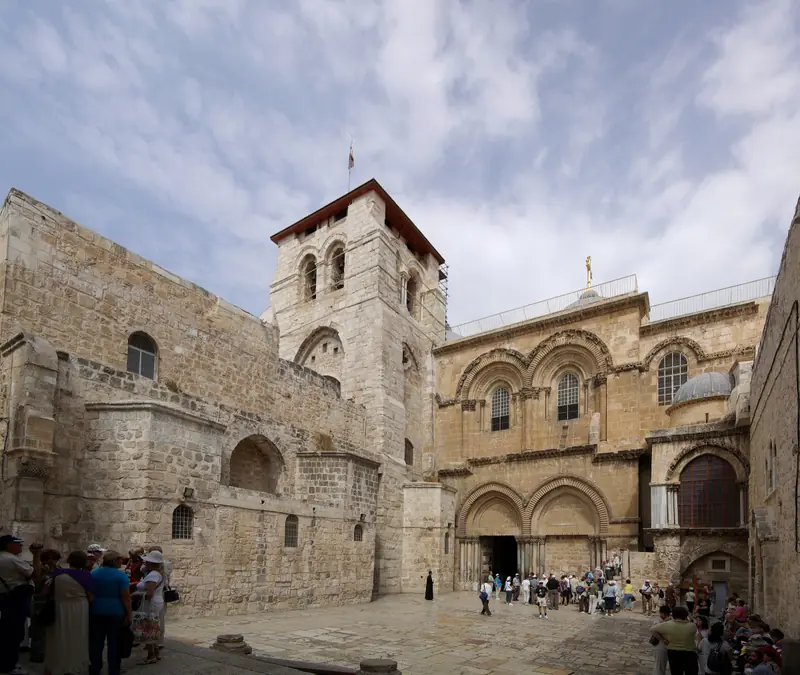
The rock of Calvary and the tomb venerated since the 4th century, under one roof shared by six Christian communities: Gospel account, history, archaeology and visiting.
Bethlehem lies in the Judean Hills, about 10 km south of Jerusalem, at an altitude of 775 m. The old town and the Church of the Nativity sit on a ridge, with Beit Jala to the west and Beit Sahour (Shepherds' Field) to the east.
Bethlehem is in the West Bank, a territory whose status is at the heart of the Israeli-Palestinian conflict. Since 1995 the town has been administered by the Palestinian Authority (Area A under the Oslo Accords), and UNESCO listed the basilica under the State of Palestine. It is therefore not an Israeli town, although most visitors reach it from Jerusalem.
In Hebrew, Beit Lehem means "house of bread"; in Arabic, Bayt Lahm is understood as "house of meat". Some scholars link the name to an ancient deity, Lahmu. The Bible also calls it Ephrath or Ephratah (Genesis 35:19; Micah 5:2).
No archaeological evidence can confirm it, but the tradition is very old: Justin mentions it around AD 150-160, Origen in the 3rd century, and Constantine built a basilica there in the 330s. It is one of the Christian holy places whose tradition goes back furthest.
It was a small farming village in Judea, estimated at a few hundred inhabitants, surrounded by fields and pastures. Houses were built against caves used as stables or storerooms. Herod's palace-fortress, the Herodium, stood a few kilometres away.
Bethlehem is about a twenty-minute drive from Jerusalem. You can go by Palestinian bus from near Damascus Gate, by taxi or with a guide; pedestrians usually cross at "Checkpoint 300". Crossing conditions change with the situation, so check them just before you leave. Israeli citizens are in principle not allowed to enter Area A.
Rachel's Tomb stands at the northern entrance to Bethlehem, less than 2 km from the basilica. Enclosed by the separation barrier, it is under Israeli control and can only be reached from Jerusalem. The Bible places it "in the way to Ephrath, which is Beth-lehem" (Genesis 35:19), but other texts suggest a location further north.
The "Door of Humility", about 1.2 m high, is the result of successive reductions of the monumental entrance, mainly in the Ottoman period, probably to stop people riding in on horseback or driving carts inside. The outlines of the older, taller doorways can still be seen in the façade.