
Bethlehem, town of the Nativity: Bible, excavations and visiting
The town of Ruth and David, where the Gospels place the birth of Jesus: a cave venerated since the 2nd century, beneath one of the oldest churches in the world still in use.
c. 7 BC – c. AD 27
The Galilean village where the Gospels place the Annunciation and the childhood of Jesus, today Israel's largest Arab city: shrines, excavations and visiting tips.
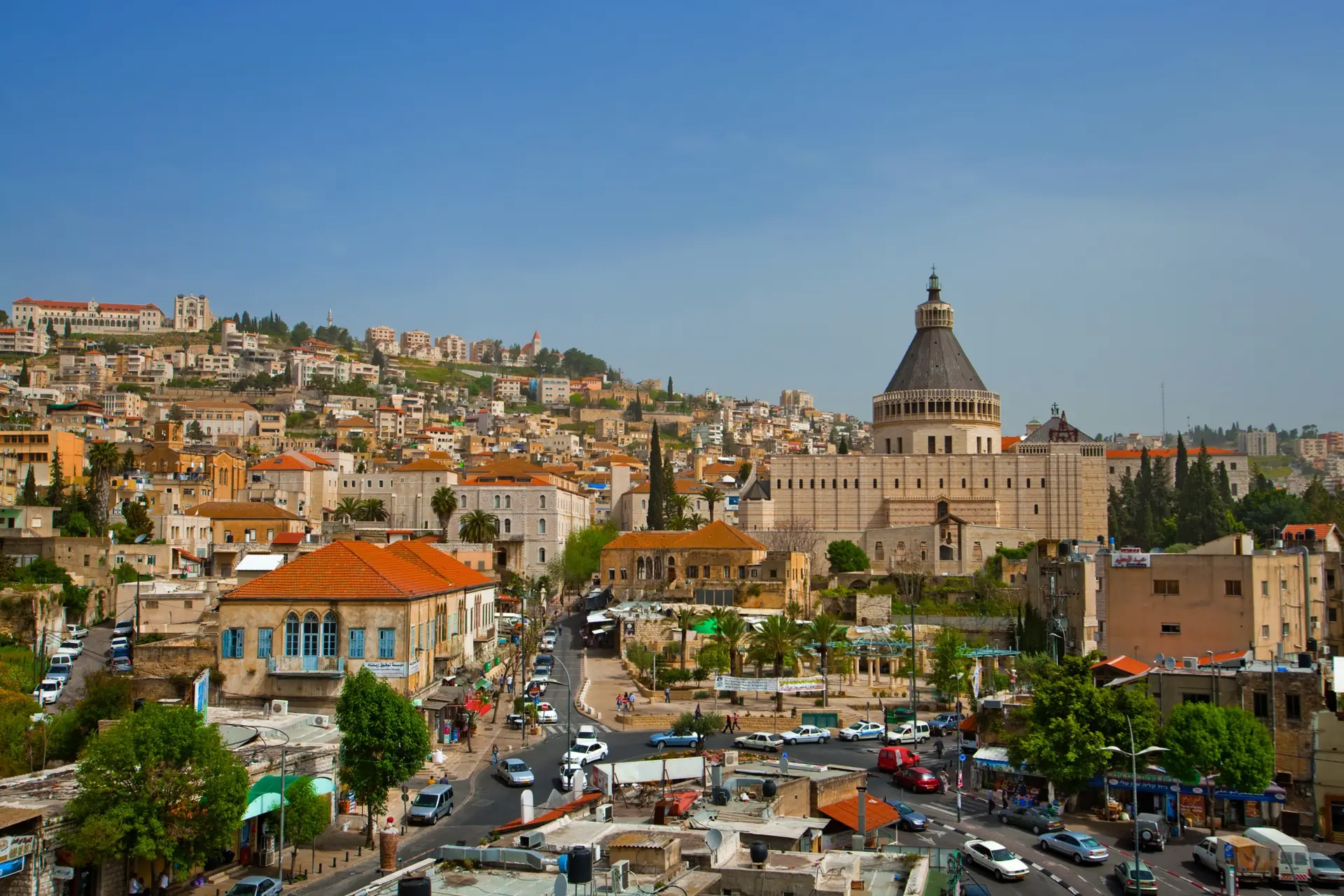
Credit: Dafna Tal / Israel Ministry of Tourism · CC BY-SA 2.0 · Wikimedia Commons
Nazareth lies in Galilee, in northern Israel, on the hills above the Jezreel Valley, some thirty kilometres from the Sea of Galilee. The Gospel of Luke sets the Annunciation here, the visit of the angel Gabriel to Mary, and it is here that Jesus grew up: hence the name "Jesus of Nazareth". The Basilica of the Annunciation, completed in 1969 above a grotto venerated since Late Antiquity, now dominates the old city.
Modern Nazareth is an Arab Israeli city of about 75,000 people, mostly Muslim with a large Christian minority. Beneath its streets, excavations have revealed Nazareth in the time of Jesus: a modest farming village of a few hundred people, with houses built against the rock, grain silos and cisterns. From the shrines to the first-century remains and the reconstruction at Nazareth Village, here is what the texts say, what archaeology shows and how to plan your visit.
 Bethlehem, Judean HillsBethlehem, town of the Nativity: Bible, excavations and visitingThe town of Ruth and David, where the Gospels place the birth of Jesus: a cave venerated since the 2nd century, beneath one of the oldest churches in the world still in use.View site →
Nazareth never appears in the Old Testament, nor in the works of the Jewish historian Flavius Josephus. It enters history with the Gospels, which make it the home town of Joseph and Mary.
Luke opens his account of Jesus' childhood with the angel Gabriel being sent to a young betrothed woman in Galilee. Mary accepts the news that she will conceive a son and call him Jesus: "Behold the handmaid of the Lord; be it unto me according to thy word" (Luke 1:38).
"And in the sixth month the angel Gabriel was sent from God unto a city of Galilee, named Nazareth, to a virgin espoused to a man whose name was Joseph, of the house of David; and the virgin's name was Mary."
Luke 1:26-27 (KJV)
In Luke, Joseph and Mary already live in Nazareth and go down to Bethlehem only for the census (Luke 2:4). Matthew mentions Nazareth only after the return from Egypt: Joseph settles there to avoid Judea, ruled by Herod's son Archelaus (Matthew 2:22-23). Both accounts agree on the main point: Jesus grew up in Nazareth.
After the presentation in the Temple, "they returned into Galilee, to their own city Nazareth" (Luke 2:39). Luke then sums up some thirty years in a single sentence: Jesus "increased in wisdom and stature, and in favour with God and man" (Luke 2:52). Mark gives his trade: the townspeople call him "the carpenter, the son of Mary" (Mark 6:3). The Greek word tektōn means a craftsman in wood and building.
At the start of his ministry Jesus returns to Nazareth, "where he had been brought up", and reads a passage from Isaiah in the synagogue. His comments anger the congregation: "No prophet is accepted in his own country" (Luke 4:24).
"And rose up, and thrust him out of the city, and led him unto the brow of the hill whereon their city was built, that they might cast him down headlong."
Luke 4:29 (KJV)
Mark (6:1-6) and Matthew (13:54-58) tell of the same unbelief. Jesus then settles by the lake, at Capernaum, the base of his ministry in Galilee.
Born in Bethlehem according to Matthew and Luke, Jesus is still named after the town where he lived, as was common at the time: "Jesus came from Nazareth of Galilee" (Mark 1:9). The name carried little prestige, as Nathanael's retort shows: "Can there any good thing come out of Nazareth?" (John 1:46). Yet it appears on the sign on the cross: "Jesus of Nazareth the King of the Jews" (John 19:19). The first disciples were called "Nazarenes" (Acts 24:5); in Hebrew Christians are still called notzrim today, and in Arabic nasara.
📖 What does Nazareth mean?
The most widely accepted etymology links Nazareth to the Hebrew netzer, "shoot, branch", the word used in Isaiah 11:1: "There shall come forth a rod out of the stem of Jesse, and a Branch shall grow out of his roots." Matthew is probably playing on this word when he writes that Jesus "shall be called a Nazarene" (Matthew 2:23), a phrase found word for word in no prophetic book. Other scholars suggest the root n-ts-r, "to watch, to guard" (a "lookout" hill). The question remains open.
Nazareth is a living, densely built city: digging is only possible through small windows, during works beneath churches, convents or building sites. Put together, however, these windows give a fairly consistent picture of the first-century village.
Neither the Old Testament, nor Josephus (who lists dozens of Galilean localities), nor the Mishnah mentions Nazareth. The earliest non-Christian reference is a marble fragment found in 1962 at Caesarea: a list of the priestly families settled in Galilee after the revolts against Rome, which places one of them at Nazareth (Natzrat). The silence is easy to explain: Nazareth was a hamlet of no political importance, away from the main roads.
When the Franciscan church of 1730 was demolished in 1955 to build the new basilica, the Franciscan archaeologist Bellarmino Bagatti was able to excavate the whole area. He uncovered a village cut into the soft limestone: caves used as dwellings or stables, grain silos, cisterns, oil and wine presses, pits, and tombs outside the inhabited area. He also exposed the foundations of the Byzantine and Crusader churches, and a Greek graffito reading "ΧΕ ΜΑΡΙΑ" ("Hail, Mary"), one of the earliest known Marian invocations, dating from before the mid-5th century.
Bagatti interpreted some features (a basin, steps, graffiti) as remains of a "Jewish-Christian" place of worship older than the Byzantine period. This reading has been challenged, notably by the historian Joan Taylor (1993), who dates these installations rather to the 4th century. Pilgrims attest that the grotto was venerated as Mary's house by Late Antiquity at the latest; its authenticity cannot be demonstrated.
In December 2009 archaeologist Yardenna Alexandre of the Israel Antiquities Authority announced the discovery of an Early Roman dwelling a few metres from the basilica, on the building site of the Mary of Nazareth International Center. The house had at least two rooms and a courtyard with a cistern; finds included pottery and fragments of chalkstone vessels, used by Jewish families for reasons of ritual purity. A pit cut into the rock may have served as a hiding place during the revolt against Rome (66-70). The remains have been incorporated into the Mary of Nazareth International Center.
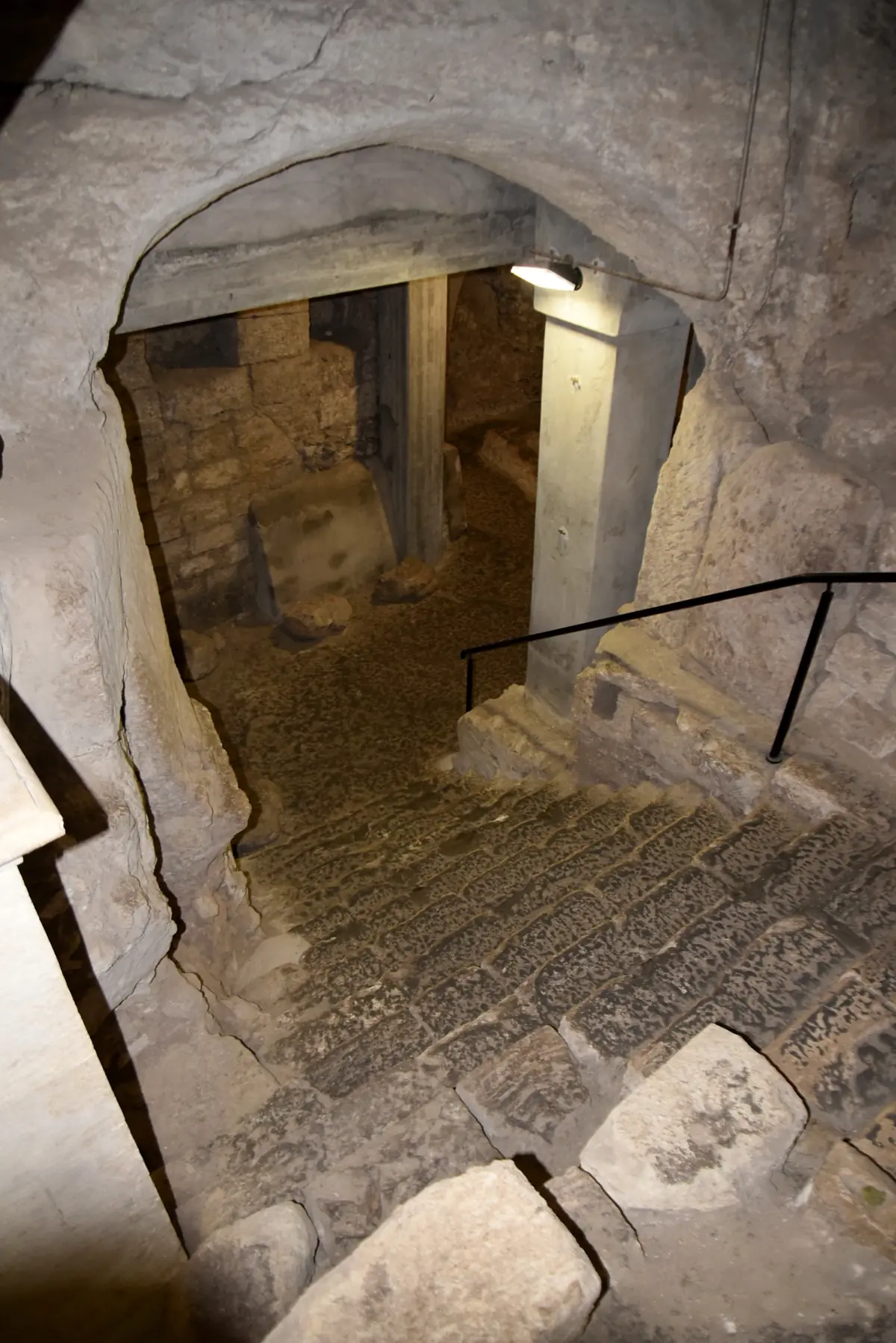
About a hundred metres from the basilica, beneath the convent of the Sisters of Nazareth, earlier excavations (late 19th century, then the 1930s to 1960s) had revealed a house partly cut into the rock, Roman-period tombs and a large Byzantine church. British archaeologist Ken Dark (University of Reading) re-examined the site from 2006. In his view the house, built in the 1st century, was venerated in the Byzantine period as the place where Jesus was brought up: the church above it would be the "Church of the Nutrition" described in the late 7th century by the Irish abbot Adomnán.
🔎 Has the house of Jesus been found?
Not in the strict sense. Ken Dark himself stresses that there is no way to prove the convent house belonged to Jesus' family; he only shows that a Byzantine tradition identified it as such. The excavations do establish one important point: Nazareth was indeed inhabited in the 1st century, which answers the claim, marginal among archaeologists, that the village did not exist in Jesus' time.
Several shrines have stood over the grotto: a Byzantine church (5th century), which the anonymous Piacenza pilgrim describes around 570 as the "house of Mary" turned into a basilica; a vast Crusader church built in the 12th century and ruined in 1263 by the Mamluk sultan Baybars; then, after the Franciscans settled here in 1620, a modest church enlarged in 1730. The present building, designed by the Italian architect Giovanni Muzio, was built between 1960 and 1969. With its 55-metre dome shaped like an inverted lily, it is the largest church in the Middle East.
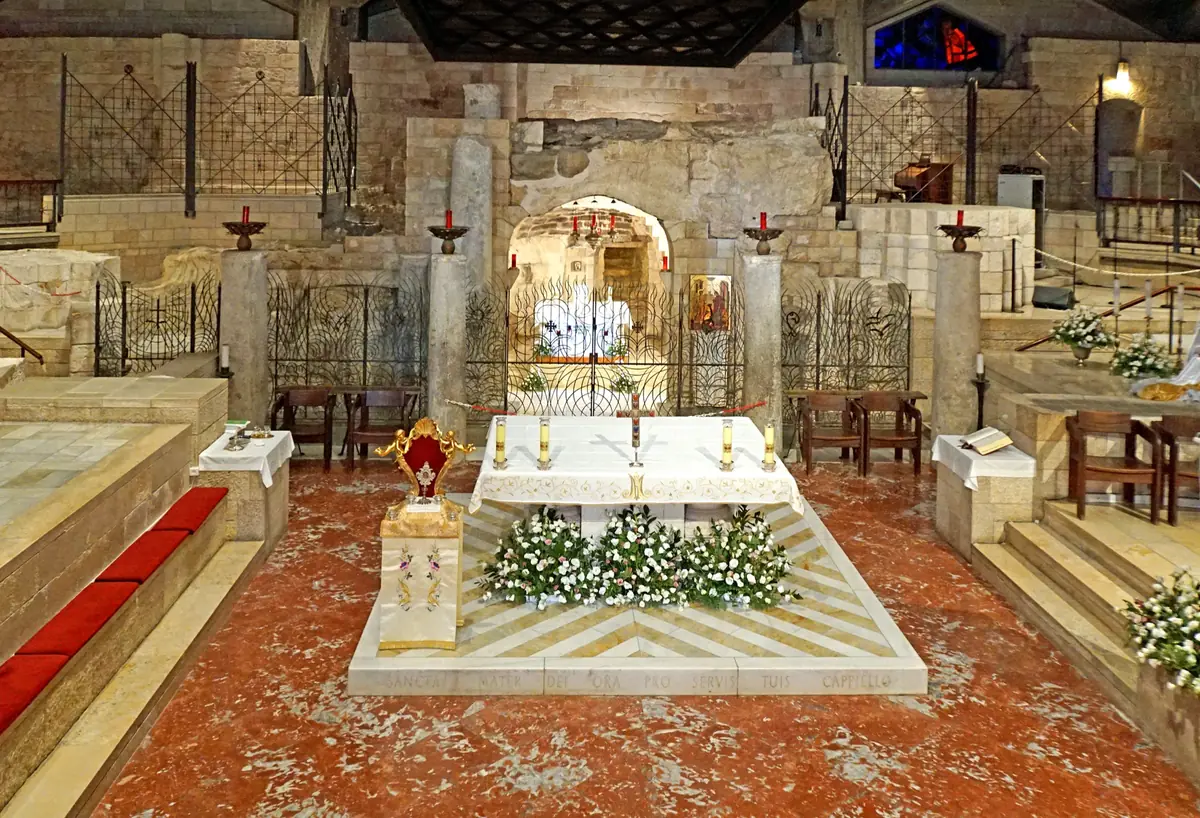
The basilica has two levels. The lower church surrounds the Grotto of the Annunciation, preserved together with remains of the Byzantine and Crusader churches; on the altar a Latin inscription reads Verbum caro hic factum est, "Here the Word was made flesh". The upper church, used for the parish Mass, is decorated with large mosaics of the Virgin donated by Catholic communities from around the world; more line the cloister. Popes Paul VI (1964), John Paul II (2000) and Benedict XVI (2009) all visited.
Just north of the basilica, in the same Franciscan compound, St Joseph's Church (1914) was built on the remains of a Crusader church. A late tradition places Joseph's workshop or house here. The crypt shows caves, silos and cisterns of the ancient village, as well as a rock-cut basin with steps, sometimes interpreted as an early baptistery.
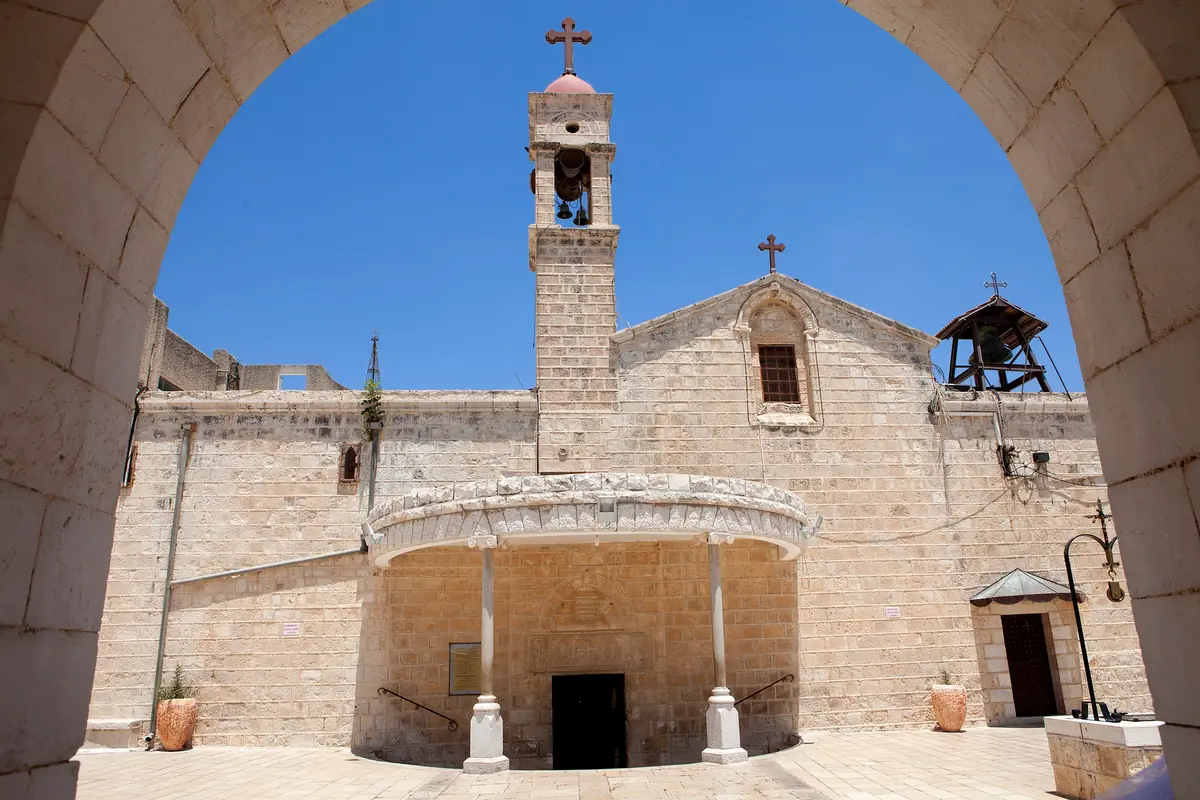
Orthodox tradition places the Annunciation elsewhere: at the village spring, where Mary is said to have gone to draw water, as told in a 2nd-century apocryphal text, the Protoevangelium of James. The Greek Orthodox Church of the Annunciation, known as St Gabriel's Church, built between 1750 and 1769 on older foundations, has a crypt where the spring still flows. About 130 metres away, Mary's Well, fed by the same spring, was rebuilt in the style of the Ottoman fountain and inaugurated for the year 2000 celebrations.
In the market, the Synagogue Church of the Greek Catholics (Melkites) preserves the memory of the synagogue of Luke 4; the medieval building is much later than the episode. South of the city, Mount Precipice (Har Kedumim) is the place tradition identifies with Luke 4:29. It offers a wide view over the Jezreel Valley and Mount Tabor; Benedict XVI celebrated Mass there in 2009.
The visit is made on foot, in a hilly district. From the Basilica of the Annunciation and St Joseph's Church, walk up through the market (souk) to the Synagogue Church, then down to St Gabriel's Church and Mary's Well, about 700 metres away. Along the way: the White Mosque (19th century), restored Ottoman houses, and the Sisters of Nazareth convent, whose remains can be seen on tours arranged by the convent when available.
Nazareth Village is an open-air museum opened in 2000 on farmland belonging to the Nazareth Hospital (Nazareth Trust). An ancient rock-cut winepress and old terraces have been preserved; around them, houses, a synagogue, a watchtower, a ritual bath and presses have been rebuilt with the techniques and materials of the period, based on archaeological data from Galilee. Costumed actors demonstrate farming and crafts. It is an educational reconstruction, not an excavated ancient site, but it helps to picture the village described above.
About 6 km as the crow flies north-west of Nazareth, Tzippori (Sepphoris) was the capital of Galilee in the early 1st century, rebuilt by Herod Antipas after 4 BC. Tzippori National Park, run by the Israel Nature and Parks Authority, displays a Roman and Byzantine town with paved streets, a theatre, a synagogue with a mosaic floor and the so-called Dionysus villa, famous for the female portrait nicknamed the "Mona Lisa of the Galilee". Some historians suggest that Joseph and Jesus may have found work there during the rebuilding; the Gospels say nothing about it.
To place Nazareth within the wider story, see the birth and childhood of Jesus. From Nazareth, the shores of the Sea of Galilee are less than an hour's drive away.
Nazareth, the Town of Jesus: Annunciation, Excavations and Visit
Basilica of the Annunciation, old city of Nazareth (market district), Lower Galilee (about 35 km south-east of Haifa, 30 km west of Tiberias)
GPS coordinates : 32.7022, 35.2978
Start navigation with:
The town of Ruth and David, where the Gospels place the birth of Jesus: a cave venerated since the 2nd century, beneath one of the oldest churches in the world still in use.
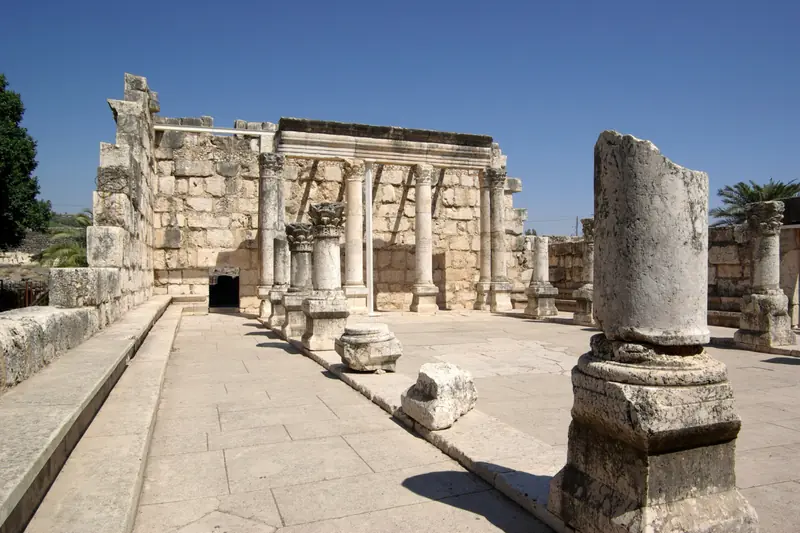
The fishing village where Jesus settled, taught in the synagogue and stayed with Peter: what the Gospels say, what the excavations found and what you can see today.
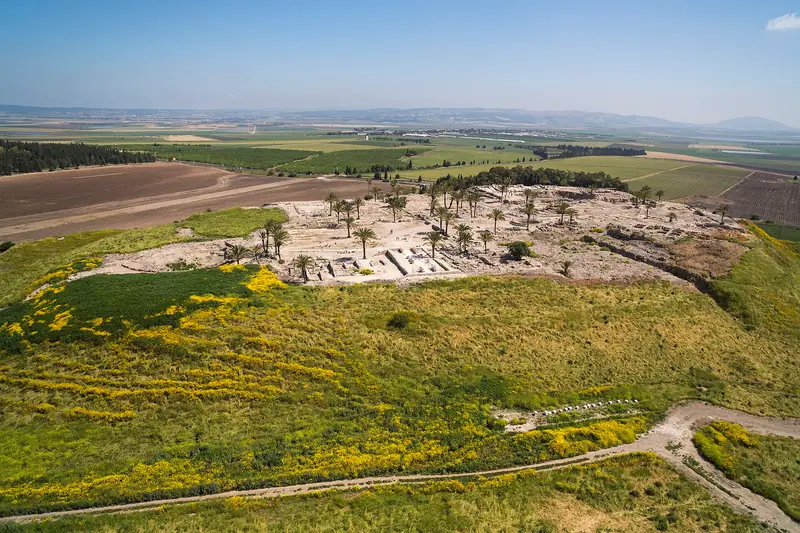
A Canaanite city the Bible says was defeated but never dispossessed: four thousand years of history at the crossroads of Egypt and Mesopotamia.
Nazareth is in Lower Galilee, northern Israel, about 35 km south-east of Haifa and 30 km west of the Sea of Galilee. It is the largest Arab city in Israel and borders the Jewish town of Nof HaGalil (formerly Nazareth Illit).
The most common view links it to the Hebrew <em>netzer</em>, "shoot, branch" (Isaiah 11:1), a word Matthew seems to echo (Matthew 2:23). Another theory connects it with the root meaning "to watch, to guard". In modern Hebrew the city is called Natzrat, in Arabic an-Nasira.
According to the Gospels, Jesus was born in Bethlehem but grew up in Nazareth, the home town of Joseph and Mary (Luke 2:39; Matthew 2:23). People were commonly identified by their place of origin or residence, and this is the name under which he was known, down to the inscription on the cross (John 19:19).
A small Jewish farming village of a few hundred people on a Galilean hill. Excavations have revealed houses partly cut into the rock, silos, cisterns, presses, chalkstone vessels linked to ritual purity and tombs outside the village. The regional capital was nearby Tzippori (Sepphoris).
The Basilica of the Annunciation and its grotto, St Joseph's Church, the market and the Synagogue Church, St Gabriel's Orthodox Church and Mary's Well, the remains beneath the Sisters of Nazareth convent, Mount Precipice and, on the edge of town, Nazareth Village. Tzippori is a few kilometres away.
An open-air museum opened in 2000 that reconstructs a first-century Galilean village: houses, a synagogue, presses and terraces, with costumed actors. It is built around a preserved ancient winepress, but most buildings are reconstructions. Visits are guided; opening times are published on its official website.
Catholic tradition places it in the grotto preserved beneath the Basilica of the Annunciation; Orthodox tradition places it by the spring, in St Gabriel's Church. Luke's Gospel simply says the angel was sent "unto a city of Galilee, named Nazareth" (Luke 1:26).
No house can be attributed with certainty to Jesus' family. Archaeologist Ken Dark has shown that a first-century house beneath the Sisters of Nazareth convent was venerated in the Byzantine period as the place where Jesus grew up, without being able to prove it. Another house of the same period was uncovered in 2009 near the basilica.