
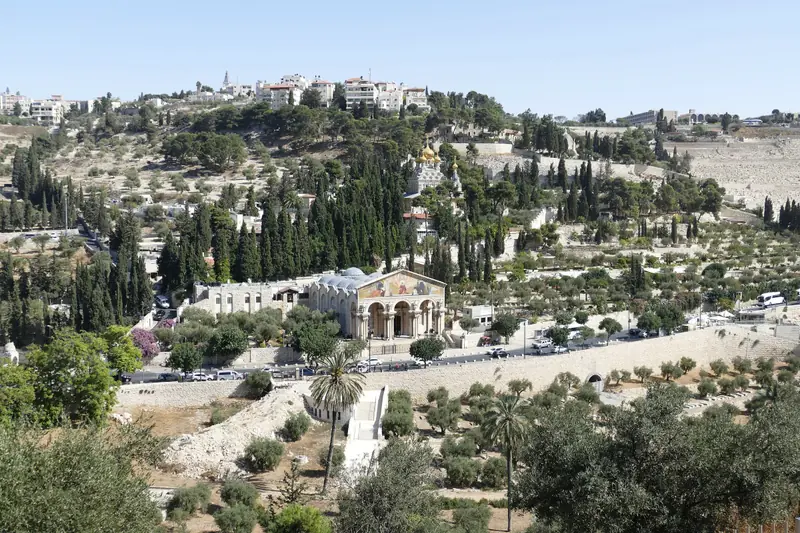
The Mount of Olives and the Garden of Gethsemane in Jerusalem
From David's flight to the agony of Jesus, the hill facing the Temple Mount holds three thousand years of Jewish and Christian memory.
c. AD 30
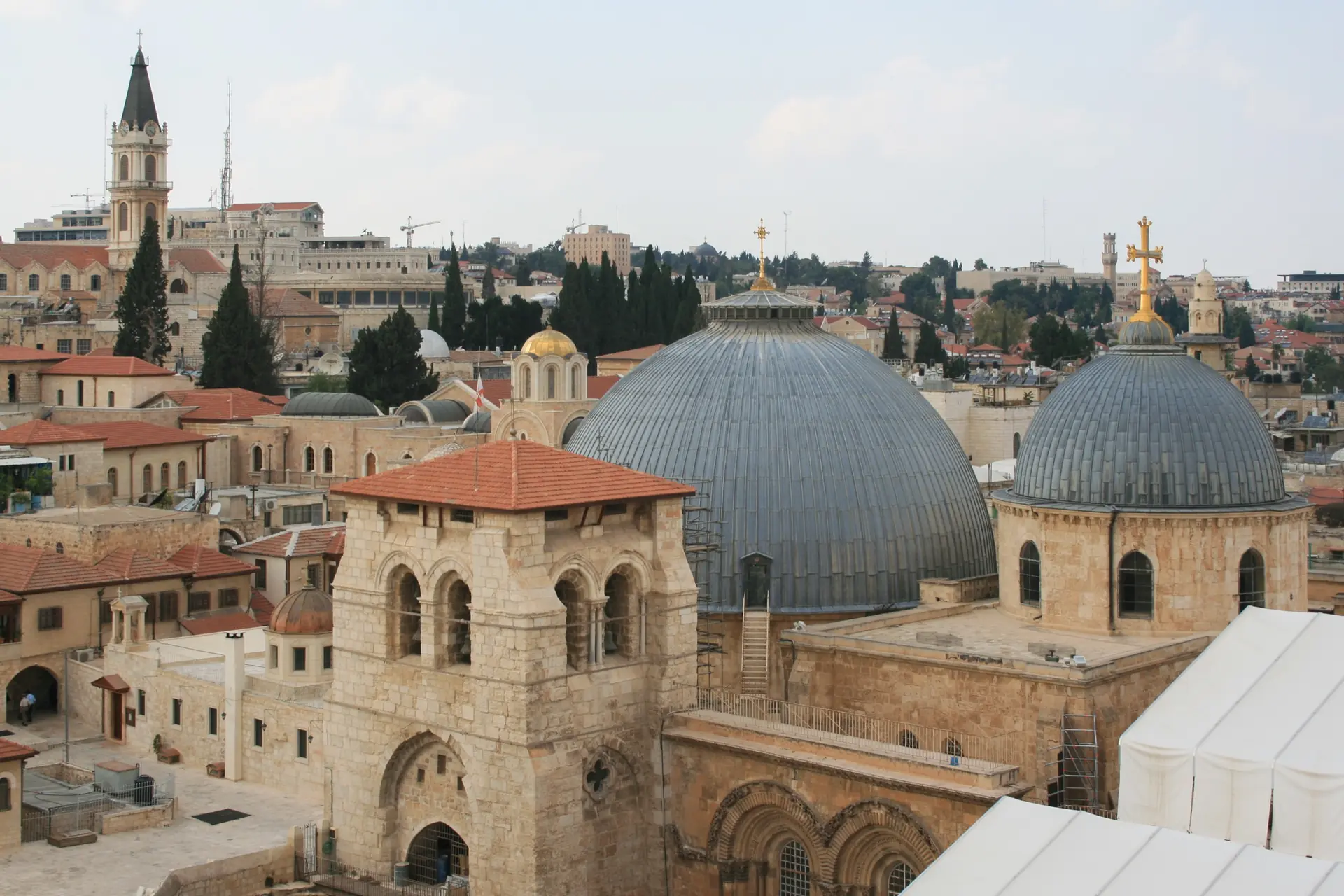
The rock of Calvary and the tomb venerated since the 4th century, under one roof shared by six Christian communities: Gospel account, history, archaeology and visiting.
Credit: Diego Delso · CC BY-SA 3.0 · Wikimedia Commons
In the heart of the Christian Quarter of Jerusalem's Old City, the Church of the Holy Sepulchre brings together under one roof the two places Christian tradition links to the death and resurrection of Jesus: the rock of Golgotha (Calvary), where he is believed to have been crucified, and the tomb of Jesus, enclosed in a small shrine called the Edicule. The Orthodox Churches call it the Church of the Resurrection (Anastasis). For pilgrims it is also the end of the Via Dolorosa, whose last five stations lie inside.
The Holy Sepulchre has been venerated since the 4th century, when Emperor Constantine had the site cleared. No archaeological proof can show that this is the exact tomb, but several clues make the location plausible: a former quarry with Jewish tombs, lying outside the city walls in Jesus' day. The restoration of the Edicule in 2016–2017 and the excavations beneath the floor from 2022 to 2025 have recently added a great deal to what we know of the site.
All four Gospels place the crucifixion at a specific spot near Jerusalem, and the burial in a nearby tomb. This account, which closes the week described in the Passion in Jerusalem, is the source of the whole tradition of the site.
Matthew (27:33), Mark (15:22) and John give the Aramaic name of the place, Golgotha, and translate it as "the place of a skull"; Luke (23:33) uses the Latin-derived word "Calvary" in the King James Version, from calvaria, "skull".
"And he bearing his cross went forth into a place called the place of a skull, which is called in the Hebrew Golgotha: where they crucified him, and two other with him, on either side one, and Jesus in the midst."
John 19:17-18 (KJV)
The texts state that the place was "nigh to the city" (John 19:20), and the Epistle to the Hebrews recalls that Jesus "suffered without the gate" (Hebrews 13:12). The origin of the name is still debated: the shape of the rock, a place of execution or simply a place name. An ancient tradition, taken up by several Church Fathers, also placed Adam's skull here, hence the Chapel of Adam beneath Calvary.
Joseph of Arimathea, a member of the council, obtains the body of Jesus from Pilate; with Nicodemus he wraps it in linen and spices (John 19:38-40). Mark specifies that he laid it "in a sepulchre which was hewn out of a rock" and rolled a stone against the door (Mark 15:46). John adds a topographical detail:
"Now in the place where he was crucified there was a garden; and in the garden a new sepulchre, wherein was never man yet laid. There laid they Jesus therefore because of the Jews' preparation day; for the sepulchre was nigh at hand."
John 19:41-42 (KJV)
On the first day of the week, the women who come to the tomb "found the stone rolled away from the sepulchre" (Luke 24:2). John describes Peter going into the tomb and seeing the linen clothes lying there (John 20:6-7). It is this empty tomb, announced with the words "He is not here: for he is risen" (Matthew 28:6), that the church commemorates.
According to the historian Eusebius of Caesarea, who lived at the time, the site was covered in the 4th century by a pagan temple built after Jerusalem was refounded as the Roman colony of Aelia Capitolina under Hadrian, around 135. Around 326, Constantine had the temple demolished and the rock cleared: a rock-cut tomb was found and identified by the local Christian community as the tomb of Jesus. Empress Helena, Constantine's mother, was then visiting the Holy Land; the tradition that she found the True Cross is only attested from the late 4th century.
The Constantinian complex, dedicated in 335, included a large basilica (the Martyrium), a courtyard where the rock of Golgotha stood, and a rotunda (the Anastasis) around the tomb, which was cut free from the surrounding rock. The Madaba mosaic map of the 6th century still shows it at the centre of the city.
Archaeology cannot prove that a particular man was buried in a particular tomb. It can, however, check whether the site matches the setting described in the Gospels, and date its veneration.
The Gospels place Golgotha outside the city, whereas the church now stands in the middle of the Old City. Kathleen Kenyon's soundings in the Muristan (1960s), followed by excavations beneath the neighbouring Lutheran Church of the Redeemer, showed that the area was an old quarry, outside the walls of Jesus' time. It was only brought inside the city by the "Third Wall" of Agrippa I, around AD 41–44. The exact line of the "Second Wall" described by Josephus is, however, still debated.
West of the rotunda, in the Syriac Orthodox chapel, visitors can see a rock-cut tomb with narrow, deep burial niches, the kokhim, a type typical of Jewish tombs of the Second Temple period. Tradition attributes it to Joseph of Arimathea. Whoever was buried there, it proves the site was a cemetery in the 1st century, which implies it lay outside the city, since Jewish law forbade burial within the walls.
At risk of collapse, the Edicule was restored by a team from the National Technical University of Athens under the scientific direction of Antonia Moropoulou, at the joint request of the three main communities. In late October 2016 the marble slab covering the burial bench was lifted for the first time in centuries: beneath a second slab carved with a cross, the team found that the original limestone burial bed was still in place. Mortar samples taken between the rock and the marble were dated by optically stimulated luminescence (OSL) to around AD 345, which fits the Constantinian period and agrees with Eusebius' account. The restored Edicule was unveiled on 22 March 2017.
The floor restoration made possible the most extensive excavation carried out in the church for a very long time, led by Francesca Romana Stasolla (Sapienza University of Rome). Its preliminary results describe a limestone quarry worked from the Iron Age, then cultivated plots separated by low walls, where pollen and plant-remains analysis identified olive trees and grapevines, as well as several rock-cut tombs. Many media outlets saw this as an echo of the "garden" in John 19:41; the researchers remain cautious about the precise dating of these crops. The excavations also exposed the circular marble foundation of the Constantinian setting around the tomb. The excavation phase is over; the results, presented in September 2026, are being published (the "Hagia Polis Project" series).
In the 19th century some Protestant travellers, doubting that a site inside the Ottoman walls could be authentic, proposed another location north of the Damascus Gate. Popularised by the British general Charles Gordon in 1883, the Garden Tomb offers a peaceful setting that many pilgrims love. The archaeologist Gabriel Barkay has shown, however, that the tomb belongs to an Iron Age cemetery (8th–7th century BC), reused in the Byzantine period: it was therefore not a "new sepulchre" in the 1st century. The association that runs the garden does not itself claim that it is the exact tomb.
🔎 Text, tradition, archaeology
The Gospel text describes a place of execution near the city and a new tomb in a garden. Tradition has identified that place with the Holy Sepulchre since at least the 4th century, probably drawing on the memory of the Jerusalem community. Archaeology confirms a compatible setting (quarry, crops, Jewish tombs outside the walls) but cannot point to the tomb itself.
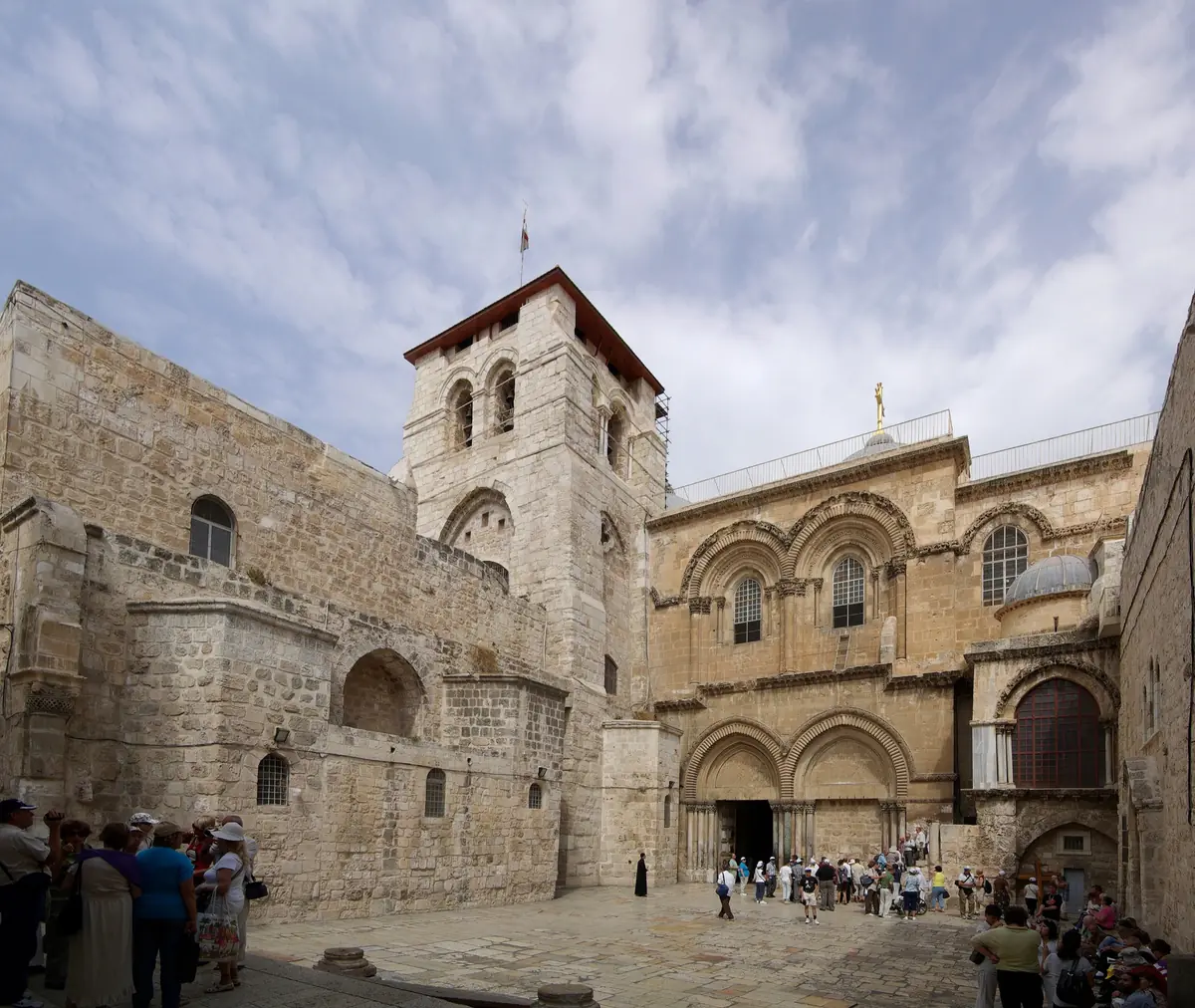
You enter through a paved courtyard facing the Crusader Romanesque façade and its single door (the second doorway was walled up after 1187). Look up: on the ledge beneath the right-hand window, a small wooden ladder leans against the wall. Shown in 18th-century engravings, it stands on a part of the building governed by the Status Quo: since no community may move it without the others' agreement, it has stayed put and has come to symbolise the delicate balance that rules the church.
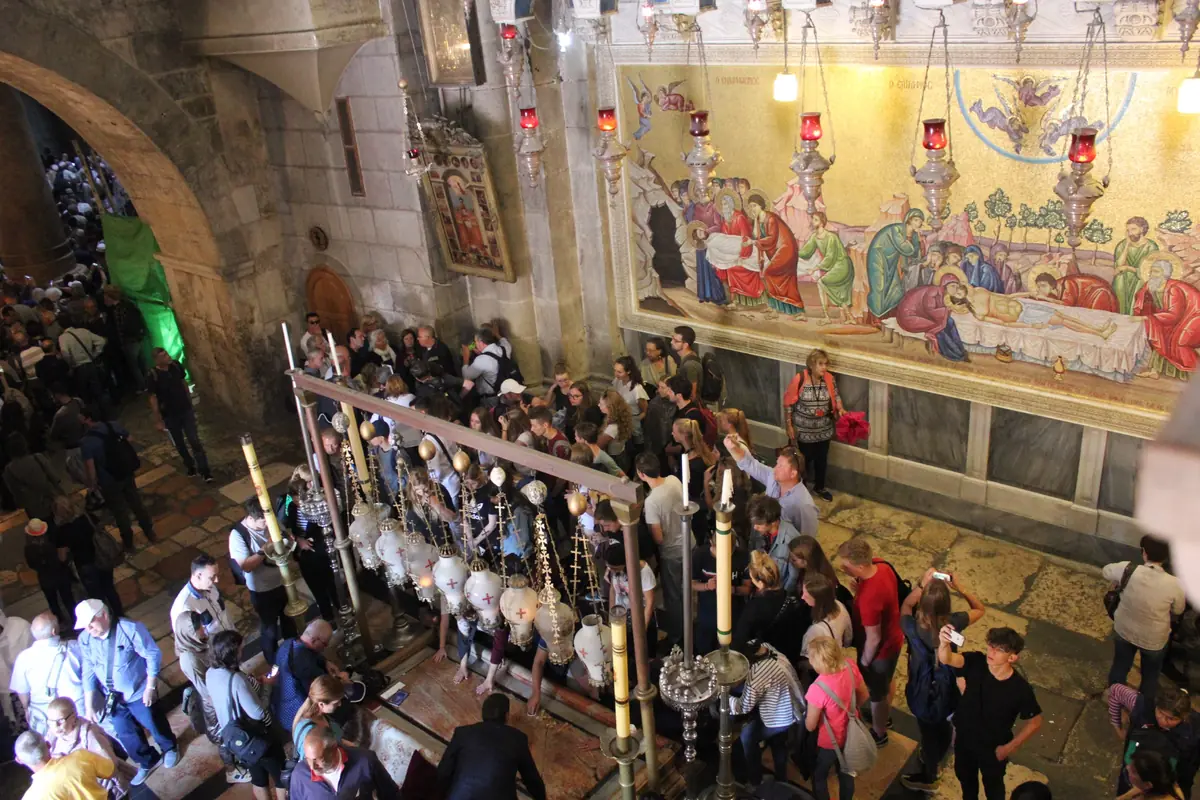
Just inside the entrance, a reddish stone slab surrounded by lamps commemorates the preparation of Jesus' body by Joseph of Arimathea and Nicodemus (John 19:38-40). The current slab dates from 1810. Many pilgrims kneel there and lay devotional objects on it.
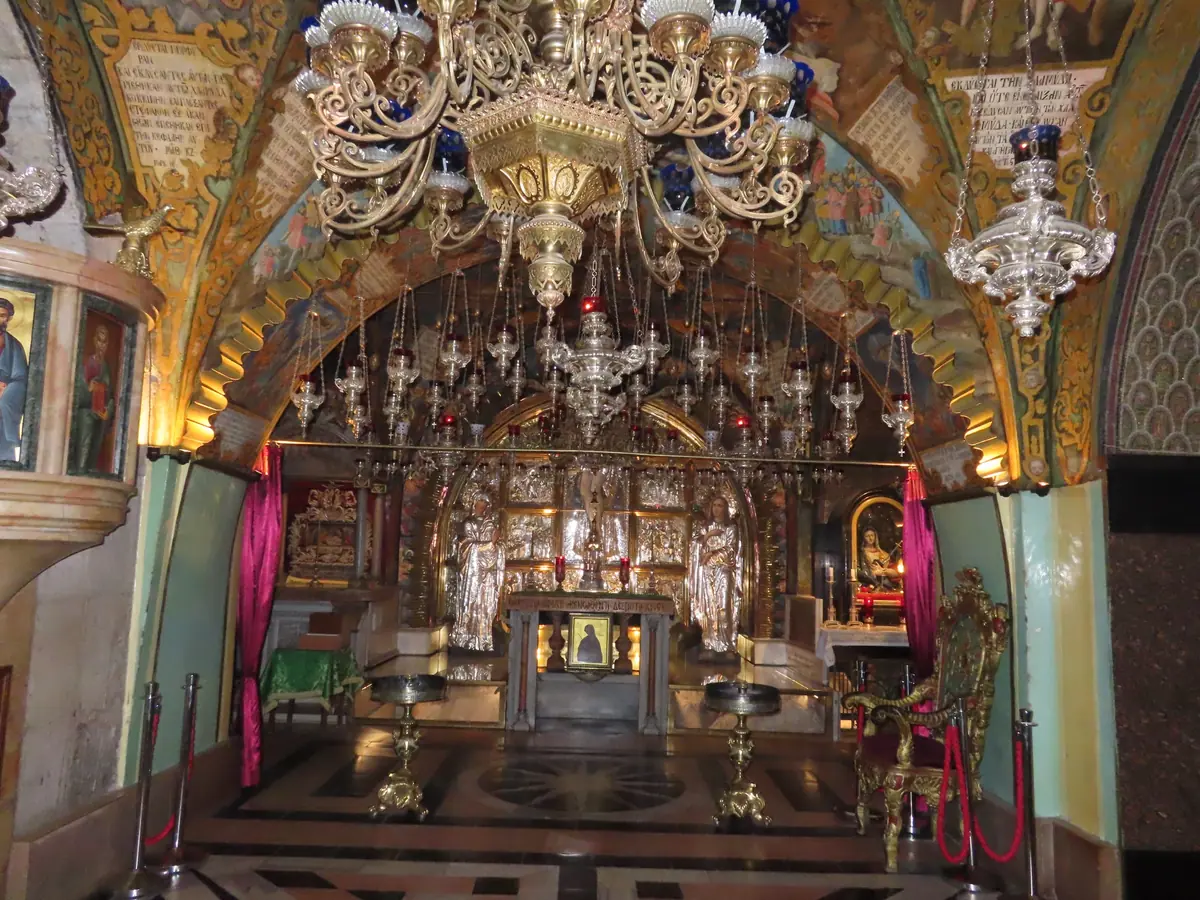
To the right of the entrance, a steep staircase climbs to Calvary, about five metres above the church floor. Two chapels share the space: the Latin Chapel of the Crucifixion (11th station) and the Greek Orthodox chapel (12th station), whose altar is built over the rock; beneath the altar a silver disc marks the traditional place of the cross, and glass panels reveal the bedrock. Between them, the Stabat Mater altar is the 13th station. On the ground floor, the Chapel of Adam shows a crack in the same rock.
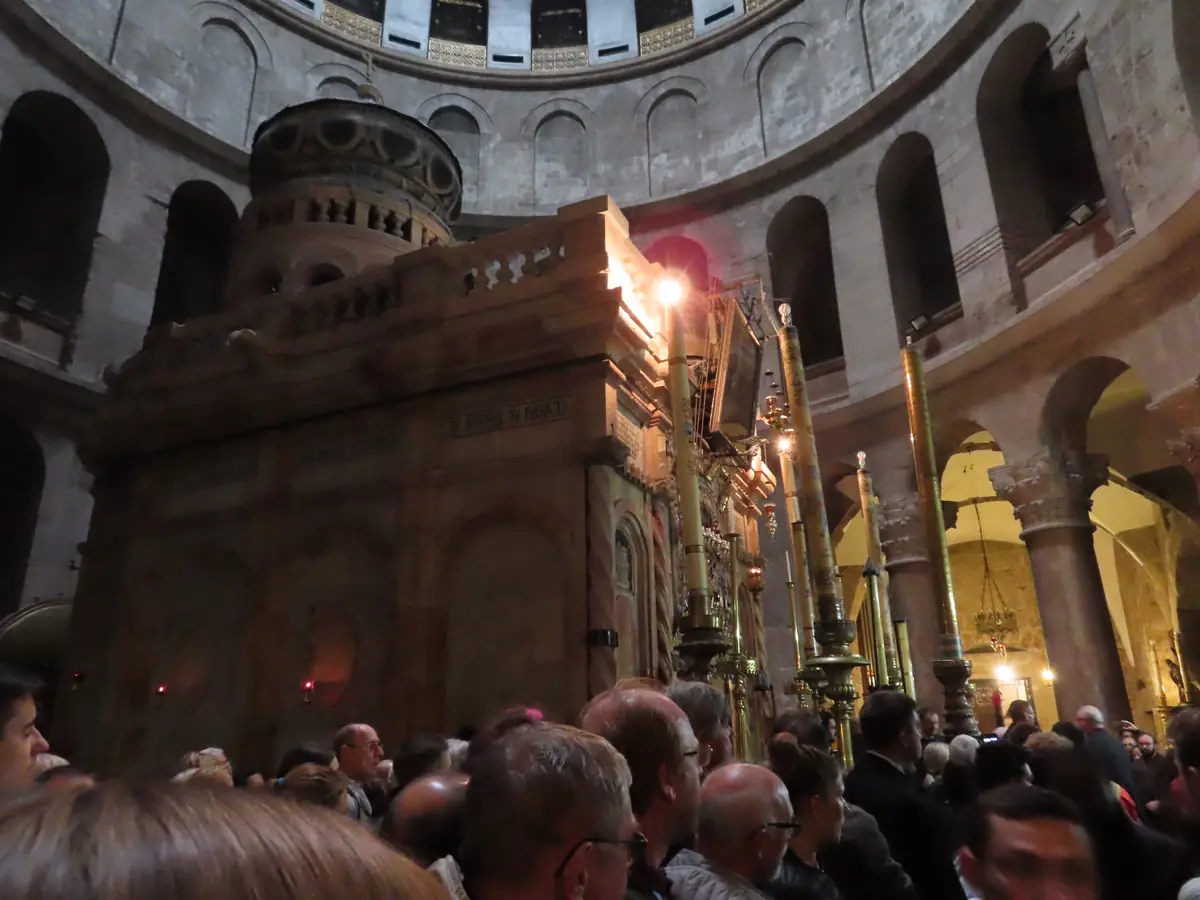
Beneath the great dome of the Anastasis stands the Edicule, the last (14th) station of the Way of the Cross. Visitors stoop to enter in small groups: first the Chapel of the Angel, which keeps a fragment of the stone said to have been rolled before the tomb, then the tiny burial chamber, where a marble slab covers the rock-cut bench. The queue can be long, and the time inside is limited by the attendants.
The Via Dolorosa, which starts in the Muslim Quarter near the Lions' Gate, ends at the Holy Sepulchre. Its route became fixed between the Middle Ages and the 18th century. A few minutes' walk away is the Temple Mount; across the Kidron Valley, the Mount of Olives and Gethsemane open the Passion story.
The church is shared by three main communities, the Greek Orthodox Patriarchate, the Latin Catholic Church (represented by the Franciscan Custody of the Holy Land) and the Armenian Apostolic Patriarchate, and three communities with smaller spaces: Copts, Ethiopians and Syriac Orthodox. The rights of each (altars, service times, lamps, cleaning) are fixed by the Status Quo, a body of rules enshrined in Ottoman decrees of 1757 and 1852 and later recognised by international treaties. Any change requires the agreement of all parties, which explains why work is slow, but also the success of the joint projects of 2016–2017 and 2022–2026.
For centuries the key to the door has been kept by a Muslim family of Jerusalem, the Joudeh, while a member of another family, the Nusseibeh, opens and closes the door every day. According to these families' own traditions, the custom goes back to Saladin (1187), or even to Caliph Omar (638) in the case of the Nusseibeh. It is often presented as a guarantee of neutrality between the Christian communities.
On Orthodox Holy Saturday, the Holy Fire ceremony draws huge crowds: the Greek Orthodox Patriarch enters the Edicule and comes out with lit candles, whose flame is passed from hand to hand and then flown to several Orthodox countries. For Orthodox believers the light is received as a sign of the Resurrection; pilgrims' accounts describe it as early as the 9th century.
The Church of the Holy Sepulchre in Jerusalem: Golgotha, the Tomb and Visiting
Christian Quarter, Old City of Jerusalem; entrance through the courtyard, reached from Christian Quarter Road or Souq al-Dabbagha, about 500 m from Jaffa Gate
GPS coordinates : 31.7784, 35.2297
Start navigation with:
From David's flight to the agony of Jesus, the hill facing the Temple Mount holds three thousand years of Jewish and Christian memory.
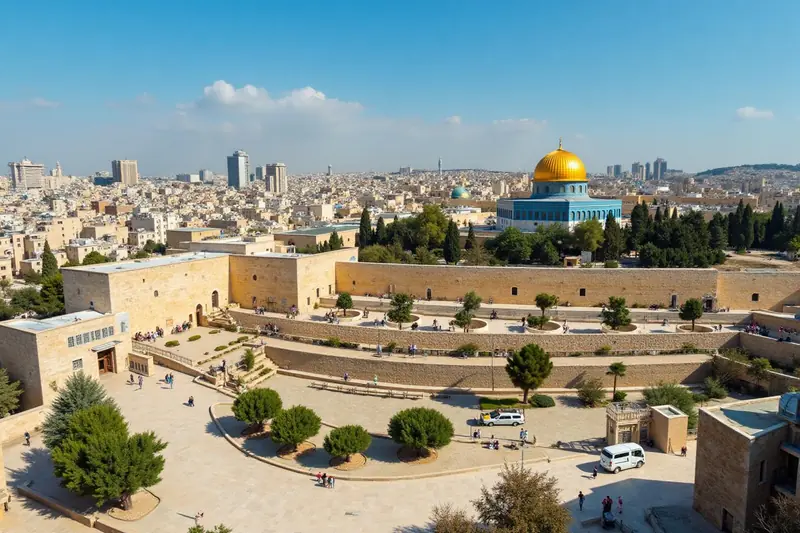
Where tradition places Abraham's test now stands the Temple Mount, one of the holiest sites in Judaism and Islam.
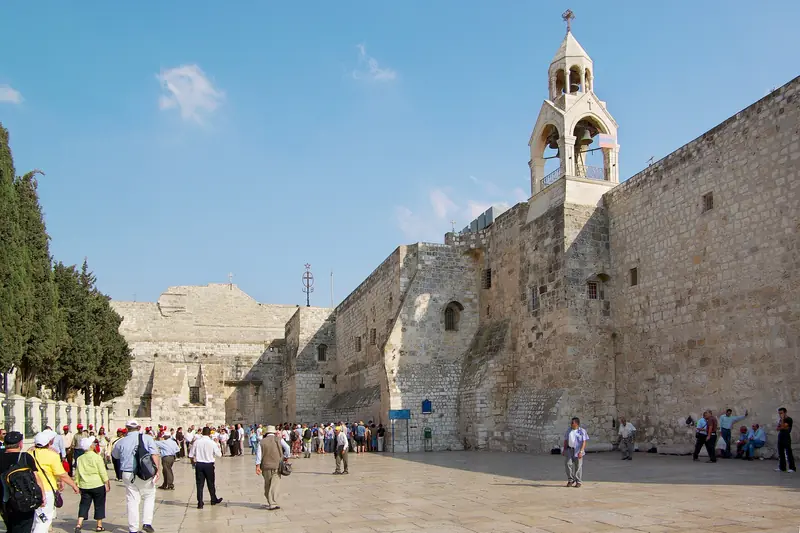
The town of Ruth and David, where the Gospels place the birth of Jesus: a cave venerated since the 2nd century, beneath one of the oldest churches in the world still in use.
According to the tradition followed by the Catholic and Orthodox Churches, Golgotha is inside the Church of the Holy Sepulchre, in the Christian Quarter of Jerusalem's Old City. The rock of Calvary rises to the right of the entrance and is reached by a steep staircase. In Jesus' time the spot lay outside the city walls.
Golgotha comes from the Aramaic <em>gulgalta</em>, "skull". The Gospels translate it as "the place of a skull" (Matthew 27:33; Mark 15:22; John 19:17). "Calvary" comes from the Latin <em>calvaria</em>, with the same meaning. Why the place was so called (the shape of the rock or something else) remains uncertain.
It cannot be proved, but it is the oldest and best-supported location: the site has been venerated since at least 326, it lay outside the walls in the 1st century and contained Jewish tombs of that period. Mortar from the Edicule has been dated to around AD 345, confirming the Constantinian works.
The Immovable Ladder, propped beneath a window of the façade, appears in 18th-century engravings. It stands in an area governed by the Status Quo: no community may move it without the agreement of the others. It has become the symbol of these rules of sharing.
Entry is free, but hours change with the season, services and feast days: check them with the Custody's Christian Information Centre (cicts.org) before you go. Early morning or late in the day, the queue at the Edicule is shorter. During Holy Week access may be restricted.
The Garden Tomb, north of the Damascus Gate, was proposed in the 19th century, notably by General Gordon in 1883. It is a much-loved place of prayer, but the archaeologist Gabriel Barkay dated the tomb to the Iron Age (8th–7th century BC): it was therefore not a new tomb in Jesus' time.
It is an Orthodox ceremony held on Holy Saturday: the Greek Orthodox Patriarch enters the Edicule and emerges with lit candles, whose flame is shared by the crowd and then sent to several Orthodox countries. Believers see it as a sign of the Resurrection; pilgrims described the ceremony as early as the 9th century.
Under the Status Quo the church is shared by the Greek Orthodox Patriarchate, the Franciscan Custody (Latin Catholics) and the Armenian Patriarchate, with spaces for the Copts, Ethiopians and Syriac Orthodox. The key is kept by a Muslim family, the Joudeh, and the door is opened by the Nusseibeh family.