
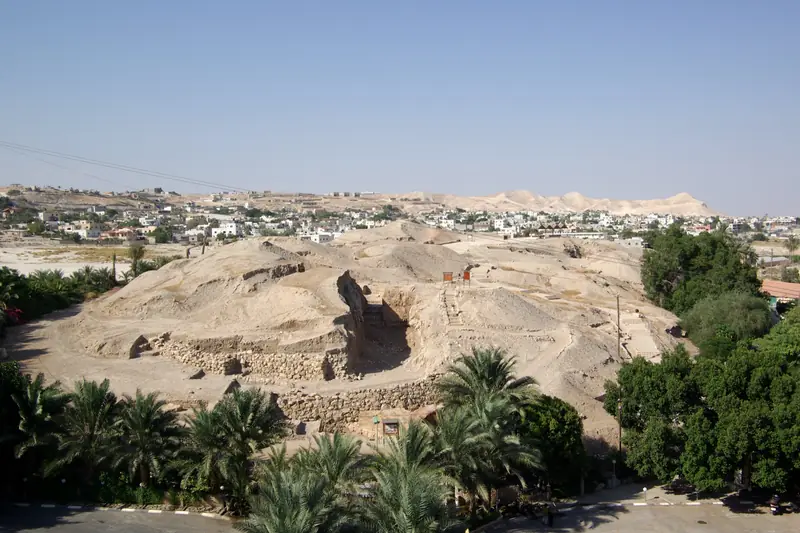
Jericho (Tell es-Sultan): the walls of Joshua
Rahab, the Jordan crossing and the falling walls: the Book of Joshua set against a century of excavation at one of the oldest towns in the world.
1500–1200 BCE
On a spur of the mountains of Moab, Deuteronomy has Moses gaze at the land he will never enter. Since the 4th century, a Christian sanctuary has kept that memory alive.
Credit: Mohammad hajeer · CC BY 4.0 · Wikimedia Commons
Mount Nebo, about 8 km north-west of Madaba in Jordan, is where Deuteronomy brings Moses at the end of the Exodus: from here he sees the Promised Land, then dies "in the land of Moab". On the headland of Ras Siyagha, traditionally identified with the top of Pisgah, stands the Memorial of Moses, a Christian sanctuary attested from the 4th century and cared for today by the Franciscans.
Three things need to be kept apart: the biblical account, which does not locate Moses' grave; Christian tradition, which fixed the memory of the event on this summit; and archaeology, which has uncovered a Byzantine basilica and mosaics (4th–7th centuries). No remains from the time of Moses have been identified here. It remains one of the finest biblical viewpoints in the Near East.
"And Moses went up from the plains of Moab unto the mountain of Nebo, to the top of Pisgah, that is over against Jericho. And the LORD shewed him all the land."
Deuteronomy 34:1 (KJV)
Nebo belongs to the "mountains of Abarim", the range that borders the Jordan Valley to the east. The Book of Numbers already tells Moses that he will see the land without entering it, recalling the episode of the waters of Meribah at Kadesh, where Moses and Aaron failed to "sanctify" God before the people (Numbers 20).
"And the LORD said unto Moses, Get thee up into this mount Abarim, and see the land which I have given unto the children of Israel. And when thou hast seen it, thou also shalt be gathered unto thy people, as Aaron thy brother was gathered."
Numbers 27:12-13 (KJV)
Deuteronomy repeats the command and this time names the place: "unto mount Nebo, which is in the land of Moab, that is over against Jericho" (Deuteronomy 32:49). The text sets the death of Moses on Nebo alongside that of Aaron on Mount Hor.
"Yet thou shalt see the land before thee; but thou shalt not go thither unto the land which I give the children of Israel."
Deuteronomy 32:52 (KJV)
The last chapter of the Torah describes a panorama far wider than the eye can actually see: Gilead as far as Dan, Naphtali, Ephraim and Manasseh, Judah "unto the utmost sea", the Negev and the plain of Jericho, "the city of palm trees". The survey reads like a symbolic taking possession of the land promised to Abraham, Isaac and Jacob rather than a topographical description.
"And the LORD said unto him, This is the land which I sware unto Abraham, unto Isaac, and unto Jacob, saying, I will give it unto thy seed: I have caused thee to see it with thine eyes, but thou shalt not go over thither."
Deuteronomy 34:4 (KJV)
Moses dies at 120, "his eye was not dim" (Deuteronomy 34:7), and Israel mourns him for thirty days in the plains of Moab. The text stresses one point: nobody knows where he is buried.
"And he buried him in a valley in the land of Moab, over against Beth-peor: but no man knoweth of his sepulchre unto this day."
Deuteronomy 34:6 (KJV)
It is Joshua who then leads the people across the Jordan to Jericho, the city Moses could see opposite. The desert journey that leads here is set out on the page The Exodus and the Conquest of Canaan.
The massif has two main summits: Jabal Nibu (≈ 800 m), the higher one, and Ras Siyagha (≈ 710 m), the western spur that overlooks the valley and carries the Memorial. Christian tradition identified Siyagha with the "top of Pisgah" of Deuteronomy. The name Nebo survives in the Arabic Nibu; a few kilometres away, Khirbet al-Mukhayyat is generally identified with the town of Nebo mentioned in Numbers 32:38 and on the Moabite Mesha Stele (9th century BC).
🔎 How certain is it?
The name Nebo is ancient and firmly rooted in the region. The exact spot from which Moses is said to have looked at the land, however, is a matter of tradition: the Bible gives no coordinates, and archaeology can neither confirm nor refute the account.
The pilgrim Egeria, who came from the western Roman world, climbed Nebo around 384. She describes "a church that is not very large" on the summit and a slightly raised spot where, the monks told her, Moses had been laid by the angels — while recalling that "no man knoweth of his sepulchre". Her account was decisive in identifying the ruins of Siyagha.
At the northern foot of Nebo, the small valley of Ayoun Musa ("springs of Moses") has springs and the remains of Byzantine churches, including the church of Kaianos and that of the deacon Thomas. Egeria saw monks there and an abundant spring. Some place here the "valley over against Beth-peor" of Deuteronomy 34:6; this is a traditional suggestion, not a proven location.
No tomb of Moses has been identified on Nebo or anywhere else. A Muslim tradition venerates a shrine of Nabi Musa near Jericho, on the other side of the Jordan; it has no archaeological basis and is unrelated to the site of Siyagha. The biblical text deliberately leaves the question open.
The Franciscan Custody of the Holy Land acquired Ras Siyagha in 1932. Excavations began in 1933 under Father Sylvester Saller, with Father Bellarmino Bagatti, in campaigns carried out in 1933, 1935 and 1937. Father Michele Piccirillo resumed the research from 1976 until his death in 2008.
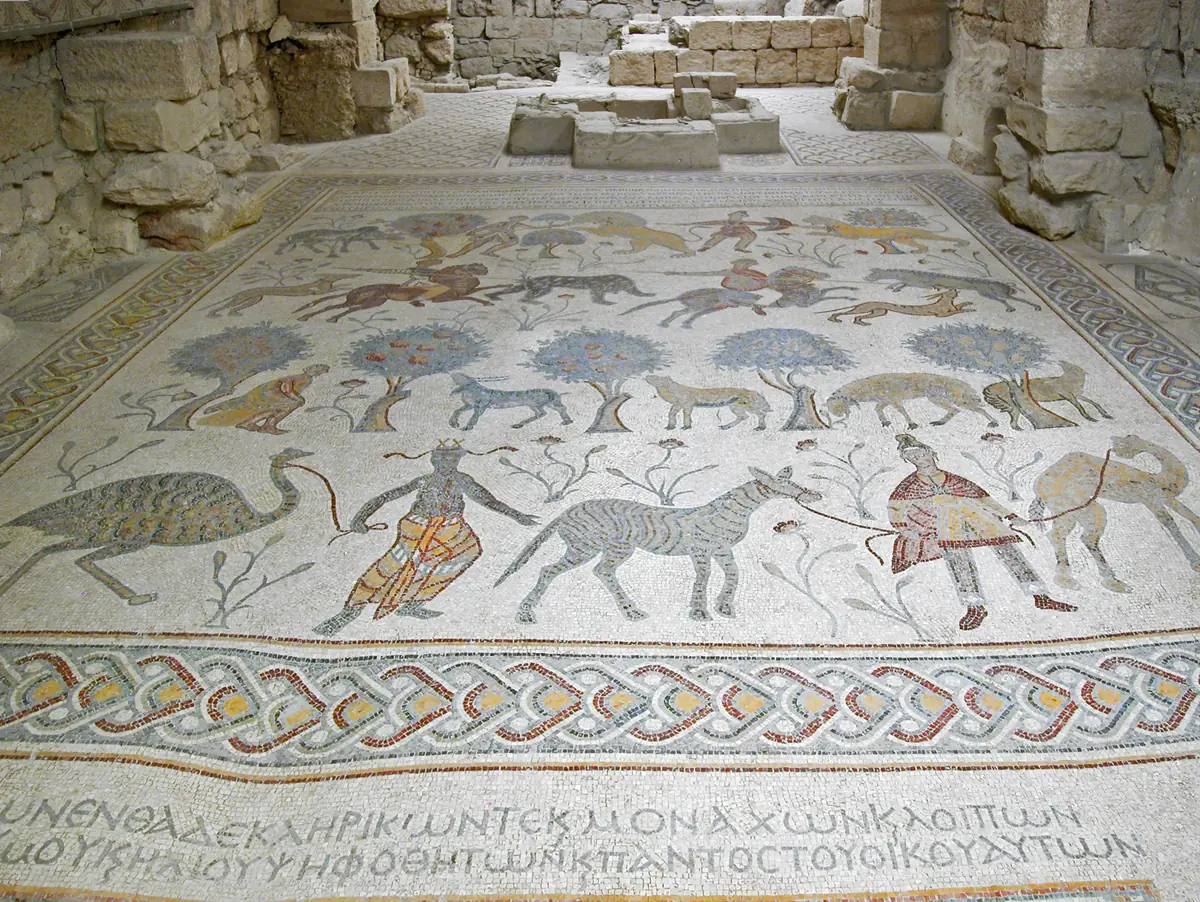
The highlight is the floor of the baptistery-diaconicon, north of the basilica. In four registers, between fruit trees, come hunting and pastoral scenes: horsemen, dogs, lions, a shepherd with his flock, a camel driver, an ostrich and a zebra on leads. A Greek inscription dates the work and names the mosaicists Soelos, Kaiomos and Elias. It is one of the best-known works of the Madaba school of mosaics.
📅 What the remains date from
Everything visible at the Memorial is Christian and Byzantine (4th–7th centuries AD), almost two thousand years after the period the Bible assigns to Moses. These remains bear witness to the memory of the place, not to the event itself.
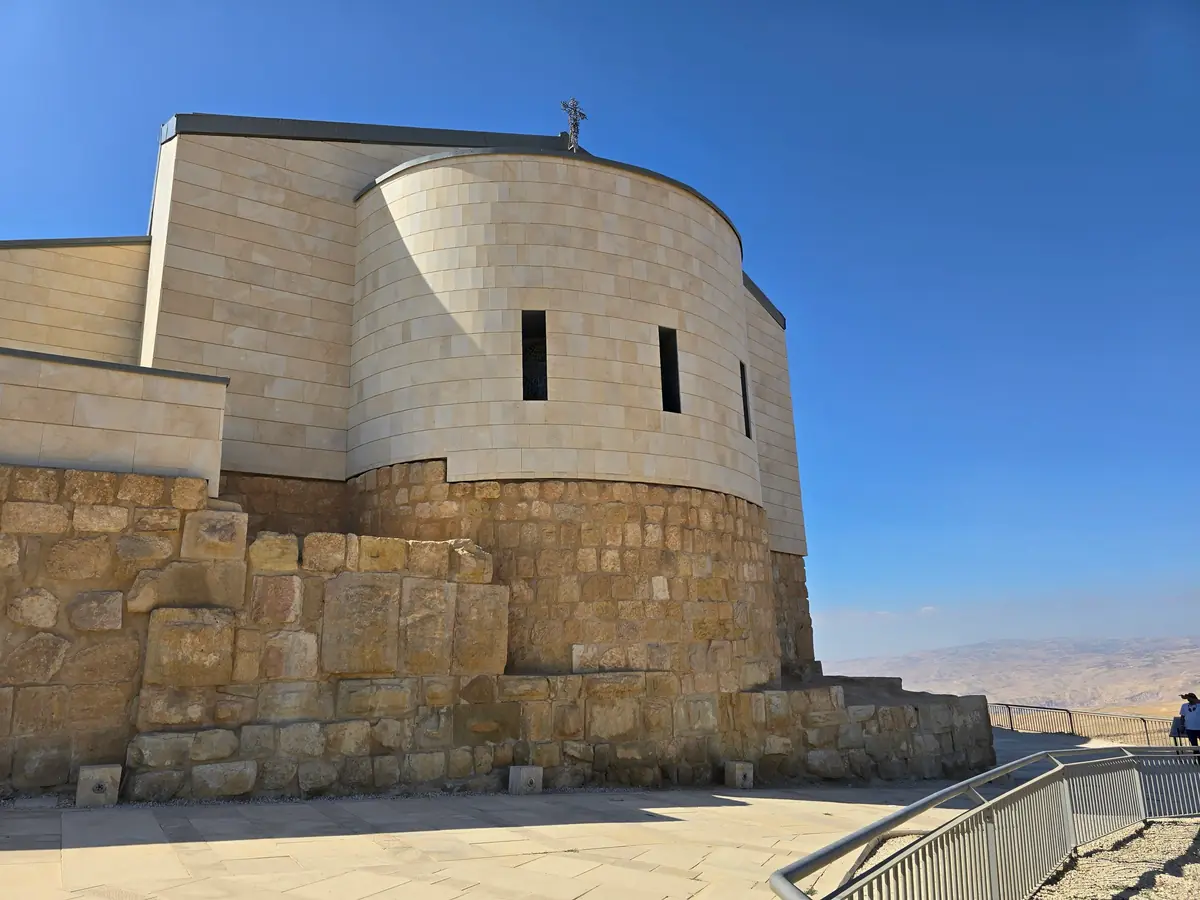
The modern building in pale stone, inaugurated in 2016, protects the Byzantine walls and floors. Inside, visitors walk between the mosaics of the basilica, the diaconicon and the side chapels. It is still a sanctuary: Mass is celebrated here, and modest dress and silence are expected.
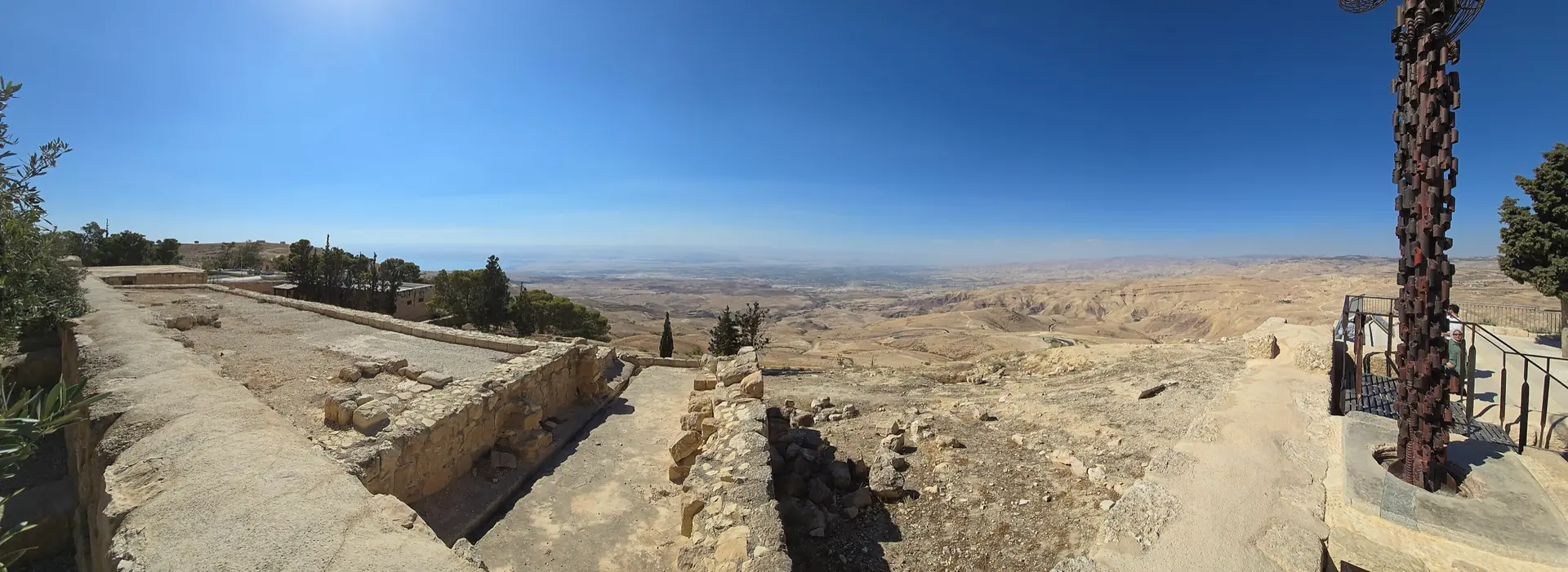
From the terrace, at about 700 m above sea level, the view drops more than 1,000 m to the Jordan Valley and the Dead Sea, which lies over 400 m below sea level. You can make out the oasis of Jericho and, on very clear days, the heights of Jerusalem and the Mount of Olives. An orientation table shows directions and distances. Summer heat haze often limits visibility.
On the esplanade stands a modern metal sculpture by the Florentine artist Gian Paolo Fantoni (1983–1984): a serpent coiled around a cross-shaped staff. It recalls the bronze serpent Moses raised in the desert (Numbers 21:8-9) and the way John's Gospel reads it (John 3:14). It is a contemporary work of art, not an ancient object. An interesting archaeological parallel can be found at Timna, where a small copper snake was discovered in the Hathor mining shrine.
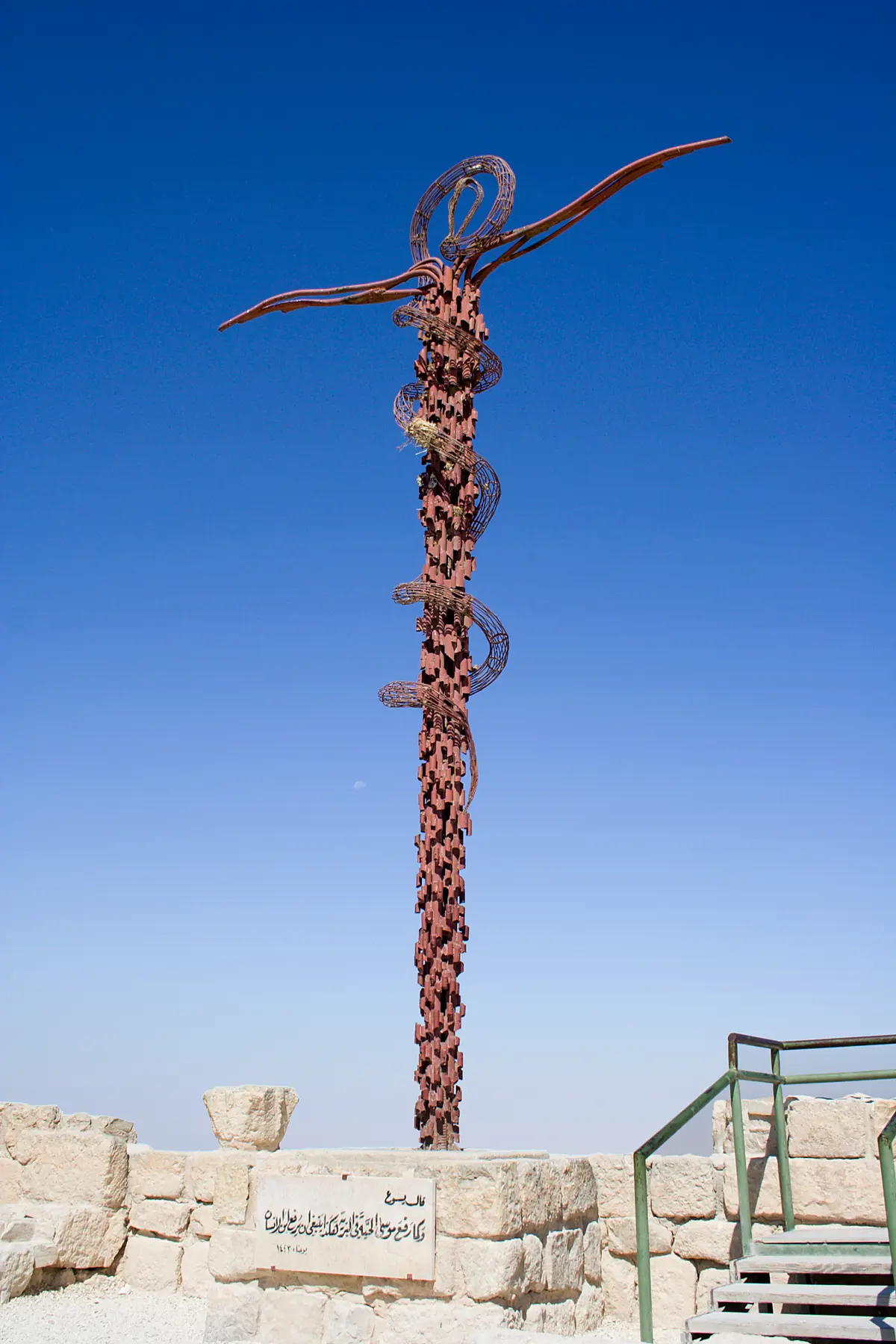
A memorial stone recalls the visit of Pope John Paul II in March 2000; Benedict XVI came in 2009. A small interpretation centre presents the history of the excavations.
Mount Nebo closes the desert story: after the departure from Egypt, Mount Sinai, the forty years of wandering and the march through Transjordan, it is the last stop before crossing the Jordan. It combines easily with Madaba and its famous 6th-century mosaic map of the Holy Land, with Khirbet al-Mukhayyat and its Byzantine churches, and with the Baptism Site of Bethany beyond the Jordan, down in the valley.
Mount Nebo – Moses' Last View of the Promised Land
Ras Siyagha, Mount Nebo, about 8 km north-west of Madaba (Jordan)
GPS coordinates : 31.7682, 35.7253
Start navigation with:
Rahab, the Jordan crossing and the falling walls: the Book of Joshua set against a century of excavation at one of the oldest towns in the world.
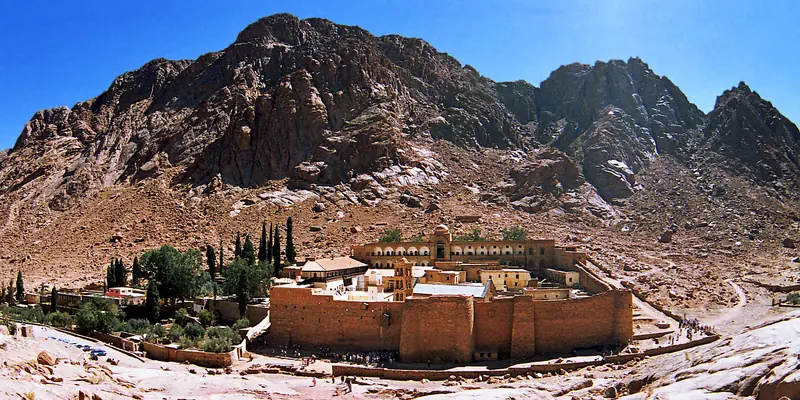
In the heart of the South Sinai mountains, a Christian tradition sixteen centuries old places the burning bush and the giving of the Law here. Yet the identification of biblical Sinai is still debated.
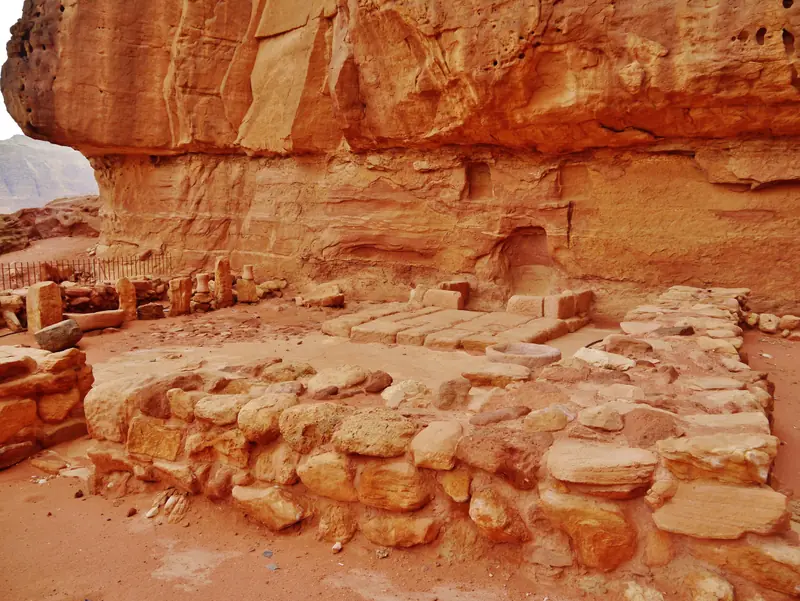
In the Arava Valley, a red sandstone landscape where the Egypt of the Ramesside pharaohs mined copper: a context site for understanding the desert of the Exodus story.
In Jordan, in the Madaba Governorate, about 8 km north-west of the town of Madaba. The Memorial of Moses stands on the Ras Siyagha spur. GPS coordinates are in the "Getting there & GPS" section.
The Bible says Moses died in the land of Moab and was buried "in a valley… over against Beth-peor", but that "no man knoweth of his sepulchre unto this day" (Deuteronomy 34:6). Excavations have not identified any tomb of Moses.
Deuteronomy speaks of "the mountain of Nebo, to the top of Pisgah" (34:1). Christian tradition identified Pisgah with Ras Siyagha, the western spur of Nebo, where the Memorial stands.
The Jordan Valley, the northern Dead Sea, the oasis of Jericho and, on very clear days, the heights of Jerusalem. Visibility depends a great deal on haze, which is common in summer.
They are Byzantine. The most famous one, in the baptistery-diaconicon, is dated by its inscription to AD 530/531; other floors date up to the early 7th century.
The Franciscan Custody of the Holy Land, which has owned Ras Siyagha since 1932. It led the excavations and the restoration of the Memorial, which reopened in October 2016.
A modern sculpture by Gian Paolo Fantoni (1983–1984). It recalls the bronze serpent of Numbers 21:8-9 and its Christian reading in John 3:14. It is not an archaeological object.
About one to one and a half hours on site. The visit is easy to combine with Madaba in the same half-day.