
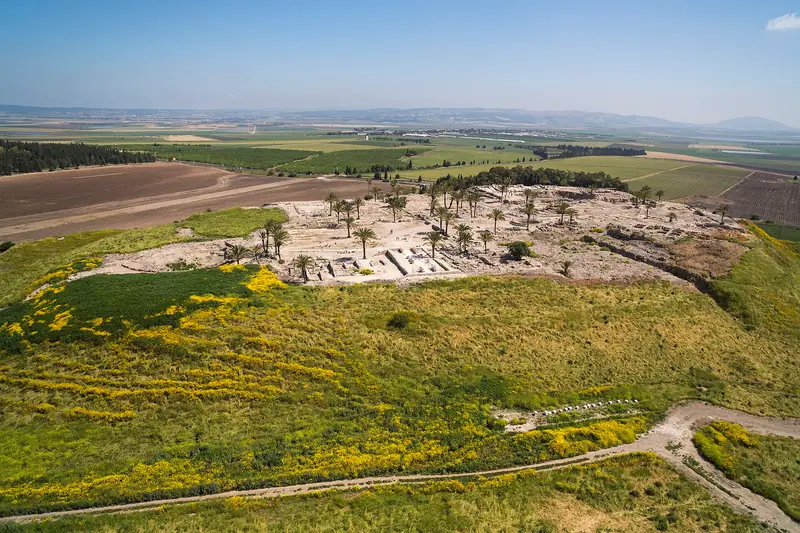
Tel Megiddo: a Canaanite city in the time of Joshua
A Canaanite city the Bible says was defeated but never dispossessed: four thousand years of history at the crossroads of Egypt and Mesopotamia.
1200–586 BCE
Fire from heaven, a little cloud rising from the sea and the hermits who gave their name to the Carmelite order: a mountain overlooking the Jezreel Valley and Haifa Bay.
Credit: Ovedc · CC BY-SA 4.0 · Wikimedia Commons
Mount Carmel is a limestone range in northern Israel, some forty kilometres long, that runs out into the Mediterranean above Haifa Bay and overlooks the Jezreel Valley to the east. It is the mountain of the prophet Elijah: according to the First Book of Kings, he summoned the people of Israel there and confronted the prophets of Baal in a contest by fire (1 Kings 18:19-40). Tradition places that sacrifice at Muhraqa ("the place of burning"), a small Carmelite monastery perched on the south-eastern tip of the range.
Carmel is also a place where memories are layered on top of each other. To the north-west, in Haifa, the Stella Maris monastery and Elijah's Cave recall the hermits who founded the Carmelite order in the 13th century; on the western slopes, the caves of Nahal Me'arot, a UNESCO World Heritage Site, preserve traces of human life across hundreds of thousands of years. This page separates what the biblical text says, what tradition holds and what archaeology has established.
The story is set in the 9th century BC, in the reign of Ahab, king of Israel (the northern kingdom), and his Phoenician wife Jezebel, who promoted the worship of Baal. After three years of drought announced by Elijah (1 Kings 17:1), the word of the Lord sends the prophet to present himself before the king (1 Kings 18:1).
Elijah asks Ahab to gather "all Israel" to Mount Carmel, together with the four hundred and fifty prophets of Baal and the four hundred prophets of the groves "which eat at Jezebel's table" (1 Kings 18:19). Before the crowd, he asks the question that sums up the whole episode:
"How long halt ye between two opinions? if the Lord be God, follow him: but if Baal, then follow him. And the people answered him not a word."
1 Kings 18:21 (KJV)
Each side lays a bull on a pile of wood without lighting it: "the God that answereth by fire, let him be God" (1 Kings 18:24). The prophets of Baal call on their god from morning until noon, then until evening, with no answer; Elijah mocks them.
Elijah then repairs "the altar of the Lord that was broken down" with twelve stones for the twelve tribes, digs a trench around it and has the offering and the wood drenched three times. He prays at the time of the evening sacrifice:
"Then the fire of the Lord fell, and consumed the burnt sacrifice, and the wood, and the stones, and the dust, and licked up the water that was in the trench. And when all the people saw it, they fell on their faces: and they said, The Lord, he is the God; the Lord, he is the God."
1 Kings 18:38-39 (KJV)
The story ends in violence: Elijah has the prophets of Baal seized and "brought them down to the brook Kishon, and slew them there" (1 Kings 18:40). The Kishon (Nahal Kishon) still flows at the foot of Carmel, through the Jezreel Valley.
Elijah then climbs "to the top of Carmel", bows down to the ground with his face between his knees, and sends his servant to look towards the sea, seven times over.
"And it came to pass at the seventh time, that he said, Behold, there ariseth a little cloud out of the sea, like a man's hand."
1 Kings 18:44 (KJV)
The sky grows black, the rain finally falls, and Elijah runs ahead of Ahab's chariot all the way to Jezreel, down in the valley. Beyond the miracle, the text sets two gods of rain and fertility against each other on a mountain famous for its greenery: it is the God of Israel, not Baal, who ends the drought.
📖 Setting the period
Ahab, son of Omri, is one of the kings of Israel best attested outside the Bible: the Assyrian "Kurkh Monolith" names him at the battle of Qarqar (853 BC). For the background of the two kingdoms, see the period of the Judges and Kings.
The biblical text only speaks of "mount Carmel" and "the top of Carmel": it names no precise spot. The identification with Muhraqa, on the south-eastern spur of the range (about 480 m above sea level), is a matter of tradition. In Arabic the place is called el-Muhraqa, "the place of burning"; in Hebrew, Keren HaCarmel, "the horn of Carmel".
No excavation at Muhraqa has uncovered an Iron Age altar that could be linked to the story. The tradition is old: in the 12th century the Jewish traveller Benjamin of Tudela reported that the site of Elijah's altar was shown on Carmel. The Carmelites acquired the land in 1867; the present building dates from 1883. Other spots on the range have been proposed in the past, none of them conclusively; Muhraqa remains the place of memory recognised by Jewish, Christian, Muslim and Druze pilgrims, all of whom revere Elijah.
🔎 Not to be confused with
The Bible also mentions a Carmel in Judah, a small town south of Hebron where Nabal and Abigail lived (1 Samuel 25:2). That village has nothing to do with Elijah's mountain in the north of the country.
After Elijah is taken up, his disciple Elisha "went from thence to mount Carmel, and from thence he returned to Samaria" (2 Kings 2:25). It is again on Carmel that the Shunammite woman, whose son has just died, comes to find him: "she went and came unto the man of God to mount Carmel" (2 Kings 4:25). The text suggests that the range served as a place of retreat for the prophets of the northern kingdom.
For the prophets and poets, Carmel stands for lush, green land. The Hebrew word karmel in fact means an "orchard" or "planted garden"; the popular etymology kerem El, "vineyard of God", is less certain. Isaiah announces the renewal of the desert in these words:
"The glory of Lebanon shall be given unto it, the excellency of Carmel and Sharon, they shall see the glory of the Lord, and the excellency of our God."
Isaiah 35:2 (KJV)
The Song of Songs compares the beloved's head to Carmel ("Thine head upon thee is like Carmel", Song of Solomon 7:5 in the KJV, 7:6 in the Hebrew); by contrast, Amos makes the withering of "the top of Carmel" a sign of judgement (Amos 1:2), and Jeremiah speaks of "Carmel by the sea" (Jeremiah 46:18). The Book of Joshua mentions Carmel on the border of the tribe of Asher (Joshua 19:26).
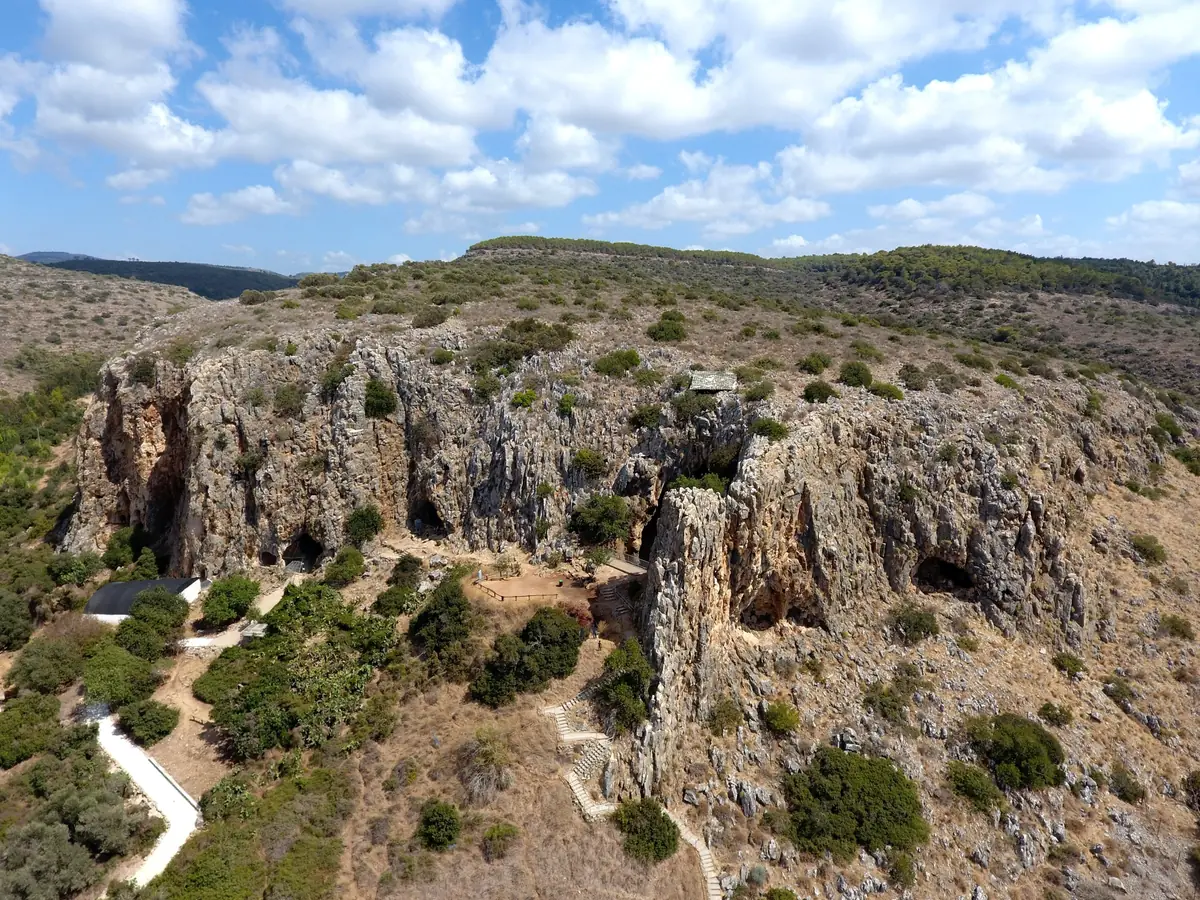
On the western slopes of the range, above the coastal plain, four caves in a cliff face — Tabun, Jamal, el-Wad and Skhul — make up the Nahal Me'arot Nature Reserve (Wadi el-Mughara, "the valley of the caves"). Excavated from 1929 by the British prehistorian Dorothy Garrod, they have yielded a sequence of occupation spanning some 500,000 years: Lower Palaeolithic tools, remains of Neanderthals (Tabun) and of early Homo sapiens (Skhul), then settlements and burials of the Natufian culture (el-Wad), around 15,000 to 11,500 years ago, at the dawn of sedentary life. Since 2012 the site has been inscribed on the UNESCO World Heritage List as "Sites of Human Evolution at Mount Carmel".
Carmel seems to have been regarded as sacred long before and long after Elijah. Some scholars recognise the promontory in a "holy headland" named in the lists of Pharaoh Thutmose III (15th century BC), an identification that is still debated. In Roman times the historian Tacitus reports that the future emperor Vespasian consulted an oracle on Carmel, at an altar with neither temple nor statue (Histories II, 78).
In the 12th century, in the Crusader period, Latin hermits settled in the caves of the north-western slopes "in imitation of the prophet Elijah". In the early 13th century (between 1206 and 1214) they received a rule of life from Albert, the Latin Patriarch of Jerusalem: this was the founding act of the Carmelite order (the Carmelite friars and, later, the Carmelite nuns). Driven out after the fall of Acre in 1291, they spread across Europe; Teresa of Ávila and John of the Cross reformed the order in the 16th century. Devotion to Our Lady of Mount Carmel, celebrated on 16 July, comes from here, as does the scapular, which Carmelite tradition links to a vision of Saint Simon Stock in the 13th century, whose historicity is debated.
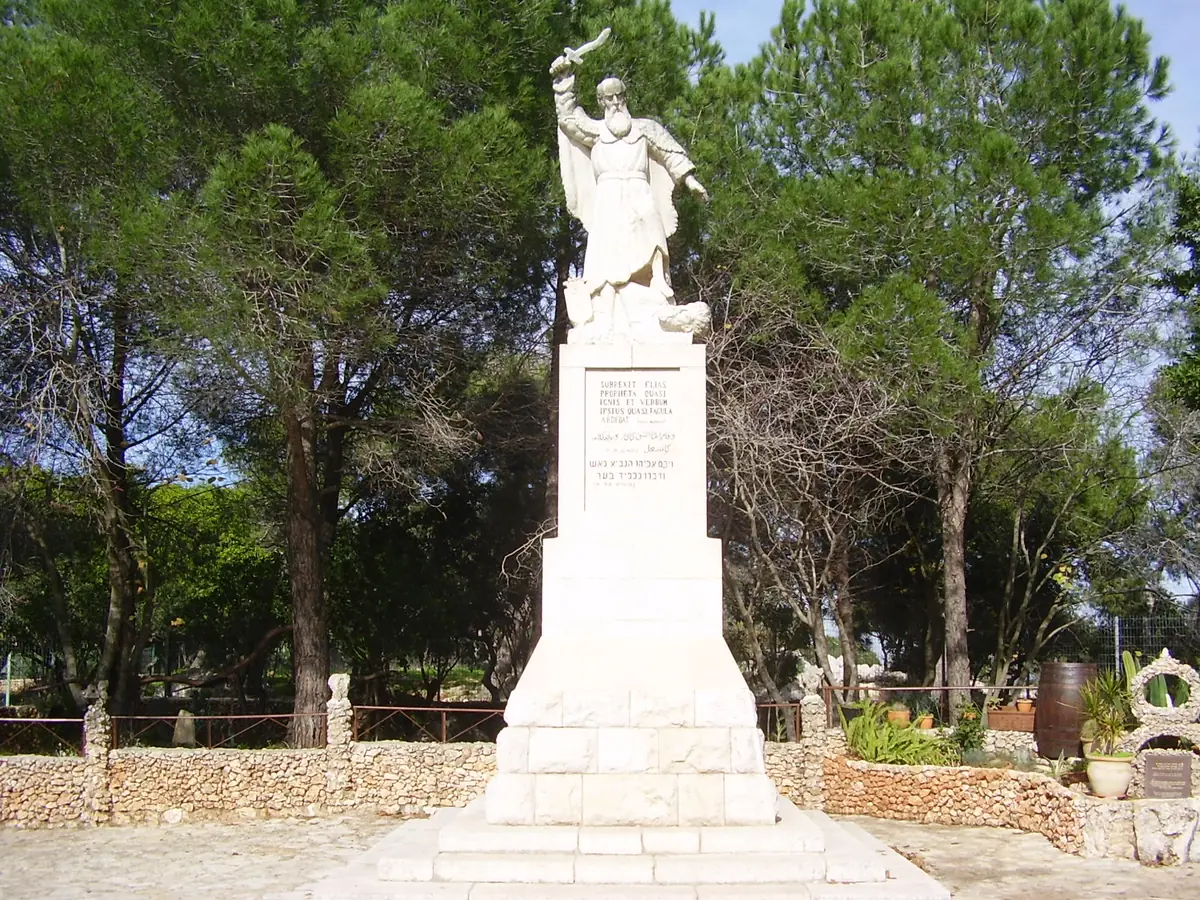
The small monastery of the Discalced Carmelites at Muhraqa stands at the end of a forest road, a few kilometres south of the Druze town of Daliyat al-Karmel. In the garden, a large statue of Elijah, sword raised, stands over a prophet of Baal; its base carries a verse from Ben Sira, in Latin, Arabic and Hebrew, about the prophet who "arose like fire" (Sirach 48:1). The simple chapel has an altar of twelve stones recalling the one in the story (1 Kings 18:31). The highlight of the visit is the roof terrace.
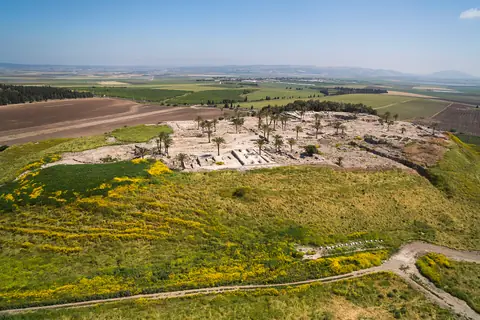 Jezreel Valley, GalileeTel Megiddo: a Canaanite city in the time of JoshuaA Canaanite city the Bible says was defeated but never dispossessed: four thousand years of history at the crossroads of Egypt and Mesopotamia.View site →
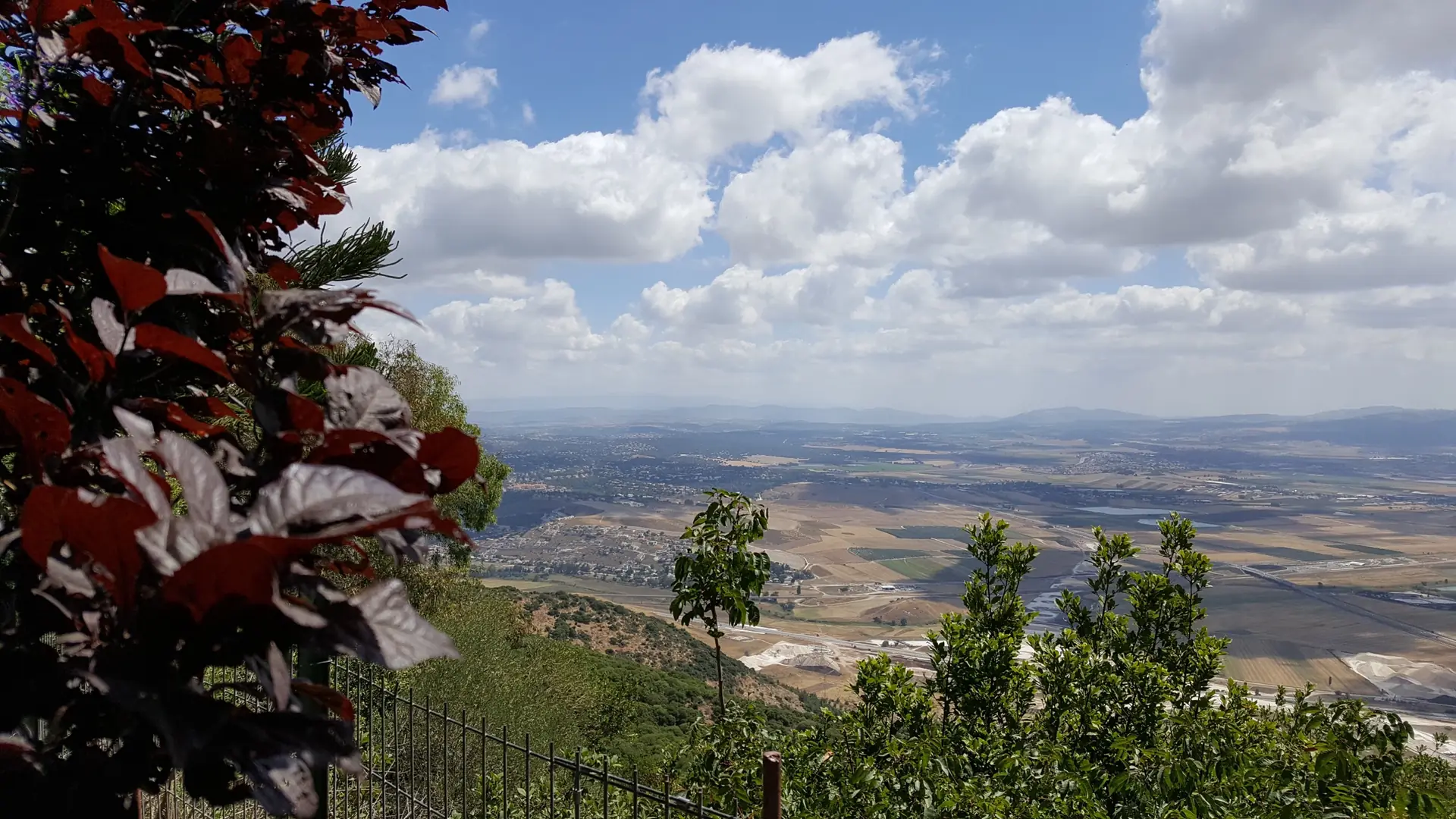
From the roof, the view takes in the whole Jezreel Valley: the course of the Kishon at the foot of the slope, the mound of Megiddo to the south-east, Mount Gilboa, Mount Tabor and the hills of Nazareth to the north-east, and on clear days the sea to the west and even Mount Hermon in the distance.
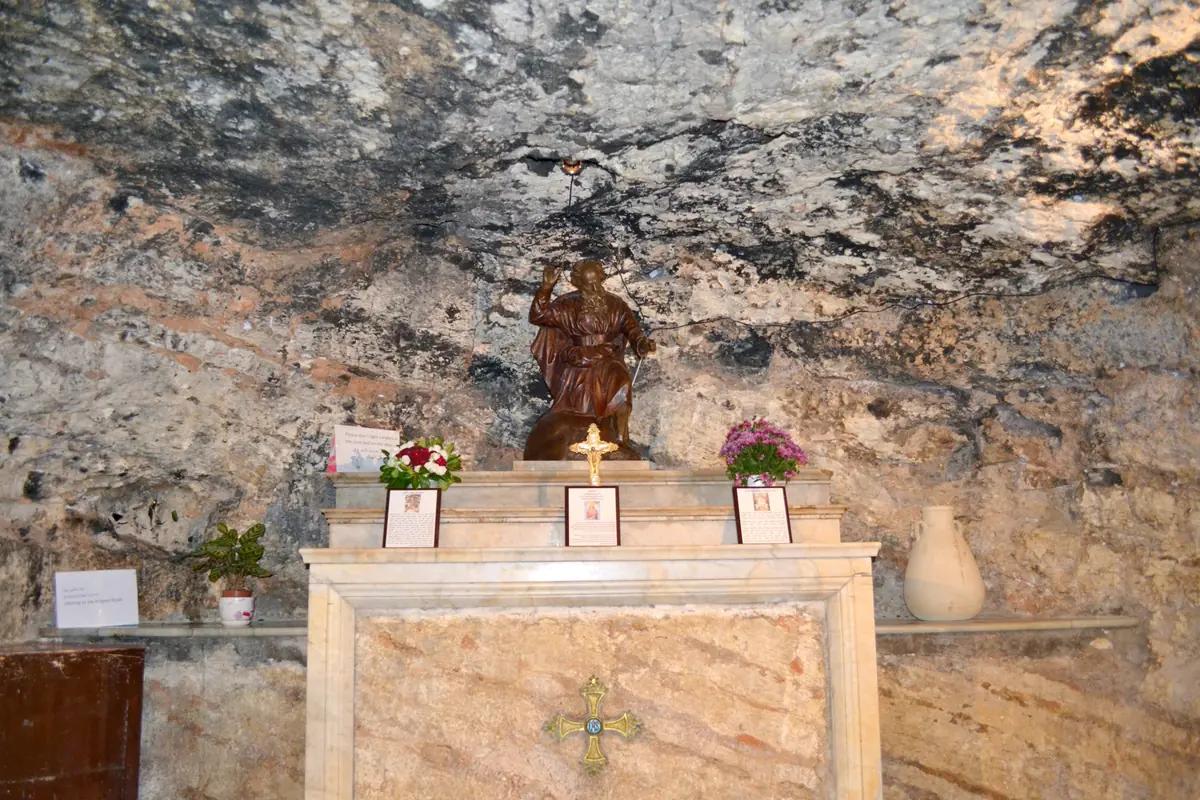
At the other end of the range, on the headland above Haifa, the Stella Maris monastery ("Star of the Sea", a title of the Virgin Mary) is the mother house of the Discalced Carmelites. The present church, opened in 1836, replaced a monastery damaged in 1799, when Napoleon had his wounded from the siege of Acre cared for there, and destroyed in 1821. Beneath the high altar, a grotto is venerated as Elijah's. Further down the slope, on Allenby Road, another Elijah's Cave, arranged as a Jewish place of prayer with separate sections for men and women, also draws Christian, Muslim and Druze pilgrims, many of whom identify Elijah with al-Khidr.
Most of the range lies within Mount Carmel National Park, Israel's largest, recognised by UNESCO as a biosphere reserve in 1996. Marked trails, pine and oak woodland, the Hai-Bar reserve (fallow deer, roe deer) and, to the south, the Nahal Me'arot caves make for a fine day outdoors. The range still bears the scars of the December 2010 fire, which killed 44 people; a memorial honours them. On the coast, Caesarea Maritima is only about thirty kilometres to the south.
Mount Carmel, Elijah's Mountain: Muhraqa, Haifa and Visiting
Muhraqa monastery (Keren HaCarmel), south of Daliyat al-Karmel, about 30 km south-east of Haifa; Stella Maris and Elijah's Cave: Haifa, Carmel headland
GPS coordinates : 32.6726, 35.0881
Start navigation with:
A Canaanite city the Bible says was defeated but never dispossessed: four thousand years of history at the crossroads of Egypt and Mesopotamia.
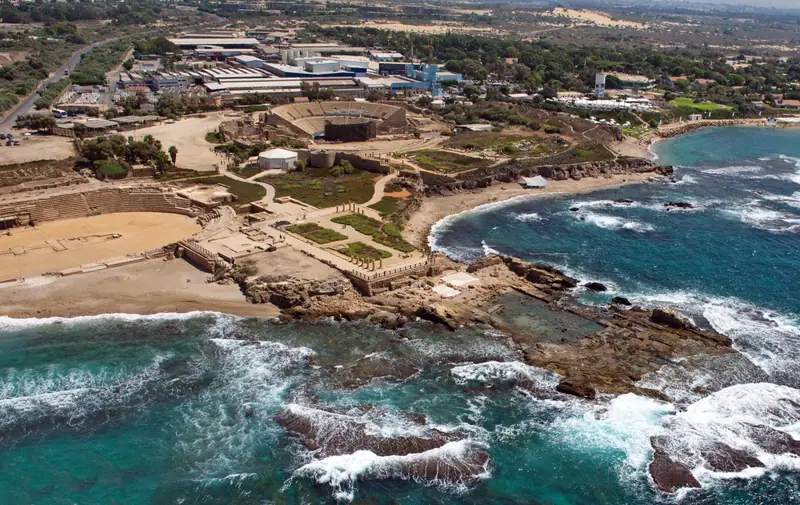
Herod's great harbour and the seat of the Roman governors, where Peter baptised Cornelius and Paul was held for two years: an archaeological park on the Mediterranean shore.
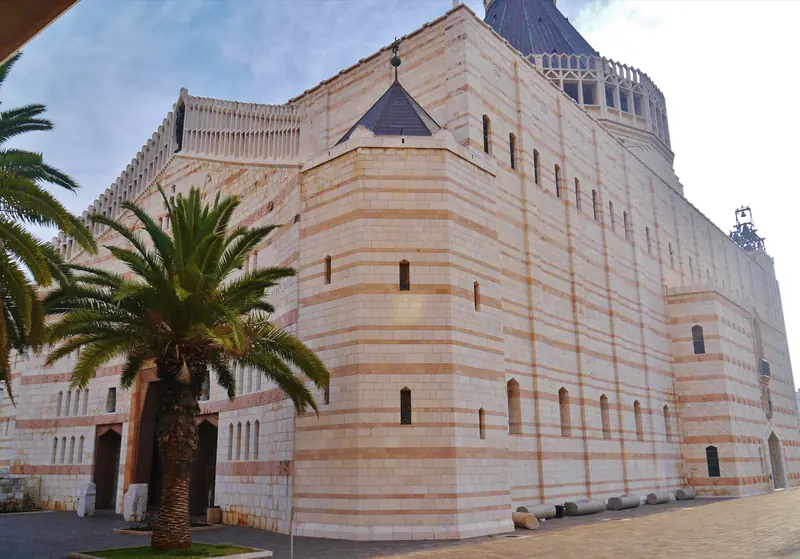
The Galilean village where the Gospels place the Annunciation and the childhood of Jesus, today Israel's largest Arab city: shrines, excavations and visiting tips.
From Genesis 14 to the "House of David" stele: archaeology, nature and biblical history at the springs of the Jordan.
According to 1 Kings 18, the prophet Elijah gathered the people of Israel there and challenged the 450 prophets of Baal: each side prepared a sacrifice, and only the God of Israel answered, sending fire from heaven. Elijah then had the prophets of Baal killed at the brook Kishon and announced the end of the drought when he saw a little cloud "like a man's hand" rising from the sea.
The Bible only says "mount Carmel". Tradition places the sacrifice at Muhraqa, on the south-eastern spur of the range, above the Jezreel Valley and the Kishon, where the Carmelites built a monastery in the 19th century. No archaeological remains confirm the exact spot.
Mount Carmel is in Israel, in the north of the country. The range stretches for about forty kilometres, from Haifa, where it meets the Mediterranean, to the edge of Yokneam and the Jezreel Valley in the south-east. Its highest point is just over 500 m.
The Hebrew word <em>karmel</em> means an orchard or planted garden, a fertile land. It is sometimes explained as <em>kerem El</em>, "vineyard of God", but that etymology is less certain. In Arabic the range is also called Jabal Mar Elyas, "the mountain of Saint Elijah".
The title comes from the Latin hermits who settled on Mount Carmel in the 12th century, received a rule around 1206-1214 and dedicated their chapel to the Virgin Mary: these are the origins of the Carmelite order. Our Lady of Mount Carmel is celebrated on 16 July; tradition links the scapular to a vision of Saint Simon Stock.
The Muhraqa monastery, with its statue of Elijah and the view over the Jezreel Valley from the roof; in Haifa, the Stella Maris monastery and Elijah's Cave; the prehistoric caves of Nahal Me'arot (UNESCO) and the trails of Mount Carmel National Park.
The Tabun, Jamal, el-Wad and Skhul caves, in the Nahal Me'arot reserve, bear witness to some 500,000 years of human evolution: Neanderthals, early <em>Homo sapiens</em> and the Natufian culture. Excavated by Dorothy Garrod from 1929, they have been a UNESCO World Heritage Site since 2012.