
Jaffa, Ancient Joppa: the Port of Jonah and Peter
From Lebanese cedars landed for the Temple to Peter's vision on the roof of Simon the Tanner: four thousand years of history on a hill above the Mediterranean.
AD 30 – 70
Herod's great harbour and the seat of the Roman governors, where Peter baptised Cornelius and Paul was held for two years: an archaeological park on the Mediterranean shore.
Credit: Abraham Graicer · CC BY-SA 4.0 · Wikimedia Commons
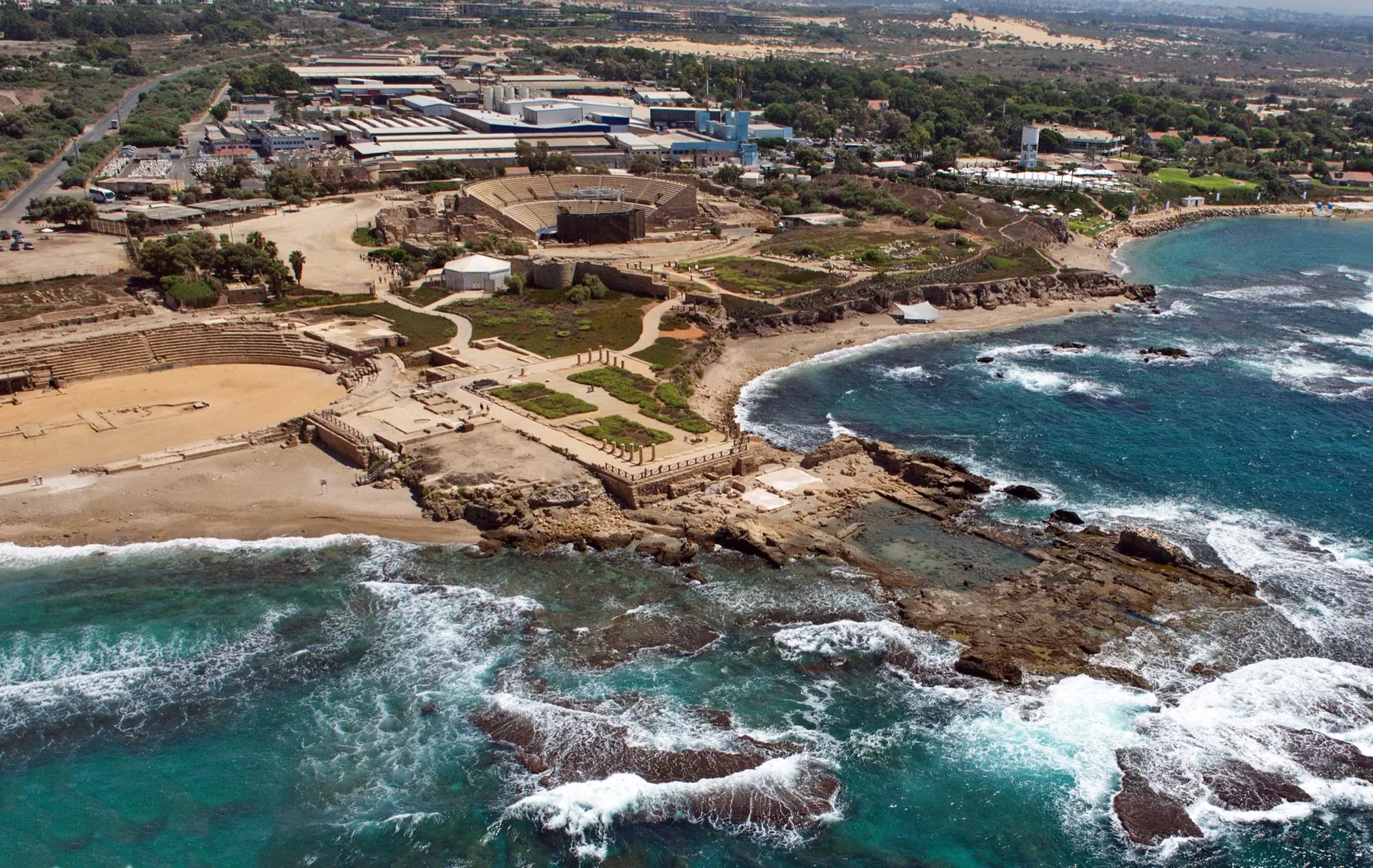
On the Mediterranean coast, halfway between Tel Aviv and Haifa, Caesarea is one of the most spectacular cities founded by Herod the Great. Built around 22–10 BC on the old Phoenician anchorage of Straton's Tower and dedicated to the emperor Augustus (Caesar), Caesarea Maritima had an artificial harbour called Sebastos, a theatre, a palace on a promontory and a hippodrome beside the waves. It later became the capital of the Roman governors of Judaea.
It is also a major place of Caesarea in the Bible: the Acts of the Apostles set here Peter's baptism of the centurion Cornelius, the house of Philip the evangelist and Paul's two years in custody. In 1961 excavations in the theatre brought to light the famous Pilate Stone. Today Caesarea National Park and the aqueduct on the beach are among the most visited ancient sites in Israel.
Caesarea appears only in the New Testament: the city did not exist in Old Testament times. The Acts of the Apostles mention it some fifteen times and present it as the gateway through which the Christian message opens to non-Jews and travels on to Rome. For the wider context of this period, see the Apostles and the early Church.
After baptising the Ethiopian eunuch on the road to Gaza, Philip, one of the seven deacons, preaches in the coastal towns: "passing through he preached in all the cities, till he came to Cesarea" (Acts 8:40). He seems to have settled there: years later Paul and his companions stay in his house. "The same man had four daughters, virgins, which did prophesy" (Acts 21:8-9).
"There was a certain man in Cesarea called Cornelius, a centurion of the band called the Italian band, a devout man, and one that feared God with all his house."
Acts 10:1-2 (KJV)
Prompted by a vision, Cornelius sends for Peter in Jaffa, some sixty kilometres to the south. Peter, meanwhile, sees the vision of the sheet let down from heaven on the roof of Simon the tanner. In Caesarea he enters the house of a Gentile, something his tradition discouraged, and declares that "God is no respecter of persons" (Acts 10:34). The Holy Spirit falls on the listeners and Peter has Cornelius and his household baptised (Acts 10:44-48). For Acts this is the first baptism of an uncircumcised Gentile, a turning point taken up again at the Council of Jerusalem (Acts 15:7-11).
Herod Agrippa I, grandson of Herod the Great and king of Judaea from 41 to 44, goes down to Caesarea after Peter's escape (Acts 12:19). Addressing the envoys of Tyre and Sidon in his royal robes, he is hailed as a god; "immediately the angel of the Lord smote him […] and he was eaten of worms, and gave up the ghost" (Acts 12:21-23). The historian Josephus describes the same sudden death at Caesarea, during games held in the theatre in honour of the emperor (Jewish Antiquities 19.343-350): two independent sources for one event.
Paul passes through the port several times (Acts 9:30; 18:22). Arrested at the Temple in Jerusalem around AD 57, he is taken by night under heavy escort to the governor Felix at Caesarea, who orders him "to be kept in Herod's judgment hall" (Acts 23:35), the praetorium. "After two years" he is still there (Acts 24:27). He stands trial before Felix, then before his successor Porcius Festus, and finally before King Agrippa II and Bernice (Acts 25:23–26:32). Fearing he will be handed over to his opponents, he invokes his Roman citizenship:
"I appeal unto Cesar. Then Festus, when he had conferred with the council, answered, Hast thou appealed unto Cesar? unto Cesar shalt thou go."
Acts 25:11-12 (KJV)
From Caesarea Paul sails for Rome, on a voyage that ends in shipwreck on Malta (Acts 27).
Before Herod, the site was only a small Phoenician anchorage, Straton's Tower, founded around the 4th century BC. Rome granted it to Herod in 30 BC, and the king launched one of the largest building projects of his reign, described by Josephus (Jewish War 1.408-415; Jewish Antiquities 15.331-341): a grid-planned city, a temple to Rome and Augustus overlooking the harbour, a theatre, a palace and an "amphitheatre" for races and games. The city was inaugurated around 10–9 BC.
With no natural bay, Herod's engineers built two great breakwaters in the open sea, enclosing a basin of about ten hectares: one of the largest artificial harbours of its day. They used hydraulic concrete made with pozzolana, a volcanic ash imported from the Bay of Naples, poured into submerged wooden forms. Weakened by ground movement and possibly a tsunami, the harbour silted up and was unusable by the end of Antiquity; its foundations can now be explored by divers.
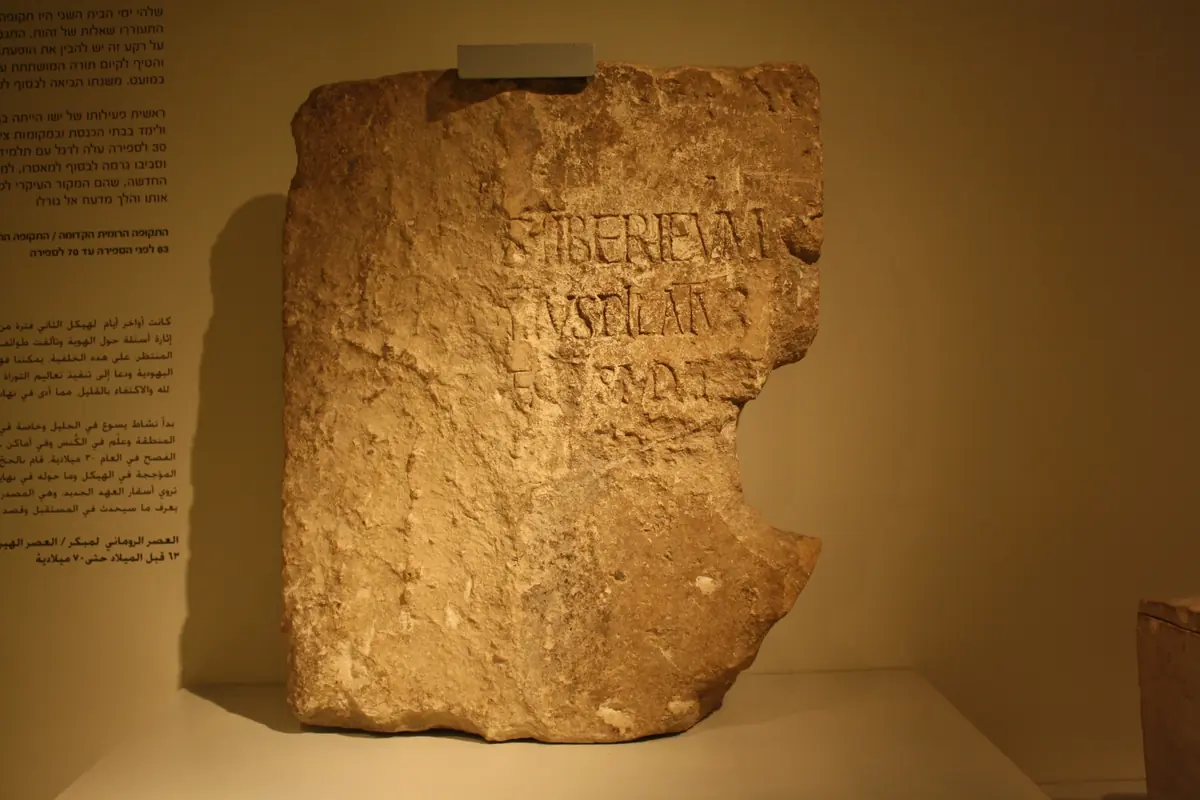
In June 1961 the Italian archaeological mission led by Antonio Frova, which was clearing the theatre, uncovered a limestone block of about 82 × 65 cm, reused in a staircase in the 4th century. It bears a damaged Latin dedication that includes TIBERIEVM, [PONTI]VS PILATVS and [PRAEF]ECTVS IVDA[EA]E: Pontius Pilate, prefect of Judaea, dedicated a building in honour of the emperor Tiberius (a "Tiberieum", whose exact nature is still debated). It is the only known contemporary inscription bearing the name of the governor who, according to the Gospels, had Jesus crucified. It also shows that his official title was "prefect", whereas Tacitus calls him "procurator". The original is in the Israel Museum in Jerusalem; a replica stands on site.
On the rocky point south of the theatre, excavations by Ehud Netzer (Hebrew University) from 1976, followed in the 1990s by Kathryn Gleason and Barbara Burrell and by Yosef Porath (Israel Antiquities Authority), revealed a two-level Herodian palace: below, living quarters around a large rock-cut pool facing the sea; above, a courtyard and reception halls. Many scholars see it as Herod's palace that later became the residence of the Roman governors, in other words the "judgment hall" (praetorium) of Herod where Paul was held (Acts 23:35). The identification is plausible, but no remains can be linked directly to his detention.
The sunken harbour has been explored since the 1980s by an underwater archaeology team led by Avner Raban (University of Haifa) and Robert Hohlfelder, who documented the Roman building techniques. Other projects, notably the Joint Expedition to Caesarea Maritima in the 1970s, excavated the lower city and its quarters. In 2019 a major programme funded by the Edmond de Rothschild Foundation, with the Israel Antiquities Authority, the Caesarea Development Corporation and the Nature and Parks Authority, restored the vaults beneath the podium of the temple of Augustus, which now house a new visitor centre.
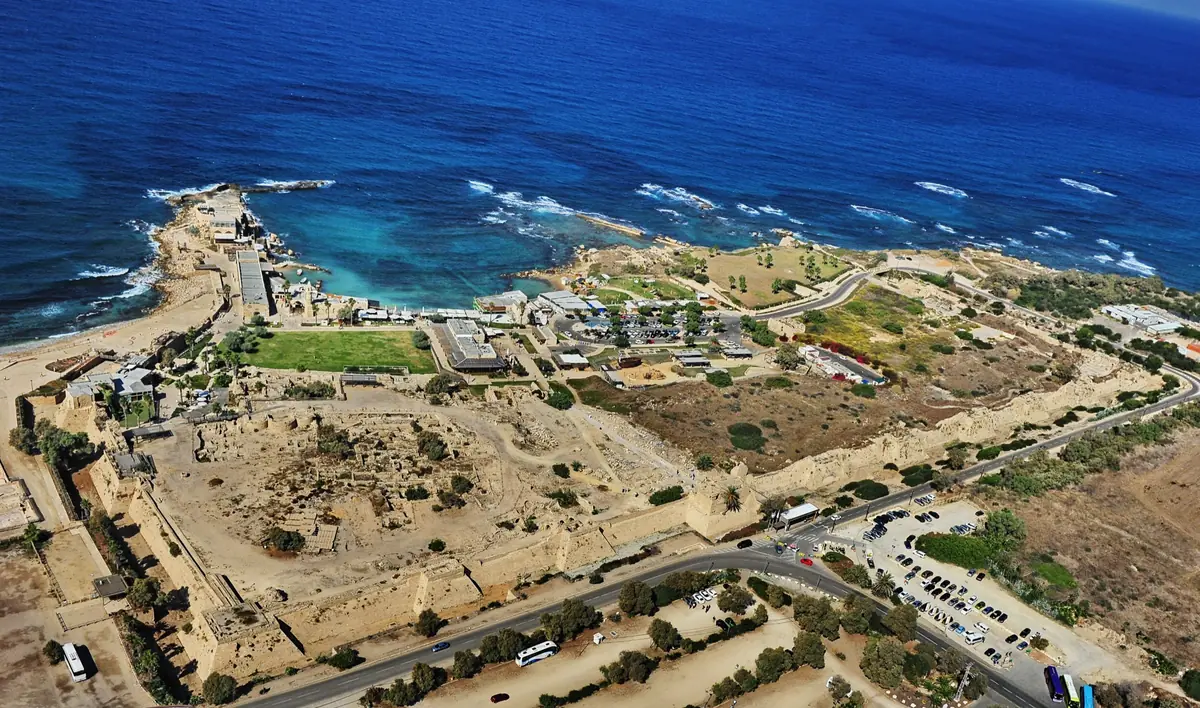
The national park stretches along the sea for more than a kilometre. A good route starts in the south at the theatre and heads north to the harbour and the Crusader town.
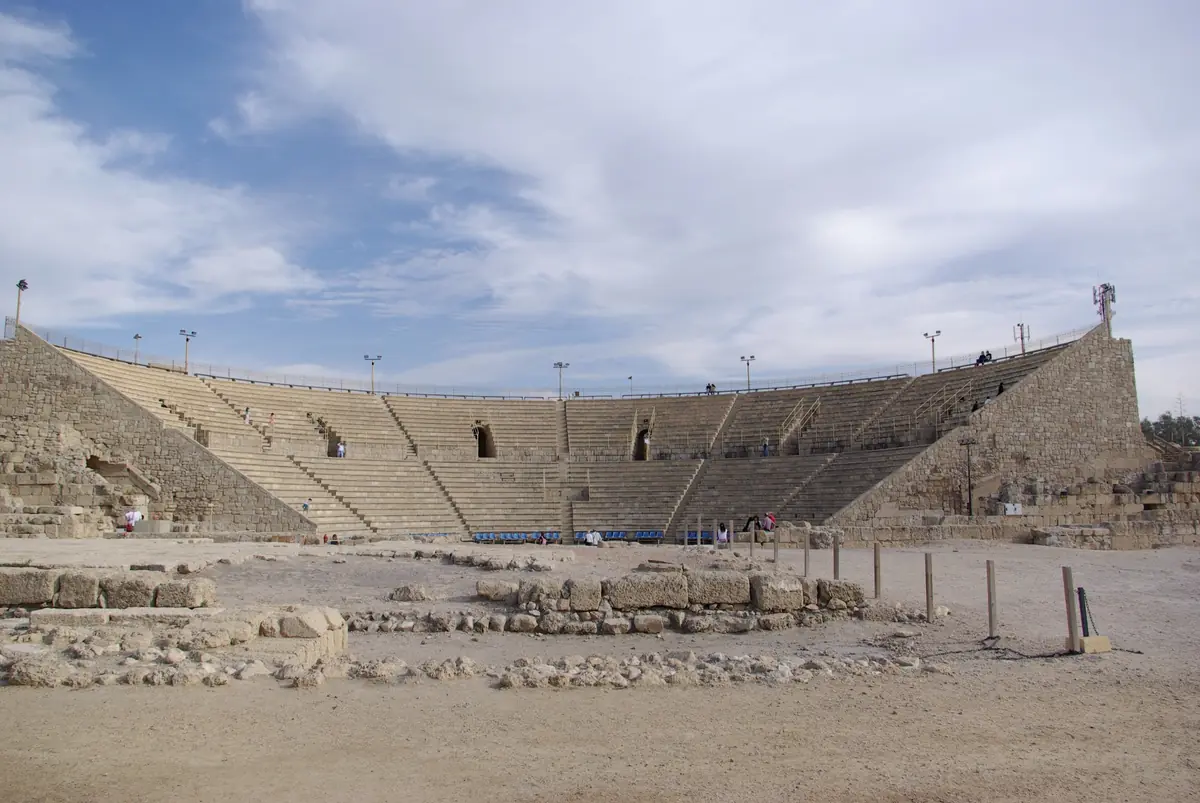
Built by Herod and later enlarged in the Roman period, the theatre faces the sea. Much of its seating was restored after the Italian excavations of the 1960s, and it is once again used for concerts. The replica of the Pilate Stone stands nearby.
Just to the north you walk across the floors of Herod's palace, around the rock-cut pool washed by the waves. Beside it runs the Herodian hippodrome, a track nearly 300 m long lined with seating, used for chariot races and shows; Josephus calls it an "amphitheatre".
Further north, the restored vaults of the temple podium house the visitor centre (finds from the excavations and a film on the building of the city). You then pass through the Crusader walls of Louis IX, with their sloping glacis and moat, to reach the old harbour, now lined with restaurants and galleries.
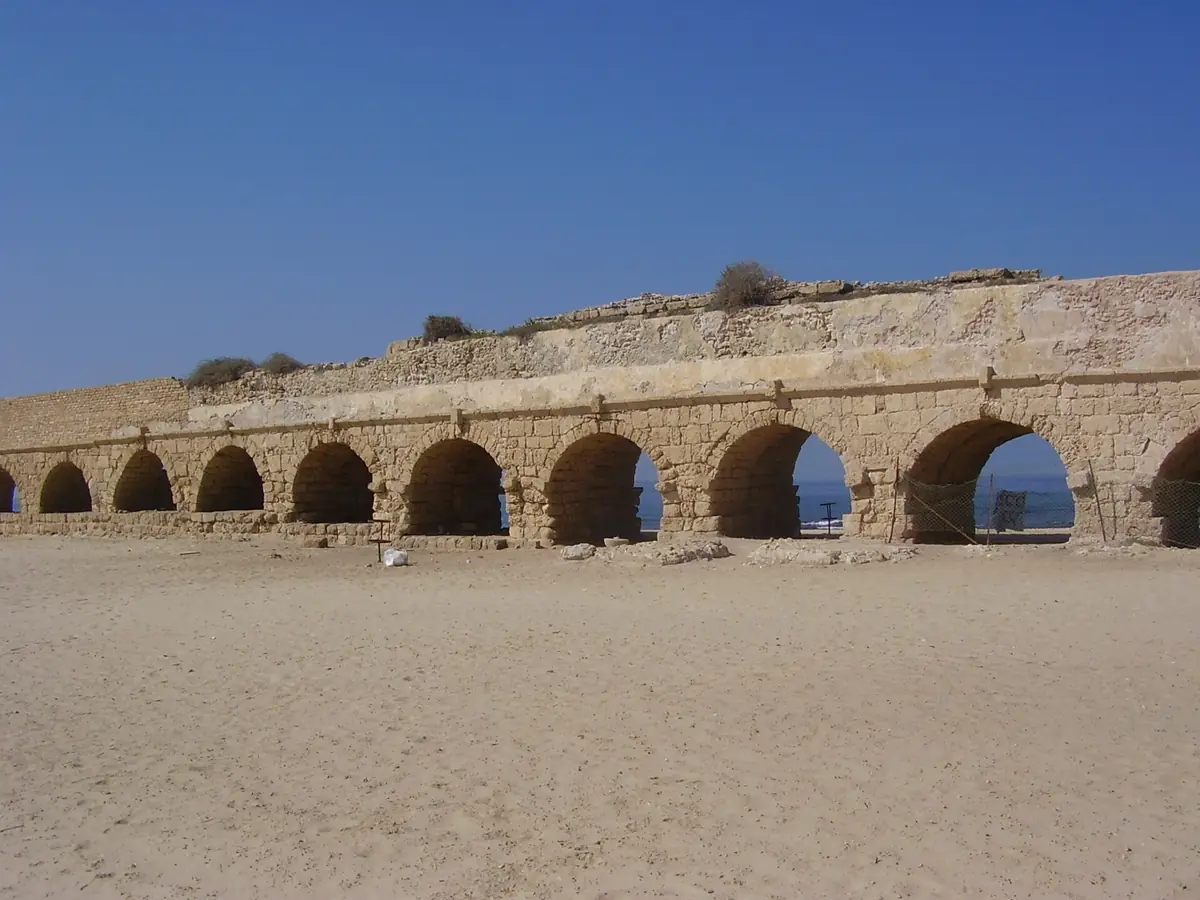
North of the park, outside its walls, the Caesarea aqueduct runs along the dunes beside a public beach. This high-level aqueduct brought water from springs at the foot of Mount Carmel. Long attributed to Herod, it went through several phases: a first channel in the 1st century AD, doubled under Hadrian, as shown by inscriptions left by the Roman legions who worked on it. Offshore, the Caesarea marine national park protects the submerged remains of the harbour.
The New Testament mentions two different places called Caesarea, some 150 km apart:
When Acts simply says "Caesarea", it always means the coastal city. The modern town of Caesarea, east of the park, was developed in the 20th century with the support of the Rothschild family.
Caesarea Maritima, Herod's city: theatre, aqueduct and visit
Caesarea National Park, Caesarea, on the Mediterranean coast, about 55 km north of Tel Aviv and 40 km south of Haifa
GPS coordinates : 32.5003, 34.8918
Start navigation with:
From Lebanese cedars landed for the Temple to Peter's vision on the roof of Simon the Tanner: four thousand years of history on a hill above the Mediterranean.
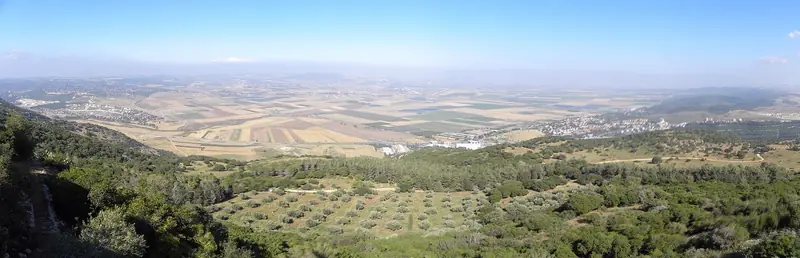
Fire from heaven, a little cloud rising from the sea and the hermits who gave their name to the Carmelite order: a mountain overlooking the Jezreel Valley and Haifa Bay.
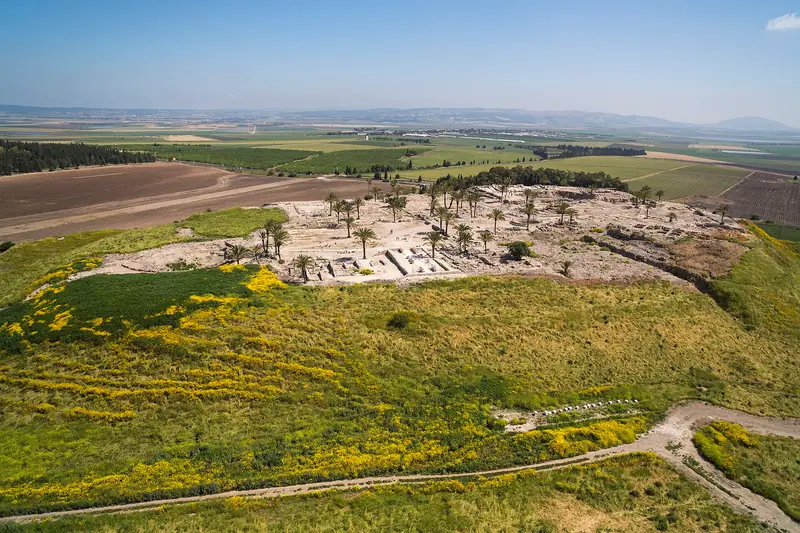
A Canaanite city the Bible says was defeated but never dispossessed: four thousand years of history at the crossroads of Egypt and Mesopotamia.
Caesarea Maritima lies on Israel's Mediterranean coast, between Tel Aviv (about 55 km to the south) and Haifa (about 40 km to the north), next to the modern town of Caesarea. The ancient remains form Caesarea National Park.
Caesarea appears in the Acts of the Apostles: Philip the evangelist lives there (Acts 8:40; 21:8), Peter baptises the centurion Cornelius (Acts 10), Herod Agrippa I dies there (Acts 12:19-23) and Paul is held for two years before appealing to Caesar (Acts 23–26).
They are two separate cities. Caesarea Maritima, on the coast, is Herod's port and the city of the Acts of the Apostles. Caesarea Philippi (Banias), at the foot of Mount Hermon, is where Peter's confession takes place in the Gospels (Matthew 16:13-20).
A limestone block found in 1961 in the theatre of Caesarea by Antonio Frova's Italian mission. Its Latin inscription names Pontius Pilate, prefect of Judaea: it is the only known inscription from his time bearing his name. The original is in the Israel Museum in Jerusalem; a replica is displayed on site.
In the national park: the Roman theatre, the promontory palace, the Herodian hippodrome, the vaults of the temple of Augustus with the visitor centre, the Crusader walls and the old harbour. North of the park, the aqueduct on the beach.
By car, allow about 45 minutes to an hour on Route 2 (Caesarea exit). By public transport, take the train to Binyamina or Caesarea–Pardes Hanna, then an infrequent bus or a taxi.
It was long attributed to Herod. Recent research dates the first channel of the high-level aqueduct to the 1st century AD and its doubling to the reign of Hadrian (2nd century), as Roman legion inscriptions show.
Allow two to three hours for the national park, plus some time for the aqueduct. Caesarea combines easily in one day with Jaffa, Mount Carmel or Megiddo.