
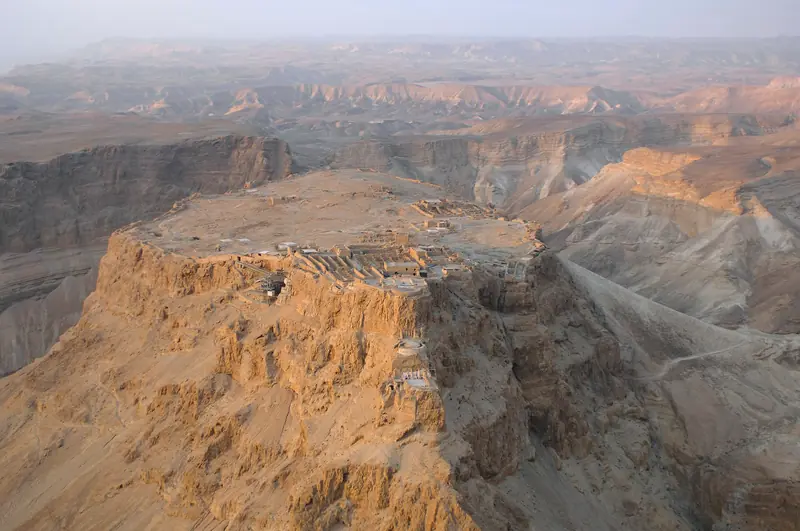
Masada, Herod's fortress above the Dead Sea
A palace hanging on the edge of the desert, the last stronghold of the Jewish revolt against Rome, and a famous story that archaeology illuminates without settling every question.
1200–586 BCE
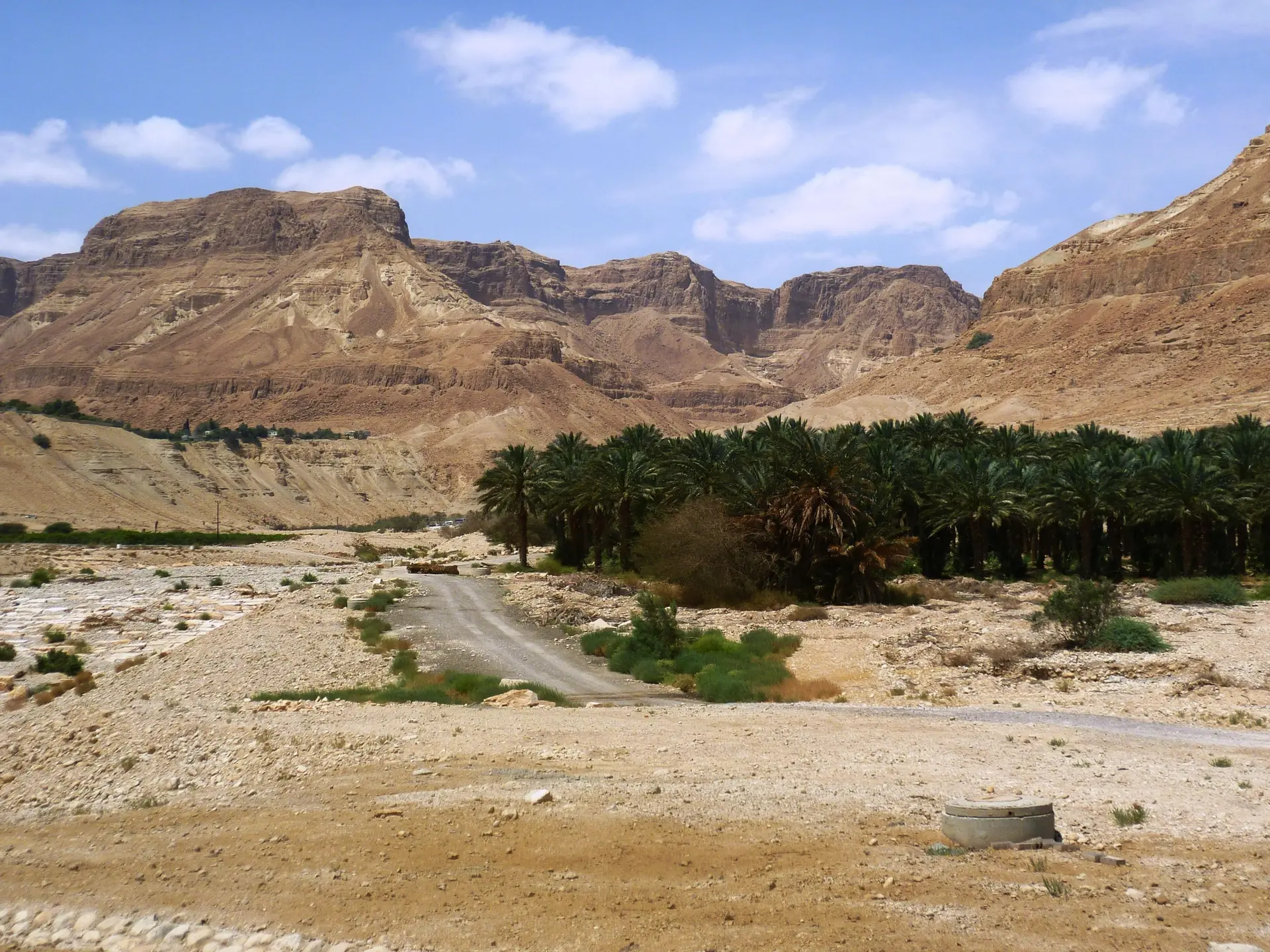
Springs at the foot of the Judean Desert cliffs: David's refuge from Saul, the "vineyards of En-gedi" in the Song of Songs, a 5,500-year-old temple and a synagogue that curses anyone who betrays "the secret of the town".
Credit: Radosław Botev · CC BY 3.0 PL · Wikimedia Commons
On the western shore of the Dead Sea, where springs burst out at the foot of the Judean Desert cliffs, Ein Gedi (the En-gedi of English Bibles) is one of the best-known oases in the Bible. Its Hebrew name means "spring of the young goat"; readers of the Latin Vulgate know it as Engaddi. It was in the "wilderness of En-gedi" that young David, hunted by King Saul, hid with his men, and in a cave nearby that he quietly cut off the skirt of Saul's robe instead of killing him (1 Samuel 24).
Today Ein Gedi combines a kibbutz, the Ein Gedi Nature Reserve run by the Israel Nature and Parks Authority (INPA), with Nahal David and its waterfall, Nahal Arugot, ibex and rock hyraxes, and an antiquities park where you can visit the Ein Gedi synagogue and its famous inscription. This page separates what the biblical text says, what excavation has shown and what you can see on site.
The story belongs to the age of the Judges and the first kings. David, who had defeated Goliath and married Saul's daughter, has had to flee the court: the king sees him as a rival. Pursued from one hiding place to the next in the wilderness of Judah (1 Samuel 22-23), he reaches the Dead Sea shore.
"And David went up from thence, and dwelt in strong holds at En-gedi."
1 Samuel 23:29 (KJV; 24:1 in Hebrew Bibles)
Hearing of it, Saul takes three thousand chosen men and seeks David "upon the rocks of the wild goats" (1 Samuel 24:2). The Hebrew word is ya'el, the Nubian ibex, which you still meet on the slopes of the reserve today. The setting of the story, with its cliffs, sheepfolds and caves, fits the Ein Gedi landscape well.
Saul goes alone into a cave "to cover his feet", a biblical euphemism for relieving himself, unaware that David and his men are hiding at the back. David's companions see the day when God has delivered the enemy into their hands.
"And the men of David said unto him, Behold the day of which the Lord said unto thee, Behold, I will deliver thine enemy into thine hand, that thou mayest do to him as it shall seem good unto thee. Then David arose, and cut off the skirt of Saul's robe privily."
1 Samuel 24:4 (KJV)
David immediately regrets it and holds back his men: he will not raise his hand against "the Lord's anointed" (24:6). Outside the cave he shows Saul the piece of cloth, proof that he could have killed him. The king weeps and admits: "I know well that thou shalt surely be king, and that the kingdom of Israel shall be established in thine hand" (24:20). The two men part, and David and his men go up "unto the hold" (24:22).
🔎 Which cave?
The text gives no precise landmark, and the Ein Gedi cliffs are full of caves. No cave has been identified archaeologically as the one in the story. Guides sometimes point to a cavity near the springs: that is an evocation, not an identification. Nor is there any basis for equating the "strong holds" with the fortress of Masada, further south.
Declared a nature reserve at the end of 1971, the Ein Gedi reserve covers about 14,000 dunams (1,400 hectares) between the Judean Desert plateau and the Dead Sea. Four perennial springs (David, Shulamit, Ein Gedi and Arugot) feed two canyons, Nahal David (Wadi David) and Nahal Arugot (Wadi Arugot), where acacia, Christ's thorn jujube, Euphrates poplar and Sodom apple grow.
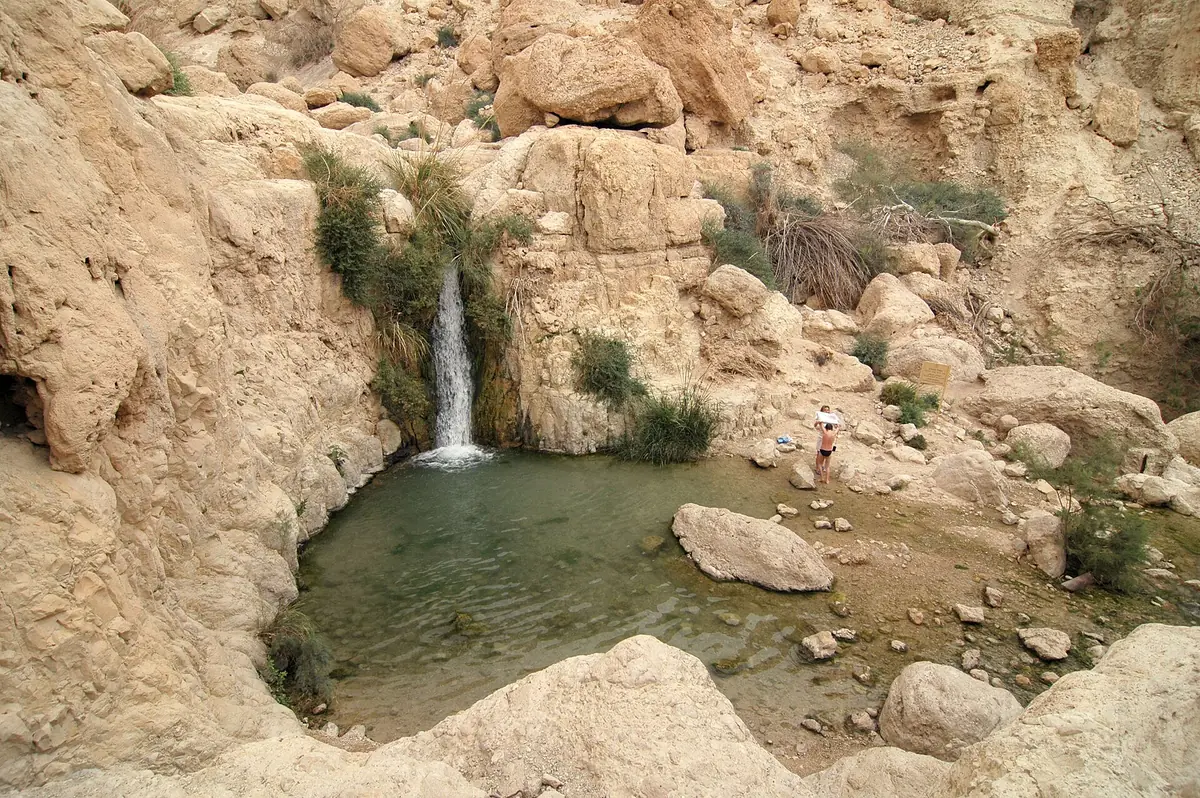
This is the best-known route: a trail climbs the canyon from pool to pool to David's Waterfall. A wheelchair-accessible section leads to the first pool. Higher up, more demanding trails reach the Shulamit spring, the so-called Lovers' Cave (Dodim), the Ein Gedi spring and the Chalcolithic temple. The stream's name recalls 1 Samuel 24; it is a modern name, not an established location.
Further south, Nahal Arugot is longer, wilder and more physical. Its trail follows a perennial stream between high walls towards pools and a so-called "hidden" waterfall. The INPA describes it as a route for fit hikers, with an earlier last-entry time than the rest of the reserve.
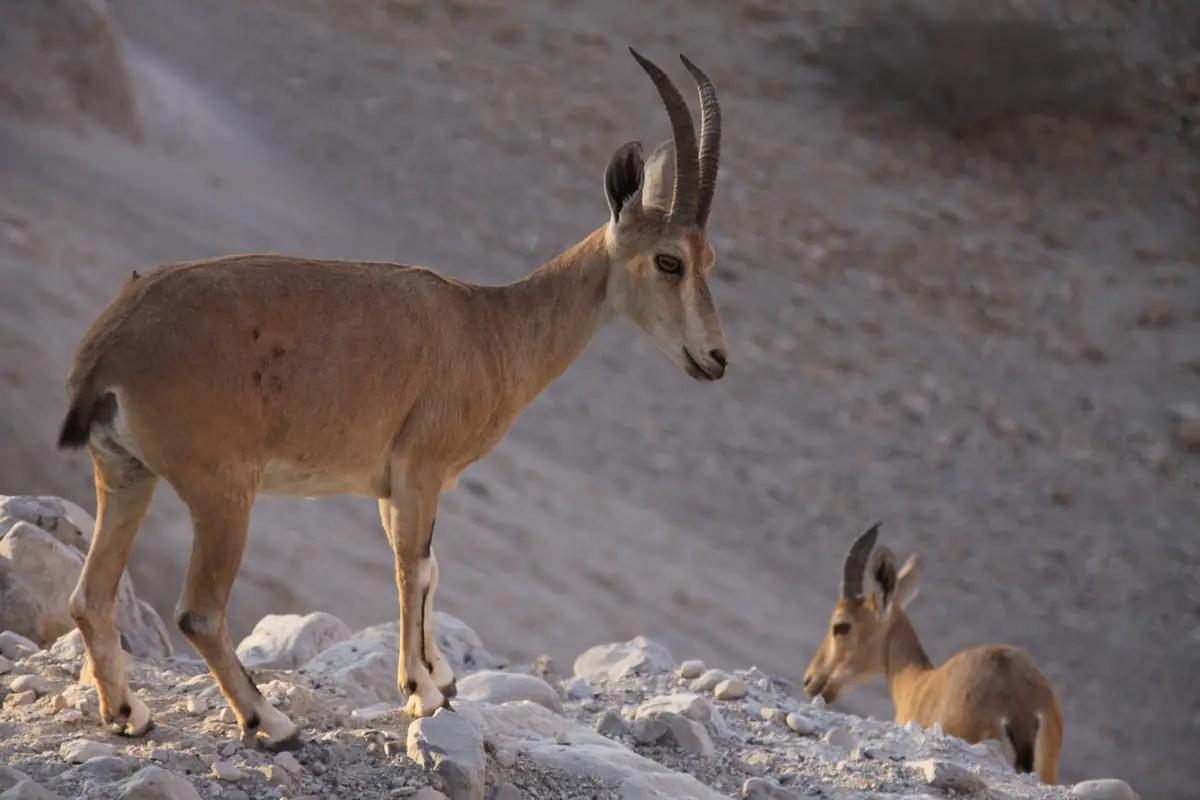
Nubian ibex roam the slopes and trail edges; rock hyraxes, small stocky mammals, bask on the boulders. Both already appear together in a single verse of the Bible:
"The high hills are a refuge for the wild goats; and the rocks for the conies."
Psalm 104:18 (KJV)
⚠️ After the May 2025 flood
On 4 May 2025 an exceptional flash flood devastated Nahal David and Nahal Arugot, sweeping away trails, stairs and footbridges. The routes reopened in stages. According to the INPA, quoted in the Israeli press on 24 September 2026, the last section still closed, lower Nahal David up to the waterfall, was due to reopen at the end of September 2026. The pools, filled with sediment, are now shallow, and bathing under David's Waterfall remains forbidden because of falling rocks. Check the day's conditions with the INPA before you go.
Plentiful water drew people here long before David. The excavations of the Hebrew University of Jerusalem and the Israel Exploration Society, directed by Benjamin Mazar from 1961 to 1965, and later those of Yizhar Hirschfeld on the Roman and Byzantine village (1996-2002), have traced more than five thousand years of history.
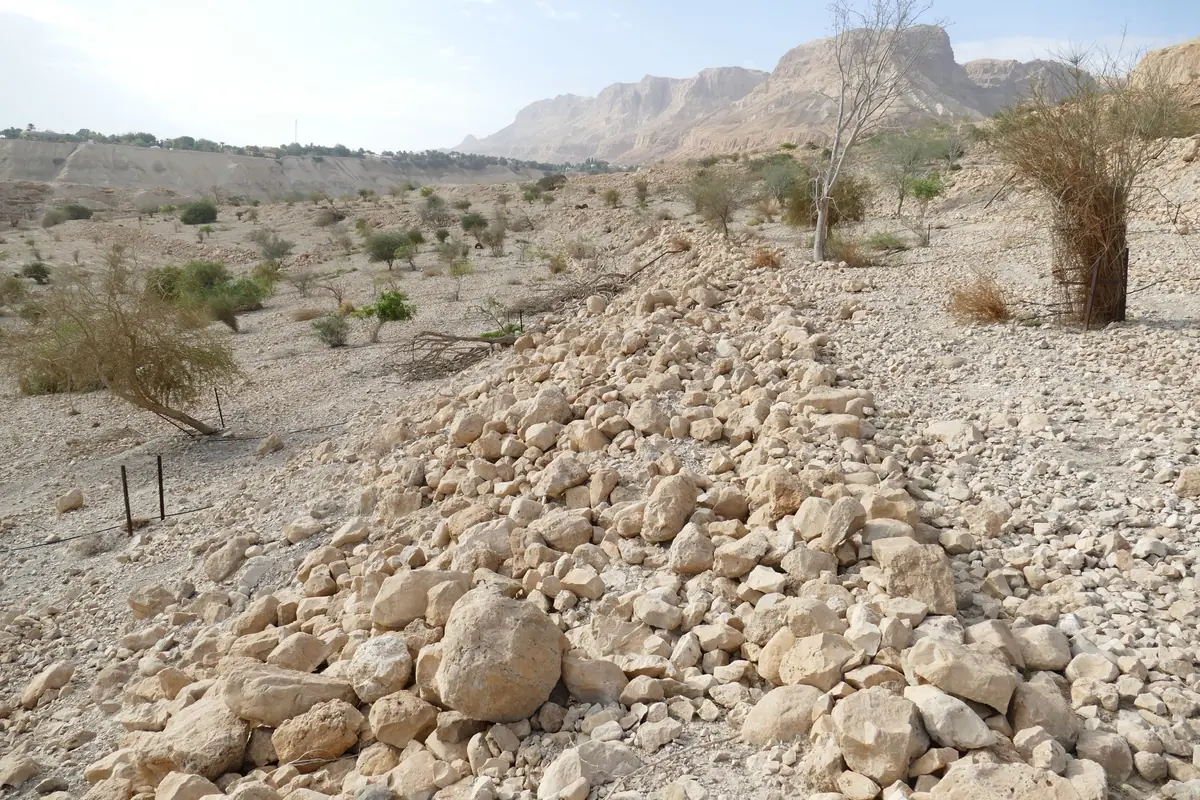
On a terrace above the Ein Gedi spring, a stone enclosure wall surrounds a courtyard, a long main building and a smaller annex. Spotted in 1956 by Yohanan Aharoni, sounded in 1957 by Joseph Naveh and excavated in 1962 under Mazar's direction, with David Ussishkin in the field, this Ghassulian building dates to about 3500 BC. No contemporary village has been found nearby: it probably served as a regional sanctuary for semi-nomadic groups. Ussishkin suggested linking it to the famous Nahal Mishmar copper hoard, found in 1961 in a cave further south; the idea is still debated.
The first known permanent village was built on Tel Goren, a mound near the springs, late in the monarchy: around the middle or second half of the 7th century BC (some evidence points to the late 8th century). Mazar found installations with jars and basins that he linked to a craft industry, perhaps the production of balsam perfume. No village remains go back to the time attributed to David. That does not contradict 1 Samuel, which describes a refuge in the wilderness, not a town.
Ein Gedi's wealth came from dates and above all from balsam, a shrub that yielded a very costly perfume and medicine, grown only in a few oases of the region such as Jericho.
Found by chance in the kibbutz fields in the 1960s, the Ein Gedi synagogue was excavated in the early 1970s by Dan Barag, Yosef Porat and Ehud Netzer. First built as a modest hall in the 3rd century, it was enlarged several times, with a niche for the Torah ark and rows of pillars. It was destroyed by fire: in the 6th century according to several authors, perhaps under Justinian, or in the early 7th century according to others.
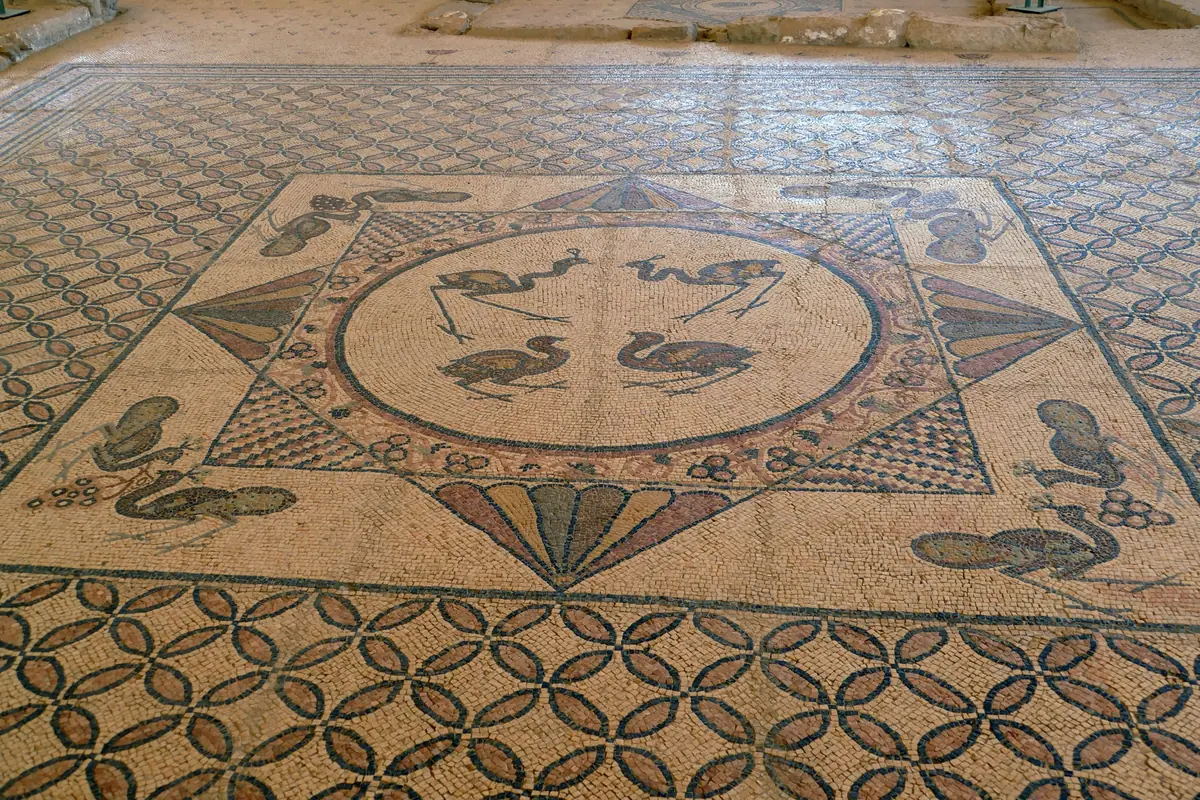
The prayer hall floor is covered by a geometric mosaic. At its centre a medallion shows four birds, with peacocks and other birds in the corners. There are no human figures, unlike some other synagogues of the same period.
In the western aisle, a long panel in Hebrew and Aramaic opens with a list: the ancestors of humanity from Adam to Japheth, the signs of the zodiac, the twelve months, Abraham, Isaac and Jacob, then Hananiah, Mishael and Azariah, Daniel's three companions. Other lines thank donors. A final section contains a curse unique in ancient Jewish epigraphy. It targets anyone who causes a quarrel between a man and his neighbour, slanders his friend to the gentiles, steals his friend's property or reveals "the secret of the town":
"He whose eyes range over the whole earth and who sees what is hidden, he will set his face against that man and against his seed, and will uproot him from under the sun. And all the people said: Amen, amen, selah."
Ein Gedi synagogue inscription (translation based on published editions)
No one knows for sure what the secret was. The most widely accepted explanation, proposed by the Talmud scholar Saul Lieberman, is the know-how of growing balsam or making its perfume, the source of local wealth. Other readings remain possible. Several sources state that the original panel is now displayed in Jerusalem, at the Israel Antiquities Authority's National Campus for the Archaeology of Israel.
In 1970 the excavators found a completely charred scroll near the ark, impossible to open. In 2015-2016 a University of Kentucky team (Brent Seales), working with the Israel Antiquities Authority, "unwrapped" it virtually from a CT scan: it contains the opening verses of Leviticus, in a text identical to the Masoretic text. Its date is debated: 3rd-4th century AD by radiocarbon, earlier on the basis of the handwriting.
 Judean Desert, western shore of the Dead SeaMasada, Herod's fortress above the Dead SeaA palace hanging on the edge of the desert, the last stronghold of the Jewish revolt against Rome, and a famous story that archaeology illuminates without settling every question.View site →
The INPA divides the reserve into three areas: Nahal David, Nahal Arugot and the antiquities park (the synagogue). The two trails must be booked separately online; a ticket for one area gives same-day entry to the others. The synagogue can be visited without booking, with its own ticket if you come only for it. It is reached along paved paths and sheltered under a large white canopy.
Founded in 1953 by Nahal pioneers, the kibbutz maintains a botanical garden of about 100 dunams, with homes set among hundreds of plant species. It also offers accommodation. The reserve is about 1 km to the north along Route 90.
As a rule, no. The rapid retreat of the Dead Sea has opened hundreds of sinkholes, sudden collapses of the ground. The Ein Gedi public beach has been closed for years, and the kibbutz's former spa no longer takes bathers according to available information. To swim, visitors usually go to the managed beaches of Ein Bokek, about thirty kilometres further south. Never step off marked access routes near the shore.
Ein Gedi combines easily with the other sites on the western shore: Masada, about twenty kilometres south; Qumran and its scroll caves, further north; and, south of the Dead Sea, the Mount Sodom landscapes linked to the story of Sodom and Gomorrah.
Ein Gedi, the oasis where David hid from Saul: reserve, synagogue and visiting
Ein Gedi Nature Reserve, Route 90, western shore of the Dead Sea, about 1 km north of Kibbutz Ein Gedi (Waze: "En Gedi Nature Reserve")
GPS coordinates : 31.4665, 35.3940
Start navigation with:
A palace hanging on the edge of the desert, the last stronghold of the Jewish revolt against Rome, and a famous story that archaeology illuminates without settling every question.
Bedouin shepherds, eleven caves and some 900 manuscripts: the site that yielded the oldest known copies of the Hebrew Bible, and the riddle of who hid them.
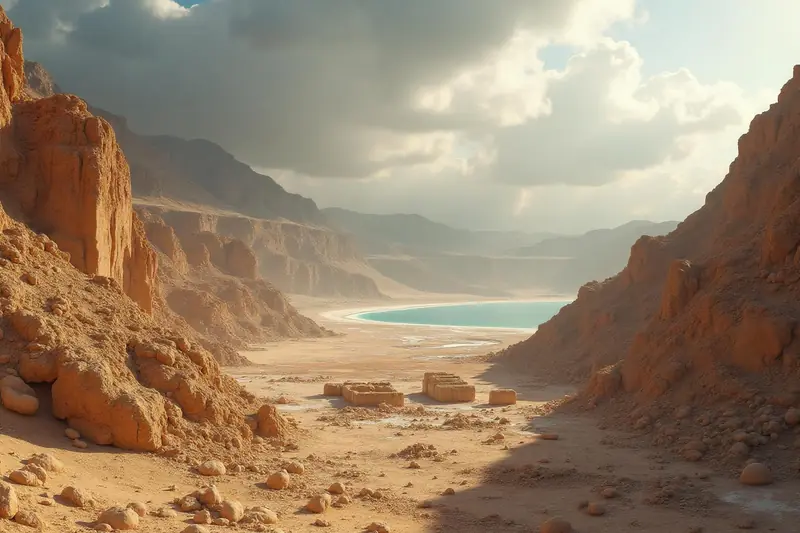
From the Genesis narrative to the excavations at Bab edh-Dhra and Tall el-Hammam: what we know — and what we do not — about the cities destroyed near the Dead Sea.
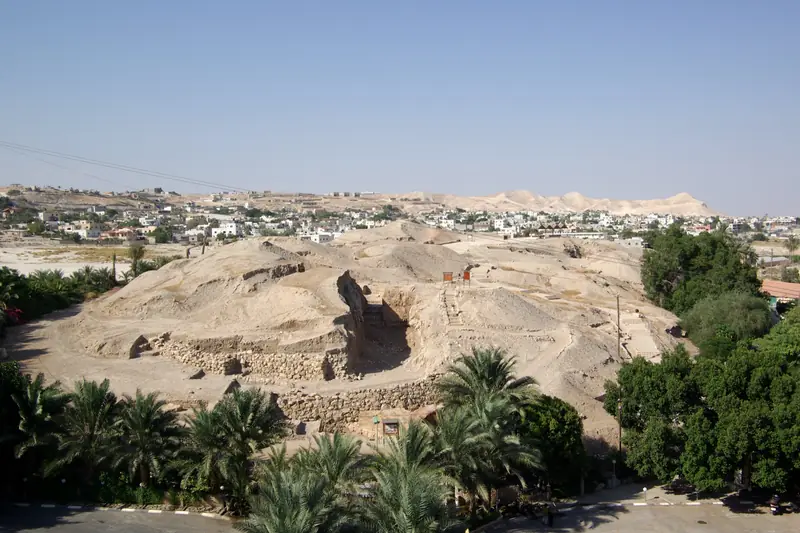
Rahab, the Jordan crossing and the falling walls: the Book of Joshua set against a century of excavation at one of the oldest towns in the world.
Ein Gedi (En-gedi) is best known as David's refuge from Saul: in a cave in the "wilderness of En-gedi", David cuts off the skirt of the king's robe instead of killing him (1 Samuel 24). The oasis also appears in the list of the towns of Judah (Joshua 15:62), in the Song of Songs ("the vineyards of En-gedi", 1:14), in 2 Chronicles 20:2 as Hazazon-tamar and in Ezekiel's vision (47:10).
They are the same place. "Ein Gedi" transcribes the modern Hebrew עין גדי and is used on signs in Israel; "En-gedi" is the form in English Bibles such as the KJV; "Engaddi" comes from the Latin Vulgate and older texts. The name means "spring of the young goat".
Nahal David is the shorter and busier trail, suitable for families, with a wheelchair-accessible section to the first pool. Nahal Arugot is longer, wilder and more demanding, meant for fit hikers, with an earlier last entry. Both must be booked with the INPA; check trail conditions since the May 2025 flood.
As a rule, no. The Ein Gedi public beach has been closed for years because of sinkholes caused by the retreating Dead Sea. To swim, visitors usually go to Ein Bokek, further south, where managed beaches are open. Inside the reserve, bathing under David's Waterfall is forbidden because of falling rocks.
The Hebrew and Aramaic panel lists the ancestors from Adam to Japheth, the signs of the zodiac, the months, the patriarchs and Daniel's companions, thanks donors, and then curses anyone who causes quarrels, slanders to the gentiles, steals or "reveals the secret of the town". The secret may have been the know-how of balsam and its perfume, but nothing is certain.
Yes, it is the most common combination: the two sites are about twenty kilometres apart on Route 90. Climb Masada early in the morning, before the heat, then hike at Ein Gedi. Book the Ein Gedi trails and keep the last-entry time in mind.
Nobody knows. The text gives no precise location and the Ein Gedi cliffs have many caves. The caves sometimes shown to visitors are evocations, not archaeological identifications.
A stone sanctuary built around 3500 BC on a terrace above the Ein Gedi spring, excavated in 1962 by the team of Benjamin Mazar and David Ussishkin. It is far older than any biblical period and can be reached on the upper trails of Nahal David when they are open.