
Jericho (Tell es-Sultan): the walls of Joshua
Rahab, the Jordan crossing and the falling walls: the Book of Joshua set against a century of excavation at one of the oldest towns in the world.
332 BCE – 70 CE
Bedouin shepherds, eleven caves and some 900 manuscripts: the site that yielded the oldest known copies of the Hebrew Bible, and the riddle of who hid them.
Credit: Bahnfrend · CC BY-SA 4.0 · Wikimedia Commons
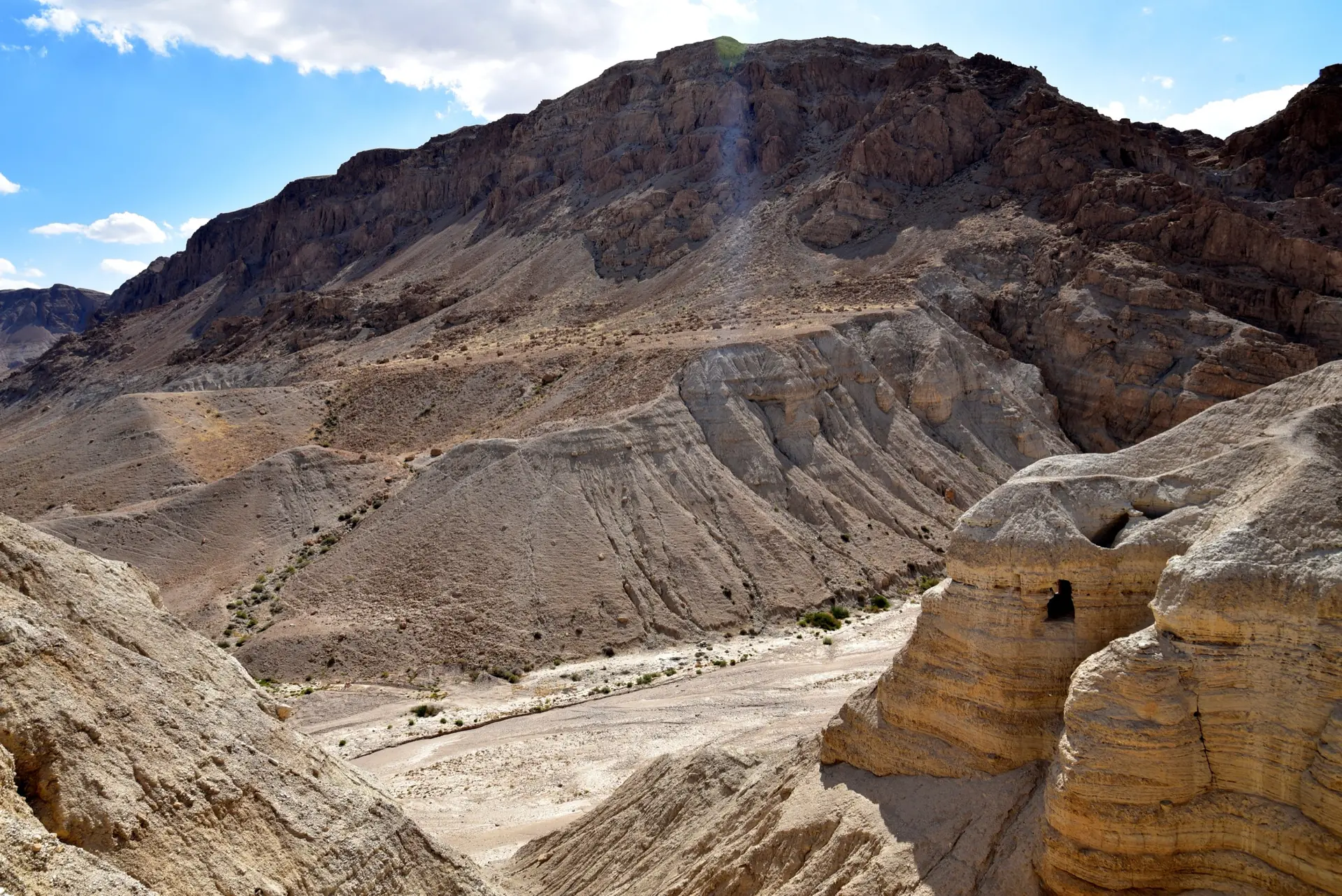
On a plateau above the north-western shore of the Dead Sea, Qumran (Arabic Khirbet Qumran, "the ruin of Qumran") is the archaeological site most closely tied to the Dead Sea Scrolls. Between 1947 and 1956, eleven Qumran caves in the cliffs and in the marl terrace yielded the remains of some 900 scrolls copied between the 3rd century BC and the 1st century AD, including the oldest known copies of the books of the Hebrew Bible.
A few hundred metres from the caves, the ruins of Khirbet Qumran, excavated by the Dominican scholar Roland de Vaux in the 1950s, are often attributed to a Jewish community identified with the Essenes. That view is still held by most scholars, but it is debated. This page separates what the texts say, what the excavations show and what is interpretation, then explains how to visit the national park and where to see the Qumran scrolls today, at the Shrine of the Book in Jerusalem.
In late 1946 or early 1947, young shepherds of the Ta'amireh Bedouin tribe, among them Muhammad edh-Dhib, explored a hollow in the cliff while looking for a stray animal. Inside they found jars holding leather scrolls wrapped in linen. Seven scrolls passed through antiquities dealers in Bethlehem: three were bought in November 1947 by Eleazar Sukenik of the Hebrew University, and four, including the Great Isaiah Scroll, by the Syrian Orthodox Metropolitan Mar Athanasius Samuel. The cave, since known as "Cave 1", was only officially excavated in 1949, by Roland de Vaux and Gerald Lankester Harding.
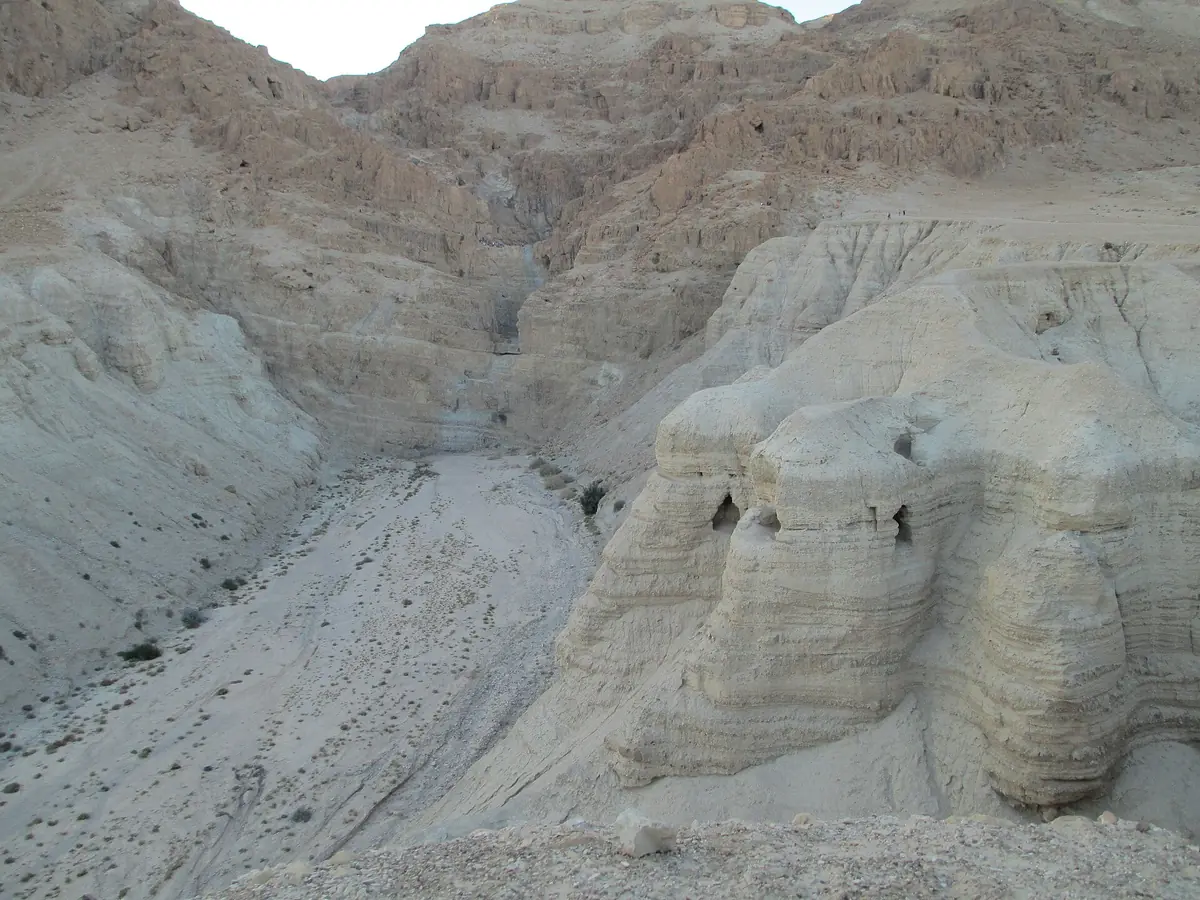
The find set off a race between the Bedouin and the archaeologists. Between 1952 and 1956, ten more scroll caves were located. The richest, Cave 4, found by the Bedouin in 1952 in the marl terrace directly opposite the ruins, produced thousands of fragments from several hundred manuscripts, about three quarters of the whole collection. Cave 3 held the enigmatic Copper Scroll, Cave 7 a handful of Greek papyrus fragments, and Cave 11, found in 1956, the Temple Scroll and a large Psalms scroll.
In February 2017 a team from the Hebrew University of Jerusalem led by Oren Gutfeld, working with Randall Price of Liberty University, announced the identification of a twelfth cave. It contained broken jars of the Qumran type, wrapping cloth, leather straps and a piece of blank parchment, but no scrolls: two mid-20th-century pickaxe heads showed that it had been looted. The excavators treat it as one of the scroll caves; some specialists remain cautious because no text was found.
About a quarter of the manuscripts are biblical books: every book of the Hebrew Bible is represented except Esther. The rest are texts related to the Bible (paraphrases, commentaries, books such as Enoch and Jubilees) and writings belonging to a particular group. Most are in Hebrew, some in Aramaic and a few in Greek.
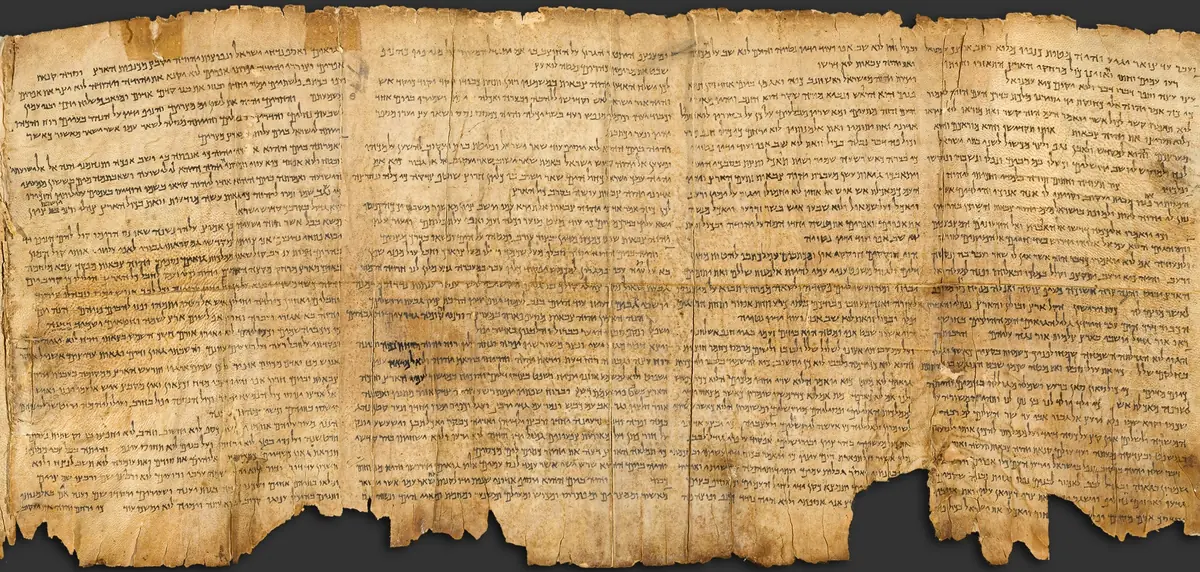
Found in Cave 1, the Great Isaiah Scroll (1QIsaa) is the only Qumran manuscript preserved almost in full: 17 sheets of parchment stitched together, about 7.34 m long, with 54 columns holding all 66 chapters of the book. Its handwriting places it towards the end of the 2nd century BC (around 125-100 BC), about a thousand years earlier than the oldest complete Masoretic manuscripts known before 1947. Its text is very close to the one handed down later, with many spelling differences and a few differences in meaning. Bought in the United States in 1954 by Yigael Yadin for the State of Israel, it is kept at the Israel Museum.
Several scrolls describe an organised group that saw itself as the true Israel: the Community Rule sets out admission, communal meals, purity and rank; the Damascus Document speaks of a "Teacher of Righteousness"; the War Scroll describes a final battle between the "sons of light" and the "sons of darkness"; and the pesharim, such as the Habakkuk Commentary, reread the prophets in the light of the group's own history. The Community Rule explains its withdrawal into the desert with a verse from Isaiah:
"The voice of him that crieth in the wilderness, Prepare ye the way of the Lord, make straight in the desert a highway for our God."
Isaiah 40:3 (KJV)
The Gospels apply the same verse to John the Baptist, who preached in the Judean wilderness (Mark 1:3; John 1:23). Links between John the Baptist and Qumran have often been suggested, but no text connects them directly.
From 1951 to 1956 Roland de Vaux, director of the École Biblique et Archéologique Française in Jerusalem, led six seasons at the ruins with Gerald Lankester Harding of the Jordanian Department of Antiquities. The pottery found in the ruins matched that of the caves, which established the link between the two.
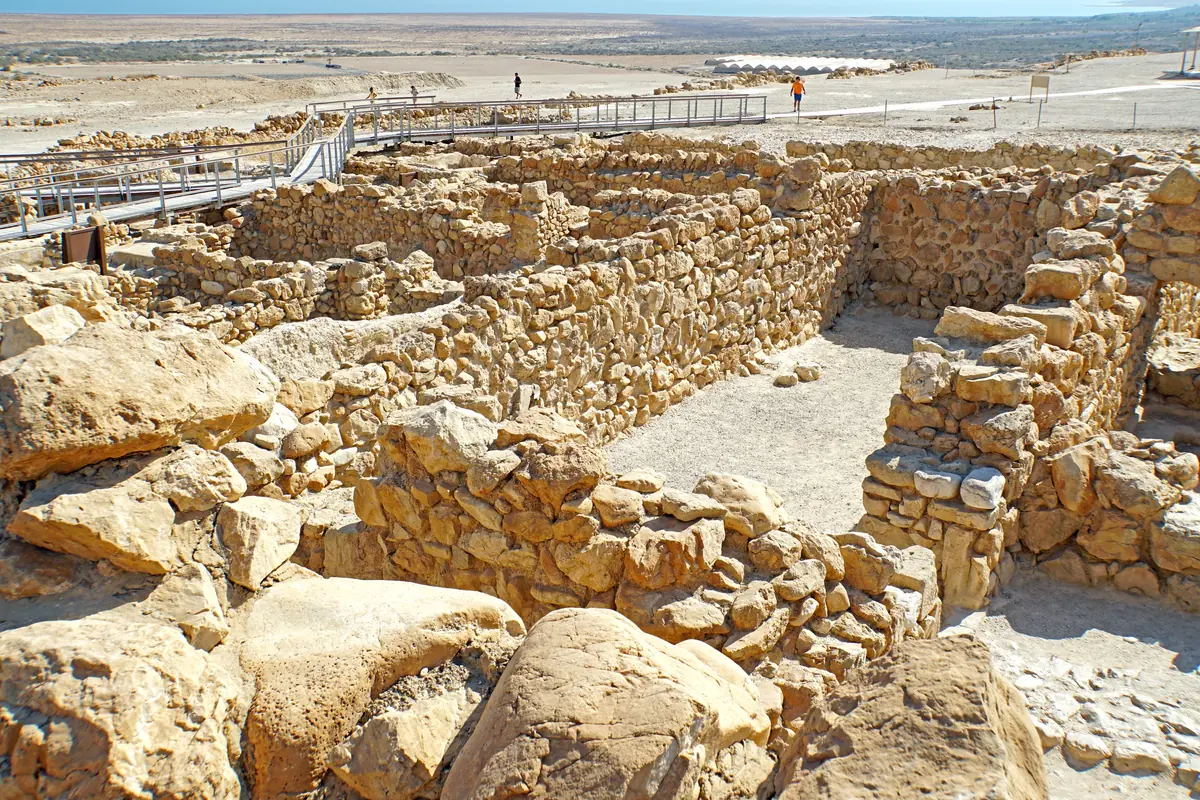
The main building, square and two storeys high, has a corner tower. De Vaux identified a large hall as a refectory: a room next to it held more than a thousand stacked bowls, plates and cups. From the collapsed upper floor of another room (locus 30) he recovered pieces of plastered tables and benches, along with inkwells, and saw it as a scriptorium, a copying room. The name has stuck, although the room's exact use is debated.
An aqueduct carried flood water from the wadi to around ten large stepped pools. Several are interpreted as ritual baths (mikvaot); others were ordinary cisterns, and some may have served both purposes. The steps of one of them are split, probably by the earthquake of 31 BC recorded by Josephus.
East of the ruins lies a cemetery of more than a thousand graves, most of them aligned north-south. Only a small number have been excavated: most of the skeletons studied are male, but women and children have also been identified, and some burials may be much later.
Ancient writers describe the Essenes as one of the main streams of Judaism in the Second Temple period, alongside the Pharisees and Sadducees. Philo of Alexandria and Josephus put their number at more than 4,000, living in communities, sharing property and careful about purity. Pliny the Elder (Natural History 5.73) places a group of Essenes on the western shore of the Dead Sea, above Engada, that is Ein Gedi. For de Vaux, the match between these texts, the rules in the scrolls and the site's installations (communal rooms, baths, inkwells) pointed to an Essene community. It is still the majority view, often in a qualified form: a settlement linked to the Essene movement, where only some of the scrolls were copied.
🔎 Where does the debate stand?
No inscription names the people of Qumran, and the word "Essene" appears in none of the scrolls. Clay analyses show that part of the pottery came from elsewhere, which weakens the workshop theory, but the variety of the scrolls also suggests they were not all written on site. Most scholars accept a link between the site, the caves and an Essene-type community; the other readings remain minority views but have forced a review of several of de Vaux's conclusions.
The site is run as a national park by the Israel Nature and Parks Authority (INPA). The entrance has a small exhibition and a short film about the discovery, subtitled in several languages. A marked trail, largely wheelchair accessible, runs through the ruins: the tower, aqueduct, stepped pools, refectory and "scriptorium". A viewpoint faces Cave 4, whose openings can be seen in the marl terrace. Entry into the caves is generally not offered to visitors; hiking paths climb towards the cliff and should only be used following the park's directions.
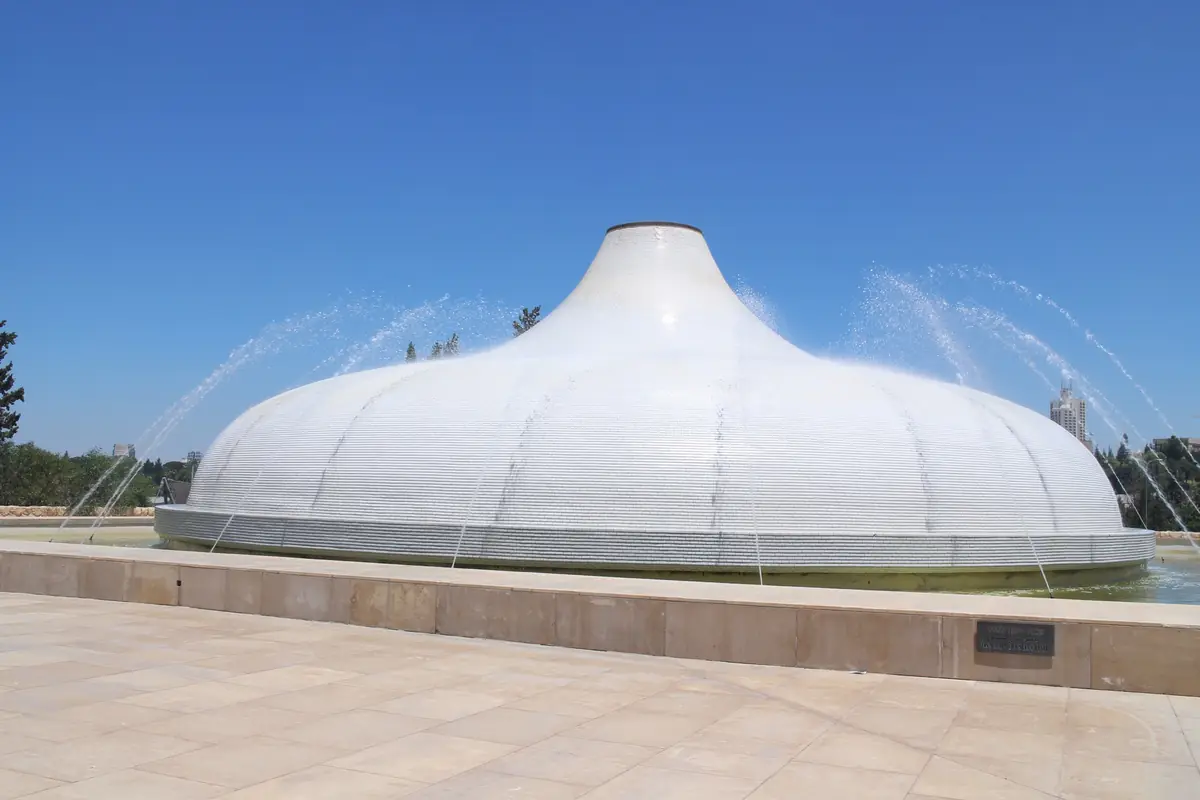
The scrolls are not displayed at Qumran. Most of the complete scrolls are kept in Jerusalem, at the Shrine of the Book of the Israel Museum, opened in 1965. Its white roof, shaped like the lid of a scroll jar and designed by Frederick Kiesler and Armand Bartos, faces a black basalt wall, echoing the battle of the "sons of light" against the "sons of darkness". At its centre is a facsimile of the Great Isaiah Scroll; the fragile originals are shown in rotation. Thousands of fragments are held by the Israel Antiquities Authority, which has digitised them in the online Leon Levy library, and the Copper Scroll is in the Jordan Museum in Amman.
A few kilometres south, the Ein Feshkha (Einot Tzukim) reserve preserves remains contemporary with Qumran. To the north, Jericho and its Hasmonean and Herodian palaces reflect the same regional setting; to the south, Route 90 leads to Ein Gedi and then Masada, where fragments of scrolls related to those of Qumran were also found.
Qumran, the site of the Dead Sea Scrolls: excavations and visiting
Qumran National Park, Route 90, north-western shore of the Dead Sea, near Kibbutz Kalia (about 40 km from Jerusalem by road)
GPS coordinates : 31.7408, 35.4586
Start navigation with:
Rahab, the Jordan crossing and the falling walls: the Book of Joshua set against a century of excavation at one of the oldest towns in the world.
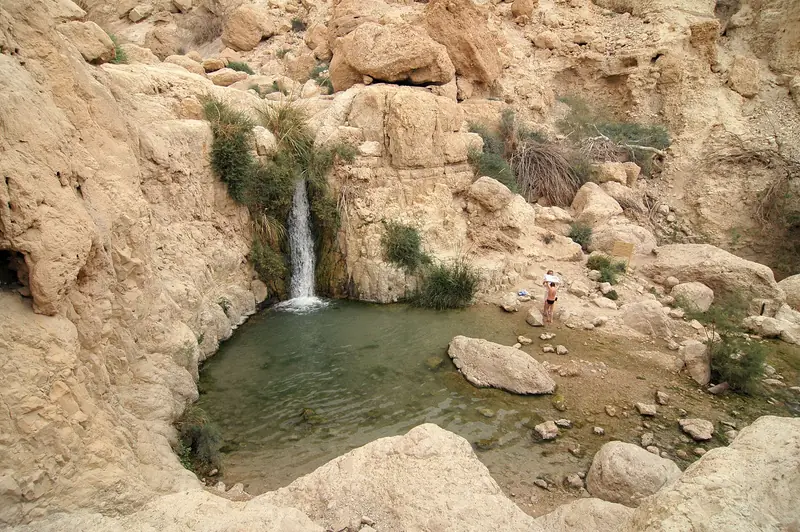
Springs at the foot of the Judean Desert cliffs: David's refuge from Saul, the "vineyards of En-gedi" in the Song of Songs, a 5,500-year-old temple and a synagogue that curses anyone who betrays "the secret of the town".
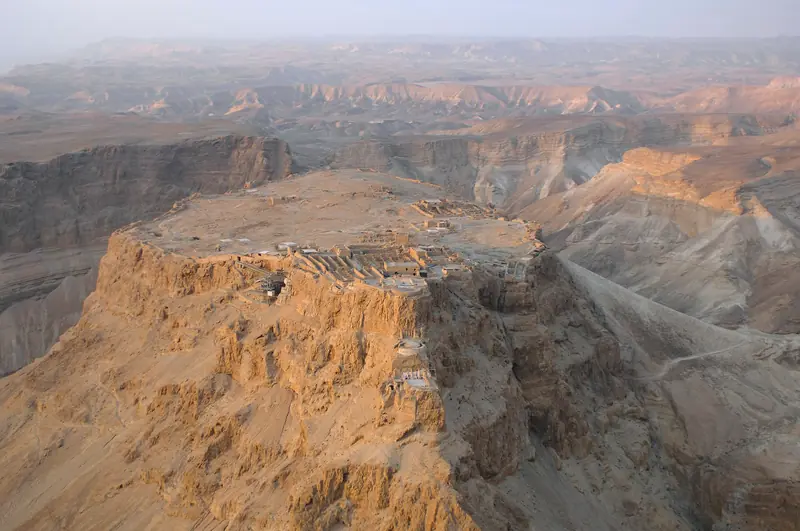
A palace hanging on the edge of the desert, the last stronghold of the Jewish revolt against Rome, and a famous story that archaeology illuminates without settling every question.
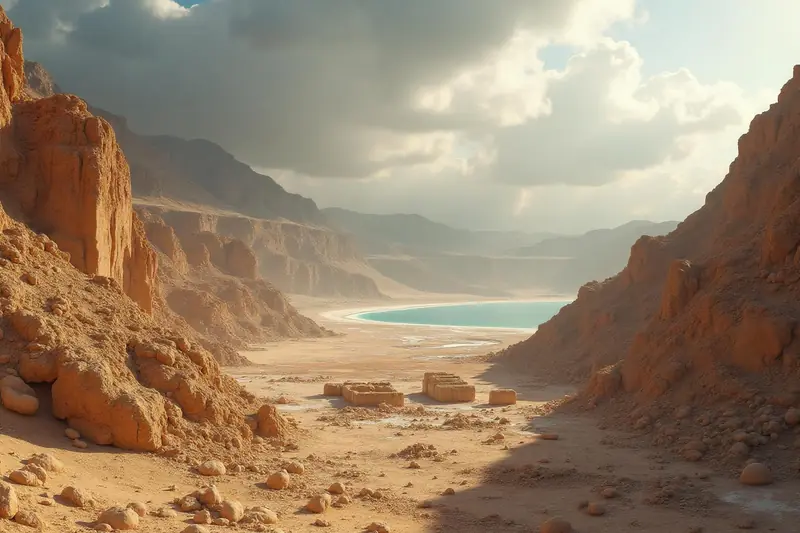
From the Genesis narrative to the excavations at Bab edh-Dhra and Tall el-Hammam: what we know — and what we do not — about the cities destroyed near the Dead Sea.
They are about 900 manuscripts, mostly on parchment, found between 1947 and 1956 in eleven caves around Qumran. Copied between the 3rd century BC and the 1st century AD, they include the oldest known copies of the books of the Hebrew Bible (all except Esther), texts related to the Bible and the writings of a Jewish community. In a wider sense the term also covers texts found elsewhere in the Judean Desert.
No scroll names its copyists. Most scholars attribute them, at least in part, to a Jewish community living at Qumran and identified with the Essenes. Others think many scrolls were brought from Jerusalem or from other Jewish groups and hidden in the caves during the war against Rome (AD 66-73).
That was Roland de Vaux's conclusion and it is still the majority view, supported by Pliny the Elder, who places Essenes on the western shore of the Dead Sea, and by the rules of life described in the scrolls. Other archaeologists (Donceel, Hirschfeld, Magen and Peleg) have suggested a villa, a fortified manor or a pottery workshop. No inscription settles the question.
The national park lets you see Cave 4 from a viewpoint opposite the ruins. Entry into the caves is generally not offered; hiking paths climb towards the cliff and should only be used following the Nature and Parks Authority's directions.
At the Shrine of the Book of the Israel Museum in Jerusalem, where a facsimile of the Great Isaiah Scroll stands at the centre and originals are shown in rotation. The fragments can also be viewed online in the Israel Antiquities Authority's Leon Levy digital library. The Copper Scroll is on display at the Jordan Museum in Amman.
Not by that name. Joshua 15:61-62 lists, among the towns of the wilderness of Judah, Secacah and "the city of Salt" (Ir ha-Melah): Roland de Vaux identified Qumran with the latter, other scholars with Secacah. The site is not mentioned in the New Testament.
It is a scroll of 17 parchment sheets, about 7.34 m long, containing all 66 chapters of the Book of Isaiah. Found in 1947 in Cave 1 and dated to around 125-100 BC, it is the only almost complete Qumran manuscript and the oldest known complete copy of a biblical book. It is kept at the Israel Museum.
Announced in 2017 by the Hebrew University of Jerusalem, Cave 12 held broken jars, wrapping cloth and a piece of blank parchment, but no scrolls: mid-20th-century pickaxes show that it had been looted.