A palace hanging on the edge of the desert, the last stronghold of the Jewish revolt against Rome, and a famous story that archaeology illuminates without settling every question.
Set on a rocky plateau rising more than 400 m above the western shore of the Dead Sea, Masada (Hebrew Metsada, "the fortress") is one of the most visited archaeological sites in Israel. In the 1st century BCE King Herod built a spectacular palace-fortress here. A century later the Masada fortress became the last stronghold of the Jewish rebels against Rome, falling in 73 or 74 CE after a siege whose traces can still be read in the landscape.
The history of Masada is known almost entirely from the historian Flavius Josephus, who tells how the defenders chose death together rather than captivity. Yigael Yadin's excavations in the 1960s uncovered palaces, a synagogue, scrolls and an intact Roman ramp, and opened debates that are still going on. A UNESCO World Heritage Site since 2001, Masada is climbed by the Snake Path, reached by cable car or, from the west, by the Roman ramp.
⏱ Visit: about 180 minUpdated
The history of Masada, from Herod to the Jewish revolt
Main periodLate 1st century BCE – 73/74 CE
BuilderHerod the Great, from the 30s BCE
PlateauAbout 550 × 270 m, cliffs on every side
Main sourceFlavius Josephus, The Jewish War, book VII
StatusNational park, UNESCO World Heritage Site since 2001
A fortified rock before Herod
According to Josephus, the rock was first fortified by a "high priest Jonathan", whom most historians identify with the Hasmonean king Alexander Jannaeus (103-76 BCE). The excavations produced Hasmonean coins but almost no building that can be securely dated to that period. In 40 BCE, fleeing the Parthian invasion and his rival Antigonus, Herod left his family here in the care of his brother Joseph; the besieged, running out of water, were reportedly saved by a downpour that filled the cisterns (Jewish War I).
Herod's palace-fortress
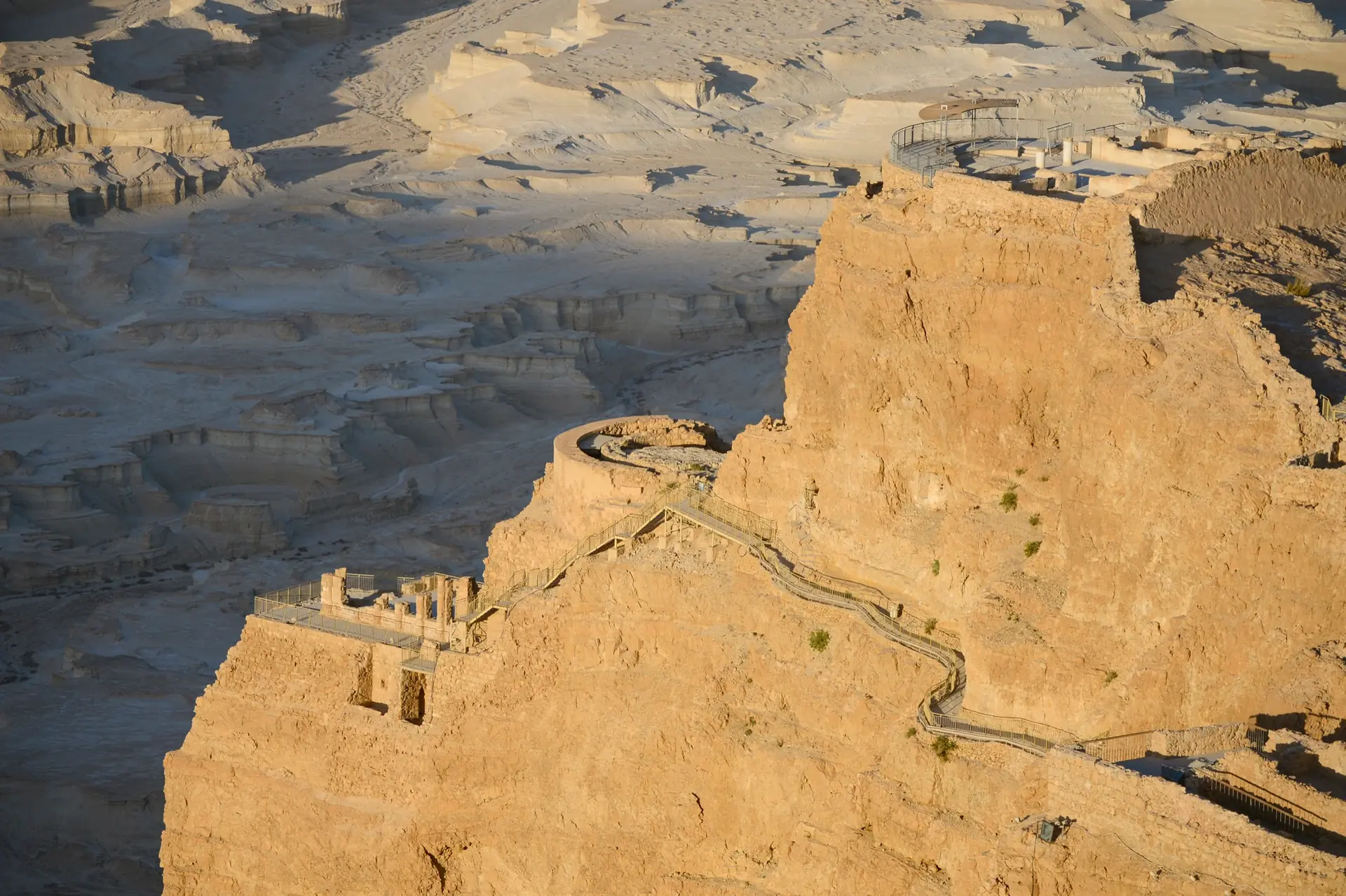
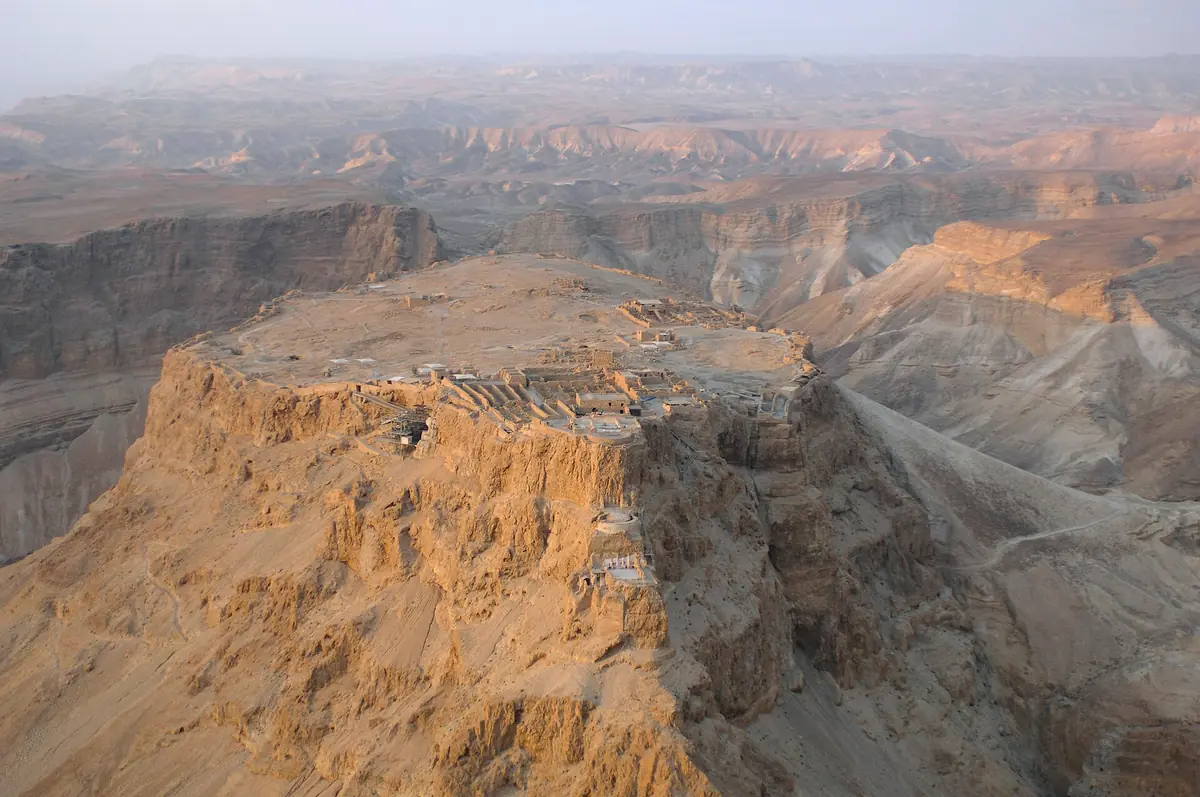
Once king of Judea, Herod turned the plateau into a royal refuge: a casemate wall all around the summit, storerooms for years of provisions, huge cisterns cut into the rock and fed by flash floods from the wadis, Roman-style baths and two palaces. The most famous, the Northern Palace, steps down the tip of the cliff in three terraces; its frescoes and stuccoed columns show the influence of Roman art at Herod's court. It is one of the great building projects of his reign, alongside the Temple in Jerusalem, Herodium and Caesarea (see the Second Temple period).
The Masada plateau from the air, with the Northern Palace at its tipCredit: Godot13 · CC BY-SA 4.0 · Wikimedia Commons
The Sicarii and the revolt against Rome
In 66 CE, at the start of the Great Jewish Revolt, a group of rebels seized Masada from its Roman garrison. Josephus calls them Sicarii, after the dagger (sica) they carried, and their leader was Eleazar ben Yair. After the destruction of Jerusalem and the Temple in 70, Masada became one of the last pockets of resistance, together with Herodium and Machaerus. Families settled on the summit; they turned Herod's halls into living quarters and added ritual baths (mikvaot).
The Roman siege and Josephus' account
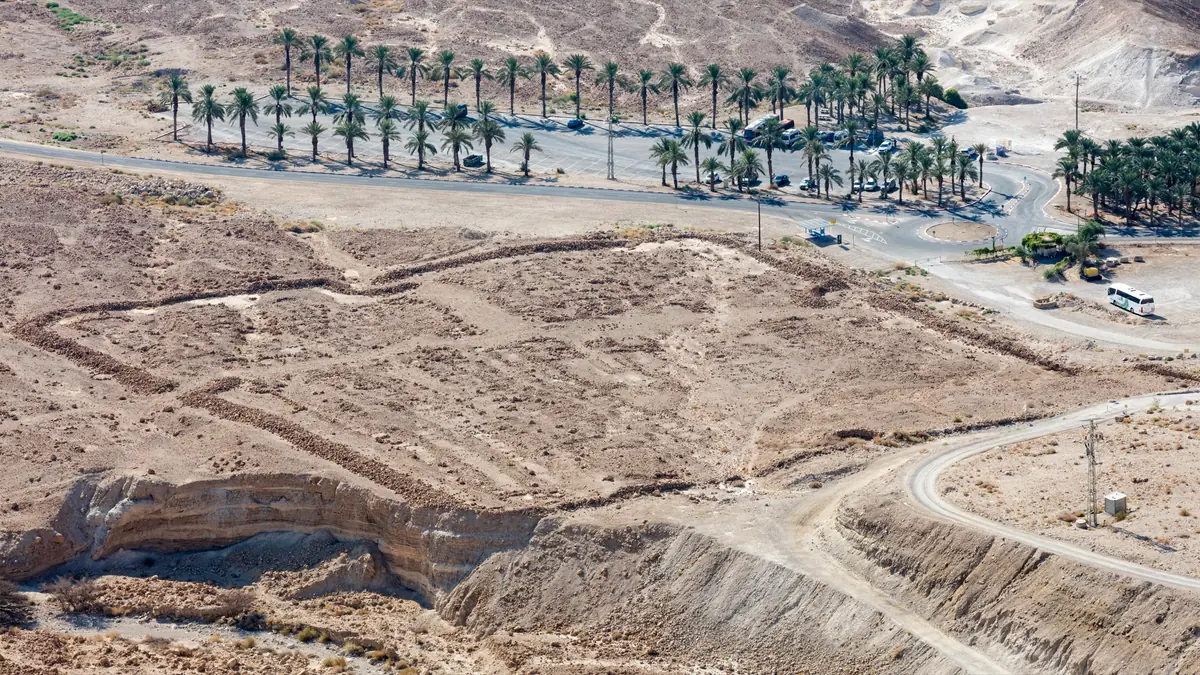
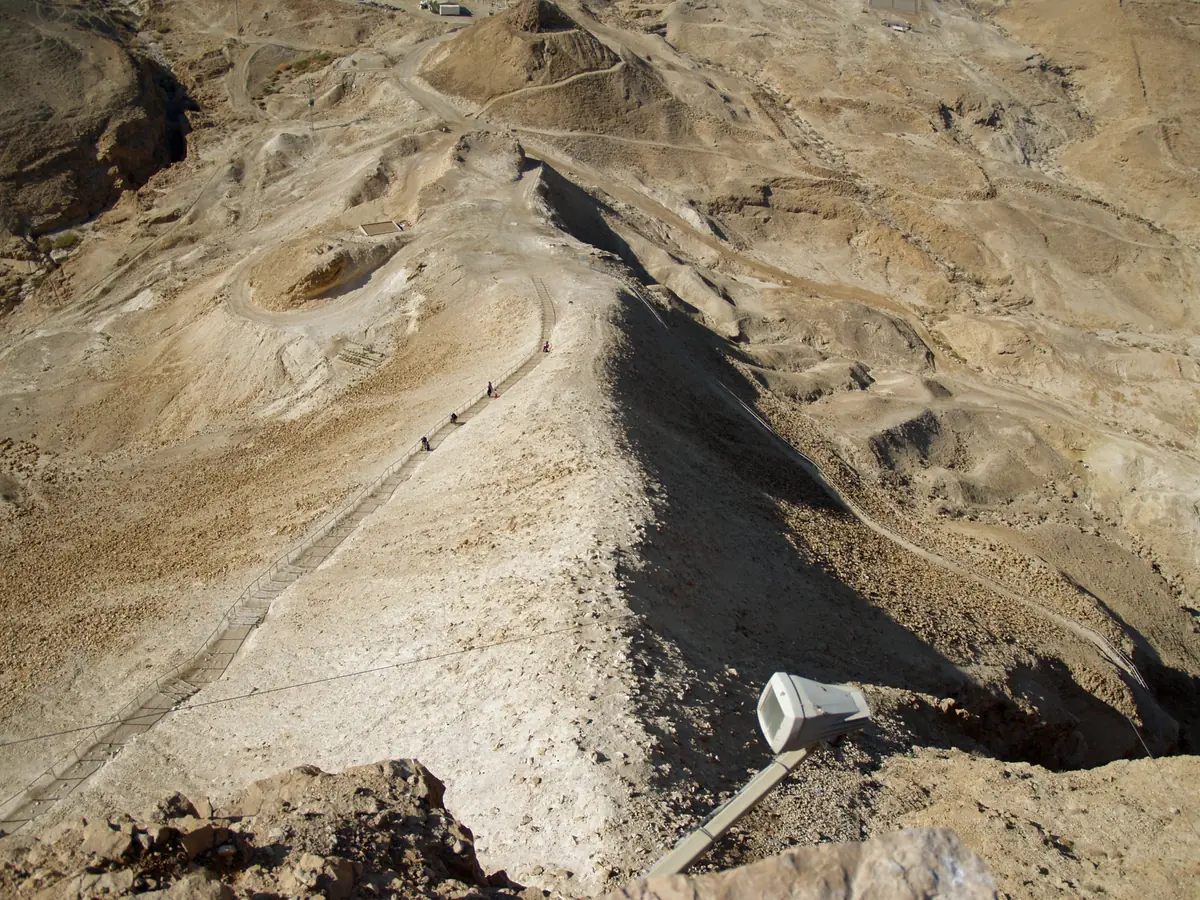
In 73 or 74 CE (the exact year is debated), the governor Lucius Flavius Silva besieged Masada with the Tenth Legion Fretensis and auxiliary troops, several thousand men in all. The Romans ringed the rock with a circumvallation wall and eight camps, then built a siege ramp of earth and stones on a natural spur of the western slope to bring a battering ram up against the wall.
One of the eight Roman siege camps, still clearly visible at the foot of the fortressCredit: Godot13 · CC BY-SA 4.0 · Wikimedia Commons
The night of 15 Xanthicus according to Josephus
In book VII of The Jewish War, Josephus tells how, once the wall was breached, Eleazar persuaded the defenders in two long speeches to die free rather than become slaves. The men killed their families; then ten of them, chosen by lot, killed the others, and a last man, also picked by lot, took his own life after setting the palace on fire. In the morning the Romans found only the dead: 960 people, according to Josephus. Two women and five children, hidden in a water conduit, are said to have survived and told the story.
Josephus was not there. A former rebel commander who had gone over to the Flavians, he wrote in Rome a few years later, probably using army reports. Eleazar's speeches, as often in ancient history writing, are the author's own literary composition.
The Roman siege ramp on the western slope, now followed by the Ramp PathCredit: David Shankbone · CC BY-SA 3.0 · Wikimedia Commons
Masada and archaeology: Yadin's excavations and the debates
Yigael Yadin's excavations (1963-1965)
After 19th-century surveys and a first Israeli exploration in the 1950s, the archaeologist Yigael Yadin (Hebrew University of Jerusalem) led two large seasons from October 1963 to April 1965, with volunteers from dozens of countries. Almost the whole plateau was cleared and partly restored: the Northern and Western Palaces, baths, storerooms, casemate wall and cisterns. Ehud Netzer later published the site's architecture, and since 2017 Guy Stiebel (Tel Aviv University) has resumed excavations there.
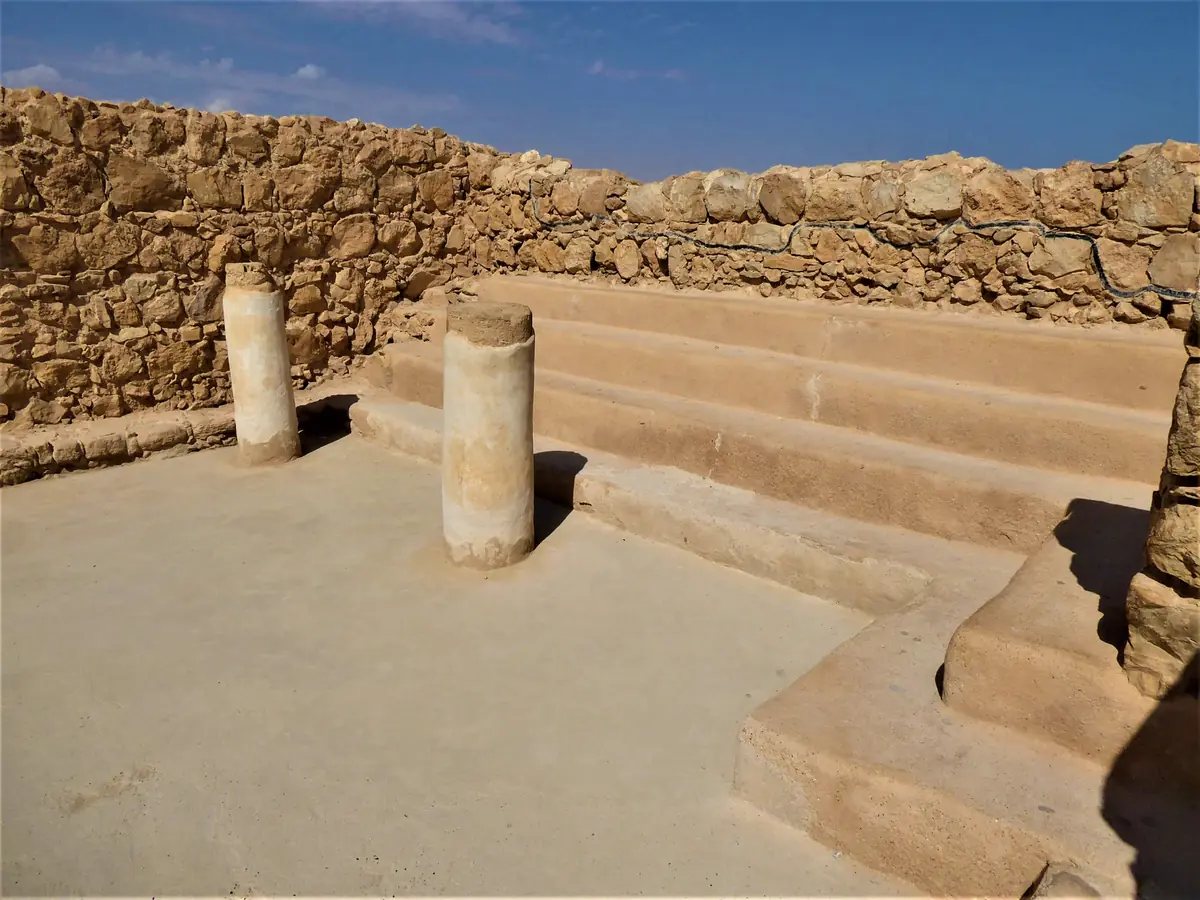
In the north-western wall, Yadin identified a hall lined with benches as a synagogue, one of the oldest known; the rebels probably adapted it from a Herodian room. Beneath its floor and elsewhere on the site, scroll fragments came to light: passages from Genesis, Leviticus, Deuteronomy, Ezekiel (including the vision of the dry bones, Ezekiel 37) and Psalms, a Hebrew scroll of Ben Sira (Sirach) and a copy of the Songs of the Sabbath Sacrifice, a liturgical text also known from Qumran. These texts, very close to the Masoretic text for the biblical books, predate 73/74.
The "lots" ostraca
Near the Northern Palace, Yadin found about a dozen potsherds (ostraca) each bearing a name, one of which reads "ben Yair". He saw them as the lots of Josephus' story. The idea is attractive but cannot be proven: such sherds may have served many other purposes (rations, guard duty).
The skeletons
Very few human remains were found: three individuals in the Northern Palace baths and about 25 in a cave on the southern slope, mixed with pig bones. They were given a state burial in 1969 as "the defenders of Masada". The anthropologist Joe Zias, among others, has questioned that identification; since the bones are no longer accessible, the question remains open.
🔎 Does archaeology confirm Josephus?
For the setting, yes: Herod's palace, the rebel occupation, the ramp, the eight camps and the siege wall match his description, and a burn layer marks the end of the site. For the heart of the story, no: no material evidence can confirm or refute the mass suicide or the figure of 960 dead. The historian Shaye Cohen (1982) and the sociologist Nachman Ben-Yehuda (The Masada Myth, 1995) have pointed out the gaps between text and remains, and the way the story became a national symbol in 20th-century Israel. In 2024 a Tel Aviv University study (Journal of Roman Archaeology), based on drone surveys, estimated that the siege works could have been built in about two weeks: the siege probably lasted a few weeks, not years.
Is Masada in the Bible? The "stronghold" in the stories of David
The name Masada does not appear in the Bible, and Herod's fortress is much later than the Old Testament. The Hebrew word, however, is biblical: metsada or metsudah means a stronghold, a steep refuge. It recurs in the story of David fleeing from Saul, in the very desert that borders the Dead Sea:
"And David went up from thence, and dwelt in strong holds at En-gedi."
1 Samuel 23:29 (KJV)
After sparing Saul in a cave, "David and his men gat them up unto the hold" (1 Samuel 24:22); earlier, David had already stayed "in the hold" while his parents were in Moab (1 Samuel 22:4-5). The same word becomes an image of God in the Psalms:
"The LORD is my rock, and my fortress, and my deliverer; my God, my strength, in whom I will trust."
Psalm 18:2 (KJV)
📖 An unproven identification
Some writers have suggested that "the hold" of 1 Samuel 22 and 24 was the rock of Masada, about twenty kilometres south of Ein Gedi. Nothing supports this firmly: the text speaks of "strong holds" in general, no remains from David's time have been identified on the plateau, and other heights in the Judean Desert fit just as well. What one can do at Masada is read, on the spot, the verses that gave the site its name. (Hebrew Bibles number these verses 1 Samuel 24:1 and 24:23, and Psalm 18:3.)
Visiting Masada: Snake Path, cable car and sunrise
Three ways up
The Snake Path, on the east side (from Route 90 and the visitor centre): a zigzag trail already described by Josephus, who calls it "the Serpent". Allow 45 minutes to an hour of steady climbing for a little over 300 m of ascent.
The cable car, on the same side: a few minutes up to the Snake Path Gate near the summit. It is the choice of groups, families and visitors with reduced mobility.
The Ramp Path, on the west side: reached only from Arad (Route 3199), it follows the Roman ramp and takes about twenty minutes.
Sunrise over the Dead Sea
Walking up before dawn to watch the sun rise over the mountains of Moab and the Dead Sea is a classic. The Snake Path opens before daybreak in some periods: check the day's opening time on the Israel Nature and Parks Authority website, bring a head torch and start early in summer, as trails may close during the hottest hours.
What to see on the summit
The marked route leads to the Northern Palace (lower terraces via a steep staircase), the baths, the storerooms, the synagogue, the Western Palace and its mosaics, the cisterns, a Byzantine church (5th-6th century) and viewpoints over the ramp and the Roman camps. A black line painted on the walls separates original masonry from restoration. At the visitor centre, a museum displays finds from Yadin's excavations.
The sound and light show on the west side
In season, a night show is projected onto the western slope, between the ramp and the Northern Palace. It can only be reached from Arad: there is no road link between the two sides of the park. Days and dates vary, so check the official programme before booking.
Masada combines easily with the other sites on the western shore: Ein Gedi to the north, Qumran further on, and to the south the landscapes associated with Sodom and Gomorrah around Mount Sodom.
Masada, Herod's fortress above the Dead Sea Masada National Park, Route 90 (east access, cable car and Snake Path); west access from Arad via Route 3199. About 20 km south of Ein Gedi.
Two and a half to three hours with the cable car; half a day if you climb the Snake Path for sunrise.
Opening hours & fees
Check with the Israel Nature and Parks Authority (parks.org.il), which runs the national park, for the site, the cable car and the night show.
Best seasons
October to April. Summer heat is extreme: climb at dawn and check trail closing times.
Accessibility
The cable car and part of the plateau are accessible; the Northern Palace's lower terraces and the footpaths are not. Check with the park before your visit.
What to bring
Plenty of water (at least 1-2 litres per person), a hat, sunscreen and walking shoes; a head torch for sunrise. Little shade on the summit.
Suggested itineraries
Masada, Ein Gedi and the Dead Sea in one day
Masada (cable car or Snake Path) → Ein Gedi → swim at Ein Bokek
In Second Temple times
Jerusalem → Qumran → Ein Gedi → Masada
Show and sunrise from the west
Arad → sound and light show → night in Arad → Ramp Path at dawn
Related sites
Western shore of the Dead Sea, Judean Desert⏱ 180 min
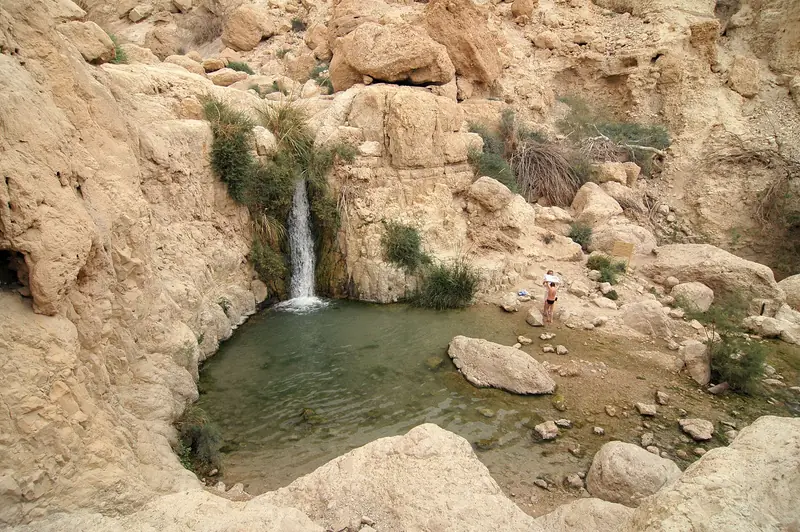
Springs at the foot of the Judean Desert cliffs: David's refuge from Saul, the "vineyards of En-gedi" in the Song of Songs, a 5,500-year-old temple and a synagogue that curses anyone who betrays "the secret of the town".
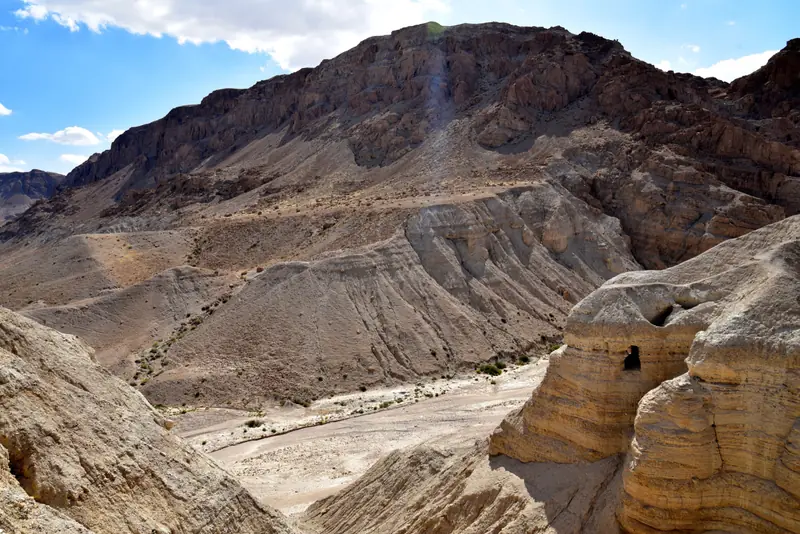
Bedouin shepherds, eleven caves and some 900 manuscripts: the site that yielded the oldest known copies of the Hebrew Bible, and the riddle of who hid them.
From the Genesis narrative to the excavations at Bab edh-Dhra and Tall el-Hammam: what we know — and what we do not — about the cities destroyed near the Dead Sea.
Where tradition places Abraham's test now stands the Temple Mount, one of the holiest sites in Judaism and Islam.
View site →
Frequently asked questions
What happened at Masada?
A fortress turned into a palace by Herod, Masada was taken in 66 CE by Jewish rebels led by Eleazar ben Yair. Besieged by the Roman Tenth Legion, it fell in 73 or 74. According to Flavius Josephus, its 960 defenders chose death over slavery.
Does archaeology confirm Josephus' account?
Partly. The palaces, the ramp, the eight Roman camps and the siege wall match his description. But nothing can prove or disprove the mass suicide: the name-bearing ostraca and the few skeletons found are interpreted in different ways.
Is it Masada or Massada?
Masada is the standard English spelling; Massada is common in French and German. The Hebrew name, <em>Metsada</em>, means "the fortress".
Snake Path or cable car?
The Snake Path (45 minutes to an hour up, a little over 300 m of ascent) requires reasonable fitness and is best done at dawn. The cable car takes a few minutes. Many visitors walk up and ride down.
Can you watch the sunrise from Masada?
Yes, it is one of the most popular experiences: you climb the Snake Path, which opens before dawn in some periods, to watch the sun rise over the Dead Sea and the mountains of Moab. Check the day's times with the national park.
Is Masada in the Bible?
Not by name. The Hebrew word <em>metsada</em> / <em>metsudah</em> ("stronghold") appears in the stories of David near En-gedi (1 Samuel 22-24) and in the Psalms (Psalm 18:2 in English Bibles), but nothing allows these "strong holds" to be identified with Masada.
Can you do Masada, Ein Gedi and the Dead Sea in one day?
Yes, it is a classic day trip from Jerusalem (about 1.5 to 2 hours by road to Masada): Masada early in the morning, Ein Gedi late morning, then a swim in the Dead Sea, for example at Ein Bokek. It is a long day; in summer, start at dawn.
Who manages Masada?
Masada is a national park run by the Israel Nature and Parks Authority. It has been on the UNESCO World Heritage List since 2001.