
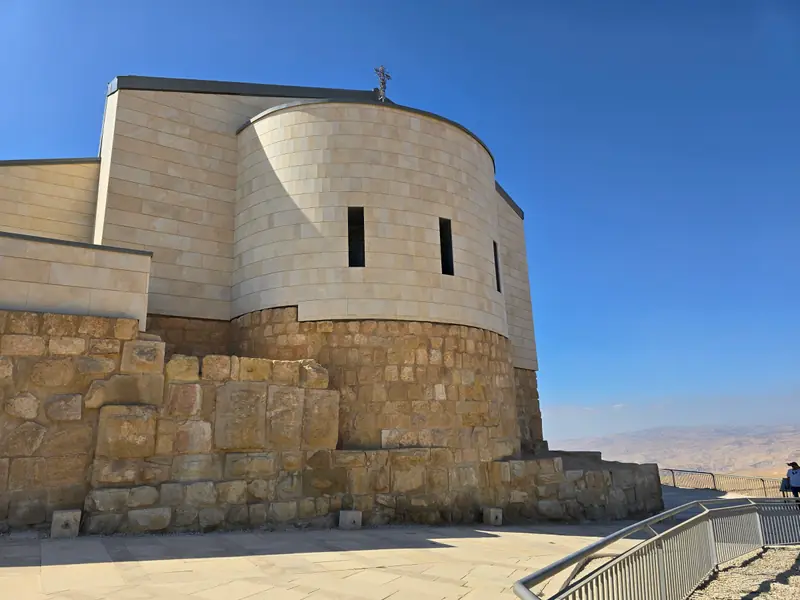
Mount Nebo – Moses' Last View of the Promised Land
On a spur of the mountains of Moab, Deuteronomy has Moses gaze at the land he will never enter. Since the 4th century, a Christian sanctuary has kept that memory alive.
1500–1200 BCE
Rahab, the Jordan crossing and the falling walls: the Book of Joshua set against a century of excavation at one of the oldest towns in the world.
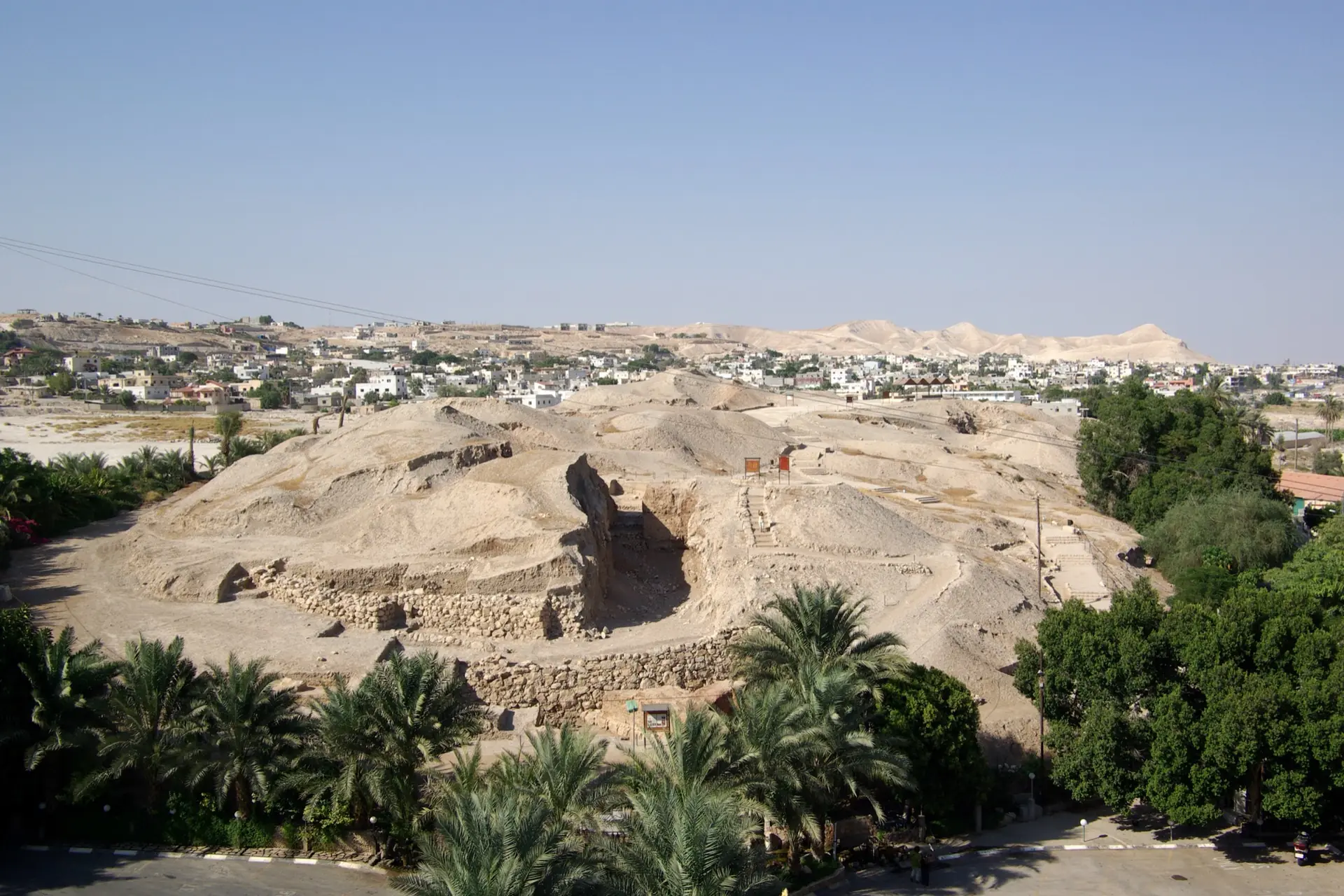
Credit: Berthold Werner · public domain · Wikimedia Commons
On the edge of the Judean Desert, a few kilometres from the Jordan River, Jericho is the first city the Israelites face in Canaan according to the Book of Joshua. The ancient site is Tell es-Sultan, an artificial mound north of the modern town, built up over thousands of years of settlement around a spring that never runs dry. This is where the Bible places the story of Rahab and the two spies, and then the fall of the walls of Jericho at the sound of the trumpets (Joshua 2 and 6).
Tell es-Sultan is also one of the most excavated and most debated sites in the Near East. Its famous Neolithic tower, built more than six thousand years before the time traditionally given for Joshua, and the question of whether a fortified town stood here in the Late Bronze Age make it a textbook case of how the biblical text and archaeology interact. Since 2023 the site has been on the UNESCO World Heritage List as "Ancient Jericho/Tell es-Sultan".
After the death of Moses, who looked out from Mount Nebo over "the valley of Jericho, the city of palm trees" (Deuteronomy 34:3), Joshua leads the people camped on the plains of Moab, on the east bank of the Jordan. Jericho is the gateway to Canaan: an oasis town guarding the road that climbs to the hills of Judah and Benjamin.
From Shittim, Joshua secretly sends two men to view the land, "even Jericho" (Joshua 2:1). They lodge with Rahab, a harlot whose house is built into the town wall. When the king of Jericho has them sought, she hides them under stalks of flax on her roof and then helps them escape. In return, the spies promise to spare her family if she ties a scarlet cord in her window.
"Then she let them down by a cord through the window: for her house was upon the town wall, and she dwelt upon the wall."
Joshua 2:15 (KJV)
Rahab, who acknowledges the power of the God of Israel (Joshua 2:11), became an important figure in both Jewish and Christian tradition: Matthew's Gospel lists her in the genealogy of Jesus (Matthew 1:5), and the Epistle to the Hebrews presents her as a model of faith (Hebrews 11:31).
The narrative then describes the crossing of the river: as soon as the priests carrying the Ark of the Covenant step into the water, the current stops upstream "very far from the city Adam", and the people cross on dry ground "right against Jericho" (Joshua 3:16). Twelve stones, one per tribe, are set up at Gilgal, the first camp in Canaan, "in the east border of Jericho" (Joshua 4:19-20). The location of Gilgal is still uncertain: several sites in the plain have been proposed, without agreement.
Jericho is "straitly shut up". At God's command, the warriors march around the city once a day for six days, preceded by seven priests blowing rams' horns and by the Ark. On the seventh day they circle it seven times; at the signal, the people raise a great shout.
"So the people shouted when the priests blew with the trumpets: and it came to pass, when the people heard the sound of the trumpet, and the people shouted with a great shout, that the wall fell down flat, so that the people went up into the city, every man straight before him, and they took the city."
Joshua 6:20 (KJV)
The city is placed under the ban (herem) and burned; only Rahab and her family are spared (Joshua 6:22-25). Joshua then pronounces a curse on anyone who rebuilds Jericho (Joshua 6:26). The Book of Kings reports that it came true in the days of Ahab, when Hiel of Bethel rebuilt the city at the cost of his sons (1 Kings 16:34).
📖 A liturgical narrative
Chapter 6 reads almost like a procession: the repeated number seven, priests, the Ark, the shofar, a collective shout. Commentators note that the victory is presented as a divine gift rather than a military feat, which explains the place of this text in liturgy and preaching, quite apart from historical questions.
No biblical site has generated as much controversy over the "conquest". The core of the debate is easy to state: did the fortified city found destroyed in the mound still exist at the time biblical chronology assigns to Joshua?
After Charles Warren's soundings (1868) and the Austro-German dig of Ernst Sellin and Carl Watzinger (1907-1909 and 1911), the British archaeologist John Garstang excavated the mound from 1930 to 1936. He uncovered a collapsed double wall and a burnt layer that he dated to around 1400 BC: for him, this was the city destroyed by Joshua. His conclusion was repeated for decades in popular books.
Using more precise stratigraphic methods, Kathleen Kenyon showed that Garstang's walls actually belonged to the Early Bronze Age, a millennium earlier. She dated the destruction of the last great fortified city ("City IV") to the end of the Middle Bronze Age, around 1550 BC, in the context of the Egyptian campaigns that followed the expulsion of the Hyksos. For the Late Bronze Age she found only faint traces (a few tombs, an isolated building), which she partly attributed to erosion of the top of the mound. Her conclusion: at the date usually given for Joshua, Jericho was at most a modest settlement.
Radiocarbon analyses carried out since then (notably Bruins and van der Plicht, 1995) have supported a destruction in the 16th century BC. In the burnt layer, the excavators found many jars still full of charred grain, a sign that the city was destroyed quickly, without its stores being plundered over time.
In 1990 the American archaeologist Bryant Wood re-examined the pottery published by Garstang and Kenyon and proposed redating the destruction to around 1400 BC, which would bring it close to the so-called "early" biblical chronology (based on 1 Kings 6:1). He cited local pottery, Egyptian scarabs and the stratigraphy. The proposal was hotly debated and has not been accepted by most specialists, particularly in the light of the radiocarbon dates. The discussion continues in some research circles.
Since 1997, Sapienza University of Rome, led by Lorenzo Nigro, has excavated the mound together with the Palestinian Department of Antiquities, now part of the Ministry of Tourism and Antiquities (MoTA). Its syntheses confirm the dating of the destruction of the Middle Bronze Age city and describe a Late Bronze Age occupation ("City V") that is real but limited, identified on the edges of the mound; the 13th-century levels appear to have been largely cut away by Iron Age levelling. Settlement then resumes in Iron Age II.
🔎 Where does the debate stand?
The spectacular remains at Tell es-Sultan (tower, ramparts, glacis) are either far older than, or one to three centuries earlier than, the range usually proposed for the conquest (15th–13th century BC). Most archaeologists consider that the account in Joshua 6 cannot be tied to a specific destruction layer; a minority of researchers argue for an earlier date. No remains can be attributed with certainty to Rahab's house or to the walls described in the text.
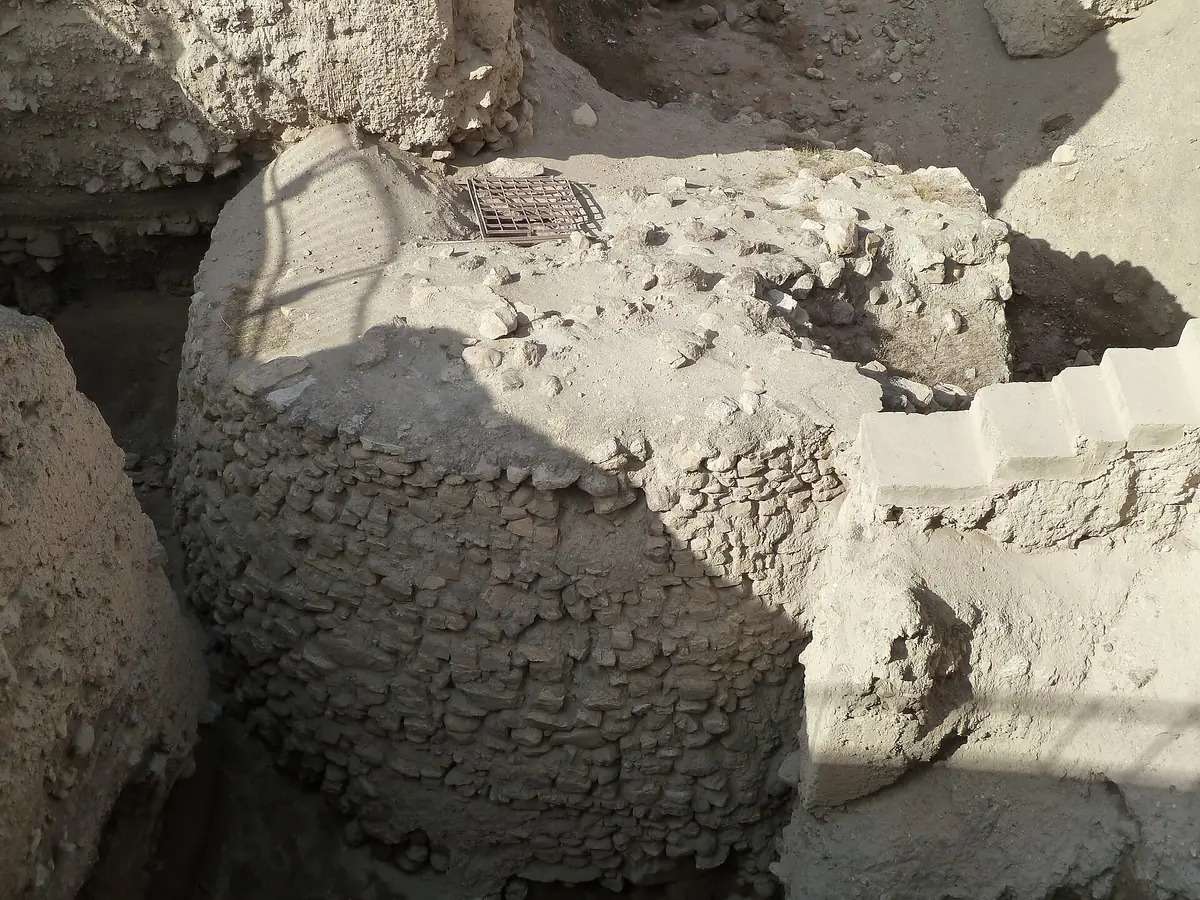
The most famous monument on the mound has nothing to do with Joshua. Discovered by Kathleen Kenyon at the bottom of her great western trench, the Tower of Jericho is a stone structure about 8.5 m high and almost 9 m across at the base, with an internal staircase of 22 steps. It dates from the Pre-Pottery Neolithic A, around 8000 BC, six to seven thousand years before the time given for the Exodus. Together with an adjoining wall, it is one of the oldest monumental structures known; its purpose (defence, flood protection, a communal landmark or a ritual building) is still debated.
In September 2023 the World Heritage Committee inscribed "Ancient Jericho/Tell es-Sultan" (State of Palestine) on the World Heritage List under criteria (iii) and (iv). UNESCO highlights the site's exceptional continuity of settlement, from the Natufian to the Neolithic and then the fortified towns of the Bronze Age.
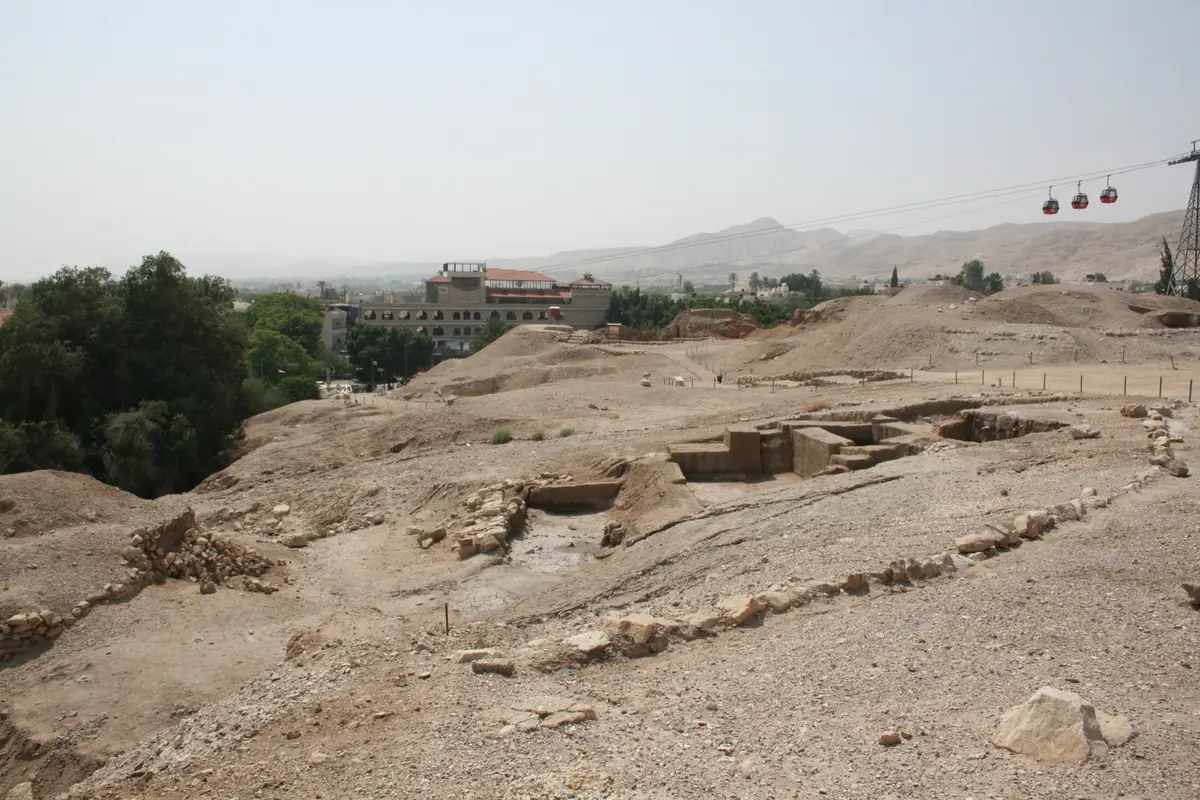
Paths and walkways lead around the mound. You can see Kenyon's great trench and the Neolithic tower behind a protective grille, sections of Early and Middle Bronze Age walls, and the earthen glacis that surrounded the Middle Bronze Age city. Information panels, partly based on the work of the Italian-Palestinian expedition, explain the successive phases. From the top, the view takes in the oasis, the mountains of Moab to the east and the cliffs of the Judean Desert to the west.
At the foot of the mound, across the road, rises the spring of Ein es-Sultan, the reason Jericho has existed for ten thousand years. Tradition calls it "Elisha's Spring": according to 2 Kings 2:19-22, the prophet healed the city's water by throwing salt into it. The identification rests on tradition and on the spring's proximity to the mound.
To place Jericho within the whole story, from Egypt to the settlement in Canaan, see the Exodus period; the next stop on the biblical journey is Shiloh, where Joshua set up the Tent of Meeting.
Jericho (Tell es-Sultan): the walls of Joshua
Tell es-Sultan, about 2 km north of central Jericho, opposite the Ein es-Sultan spring (≈ 35 km east of Jerusalem)
GPS coordinates : 31.8712, 35.4440
Start navigation with:
On a spur of the mountains of Moab, Deuteronomy has Moses gaze at the land he will never enter. Since the 4th century, a Christian sanctuary has kept that memory alive.
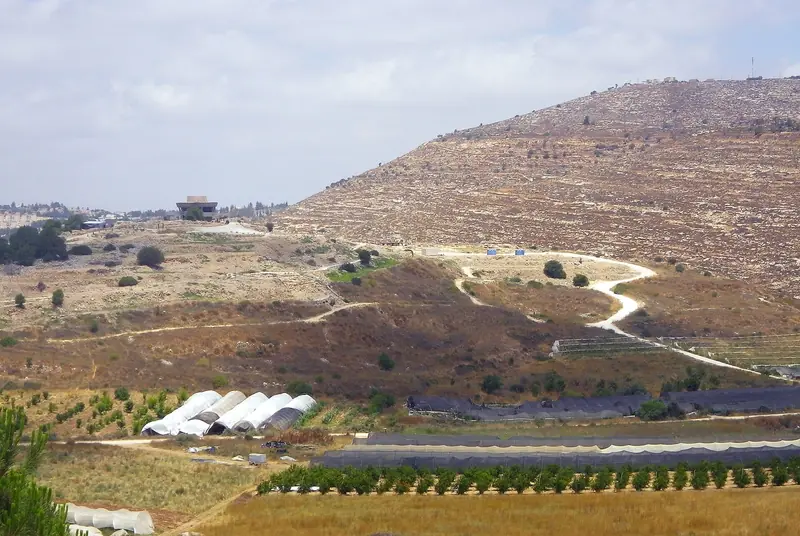
Israel's first great sanctuary according to the Bible: Joshua sets up the Tent of Meeting here, Hannah prays for a son, and Samuel grows up beside the priest Eli.
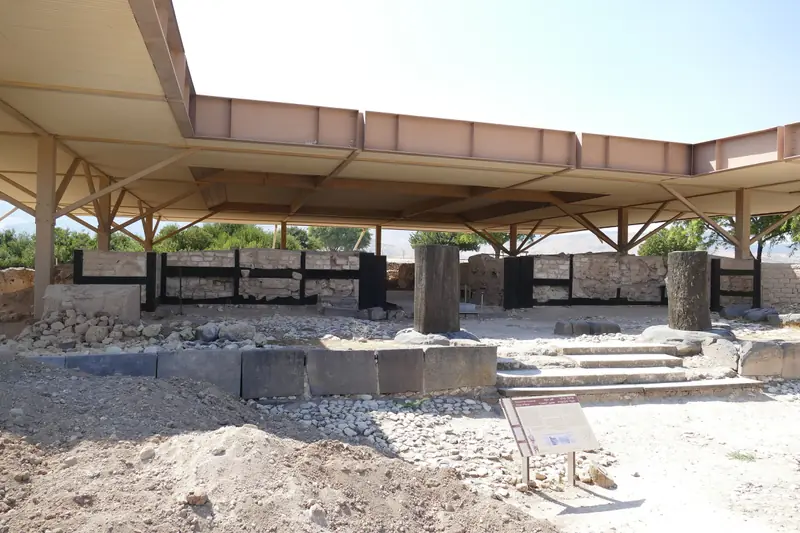
"The head of all those kingdoms": the largest Canaanite city in the land, its destruction by fire and an archaeological debate that is still open.
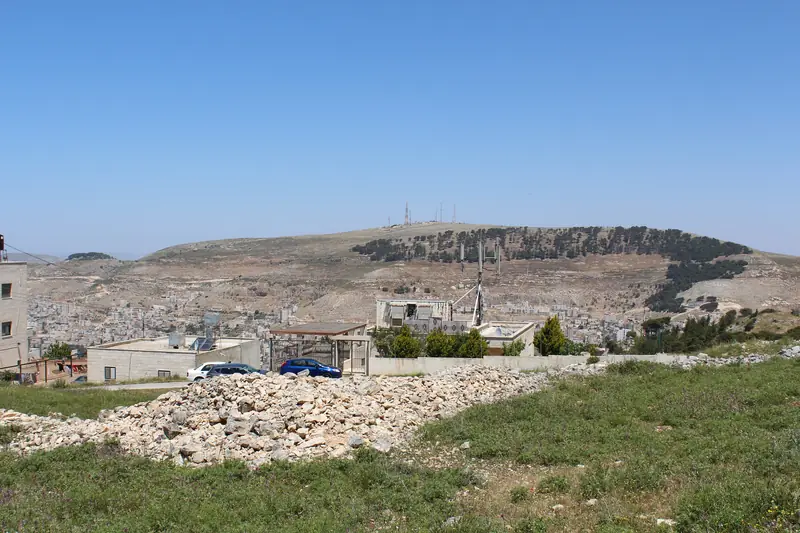
Between Mount Ebal and Mount Gerizim, Joshua has the Law read aloud, then gathers the tribes at Shechem and asks them to choose whom they will serve.
Old Testament Jericho is Tell es-Sultan, an archaeological mound about 2 km north of the centre of modern Jericho, next to the Ein es-Sultan spring. The identification is very widely accepted.
Several collapsed walls have been found, but none can be attributed with certainty to the episode in Joshua 6. The walls Garstang linked to Joshua date from the Early Bronze Age; the last great fortified city was destroyed at the end of the Middle Bronze Age, around 1550 BC according to the majority dating.
Kathleen Kenyon, followed by radiocarbon dating and the Italian-Palestinian expedition, dates the destruction of the fortified city to around 1550 BC, before the time given for Joshua. In 1990 Bryant Wood proposed redating it to around 1400 BC; this remains a minority view. Erosion of the Late Bronze Age levels makes interpretation even harder.
The stone tower on the mound dates from the Pre-Pottery Neolithic A, around 8000 BC. About 8.5 m high, with an internal staircase of 22 steps, it long predates any biblical period.
Yes. "Ancient Jericho/Tell es-Sultan" was inscribed on the World Heritage List in September 2023, for the State of Palestine, for its exceptional continuity of settlement since the 10th millennium BC.
Jericho is about 35 km from Jerusalem by road. The town is in Area A, administered by the Palestinian Authority: access conditions vary with the situation and the visitor's nationality. Many travellers go with a local agency or guide; check official advice before you leave.
No. Hisham's Palace (Khirbet al-Mafjar) is an Umayyad complex of the 8th century AD, built more than two thousand years after the time of Joshua. It is often visited on the same day as Tell es-Sultan.
According to Joshua 6:25, Rahab and her whole family were spared and lived among Israel. The New Testament names her in the genealogy of Jesus (Matthew 1:5) and among the examples of faith (Hebrews 11:31).