Nazareth, the Town of Jesus: Annunciation, Excavations and Visit
The Galilean village where the Gospels place the Annunciation and the childhood of Jesus, today Israel's largest Arab city: shrines, excavations and visiting tips.
c. AD 27 – 30
The fishing village where Jesus settled, taught in the synagogue and stayed with Peter: what the Gospels say, what the excavations found and what you can see today.
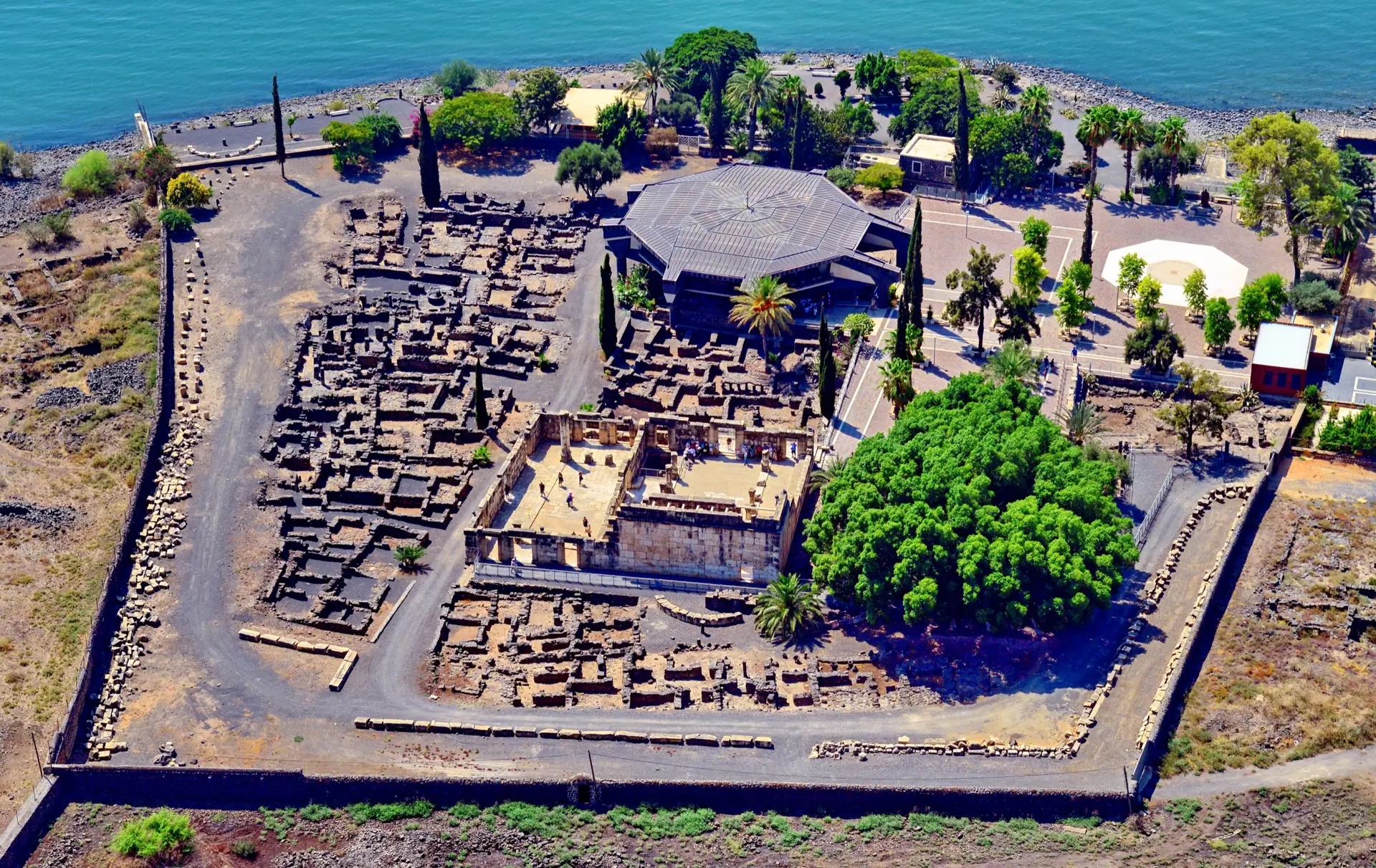
Credit: AVRAMGR · CC BY-SA 4.0 · Wikimedia Commons
On the north shore of the Sea of Galilee, Capernaum is the fishing village the Gospels call Jesus's "own city": he left Nazareth to live here, taught in the synagogue and stayed in the house of Simon Peter. Its Hebrew name, Kfar Nahum, means "village of Nahum"; the Arabs called its ruins Tell Hum. Today the site is Kfar Nahum National Park and the Franciscan sanctuary of the "Town of Jesus".
Here you can see one of the finest ancient synagogues in Galilee, built of white limestone on top of older basalt foundations, and, a few metres away, the remains of a 1st-century house venerated from very early on as the house of Peter, now covered by a modern memorial church. In French, the word "capharnaüm" even means a cluttered mess, because of this town and the crowds that gathered here around Jesus.
Capernaum does not appear in the Old Testament. It emerges in all four Gospels, where, after the lake itself, it is the place most often named in Jesus's ministry in Galilee.
After his baptism and the arrest of John the Baptist, Jesus leaves the village of his childhood, Nazareth, up in the hills, for this lakeside town on a trade route, at the edge of the territory of Herod Antipas.
"And leaving Nazareth, he came and dwelt in Capernaum, which is upon the sea coast, in the borders of Zabulon and Nephthalim."
Matthew 4:13 (KJV)
It is by this lake that he calls his first disciples, the fishermen Simon Peter and Andrew, then James and John (Matthew 4:18-22), and, in Capernaum itself, the tax collector Levi, also called Matthew (Mark 2:14; Matthew 9:9). Matthew ends up calling it simply "his own city" (Matthew 9:1).
Mark's Gospel describes a typical day: on the Sabbath, Jesus teaches in the synagogue and frees a possessed man; his hearers "were astonished at his doctrine" (Mark 1:21-28). On leaving, he enters the house of Simon and Andrew and heals Simon's mother-in-law of a fever (Mark 1:29-31). In the evening "all the city was gathered together at the door" (Mark 1:33).
A few days later, word spreads that Jesus is "in the house". The crowd is so dense that four men carrying a paralysed friend have to open up the roof to lower him down in front of Jesus (Mark 2:1-12).
"And straightway many were gathered together, insomuch that there was no room to receive them, no, not so much as about the door: and he preached the word unto them."
Mark 2:2 (KJV)
🔎 Why "capharnaüm" means a mess in French
In French, "un capharnaüm" is a room crammed with clutter. The figurative sense appeared in the 19th century. According to the Dictionary of the Académie française, it comes from "Capernaum, the town in Galilee where Jesus was besieged by a motley crowd of sick people": from that crush at the door, the name of the town passed to any place piled high with things in disorder. The real site is one of the most peaceful spots on the lake.
In Capernaum a Roman centurion asks Jesus to heal his servant. The village elders plead for him: "he loveth our nation, and he hath built us a synagogue" (Luke 7:5; Matthew 8:5-13). John's Gospel also places here the long discourse on the bread of life, given after the feeding of the five thousand: "These things said he in the synagogue, as he taught in Capernaum" (John 6:59). It is here, too, that Peter finds a coin in a fish's mouth to pay the Temple tax (Matthew 17:24-27).
The story ends on a dark note. Along with the neighbouring villages of Chorazin and Bethsaida, Capernaum is rebuked for not repenting despite the miracles, and compared to Sodom:
"And thou, Capernaum, which art exalted unto heaven, shalt be brought down to hell: for if the mighty works, which have been done in thee, had been done in Sodom, it would have remained until this day."
Matthew 11:23 (KJV)
Christian readers have often seen the ruins of the village, abandoned in the Middle Ages, as the fulfilment of this saying. The excavations, however, show a longer story: the village went on thriving for six more centuries after Jesus.
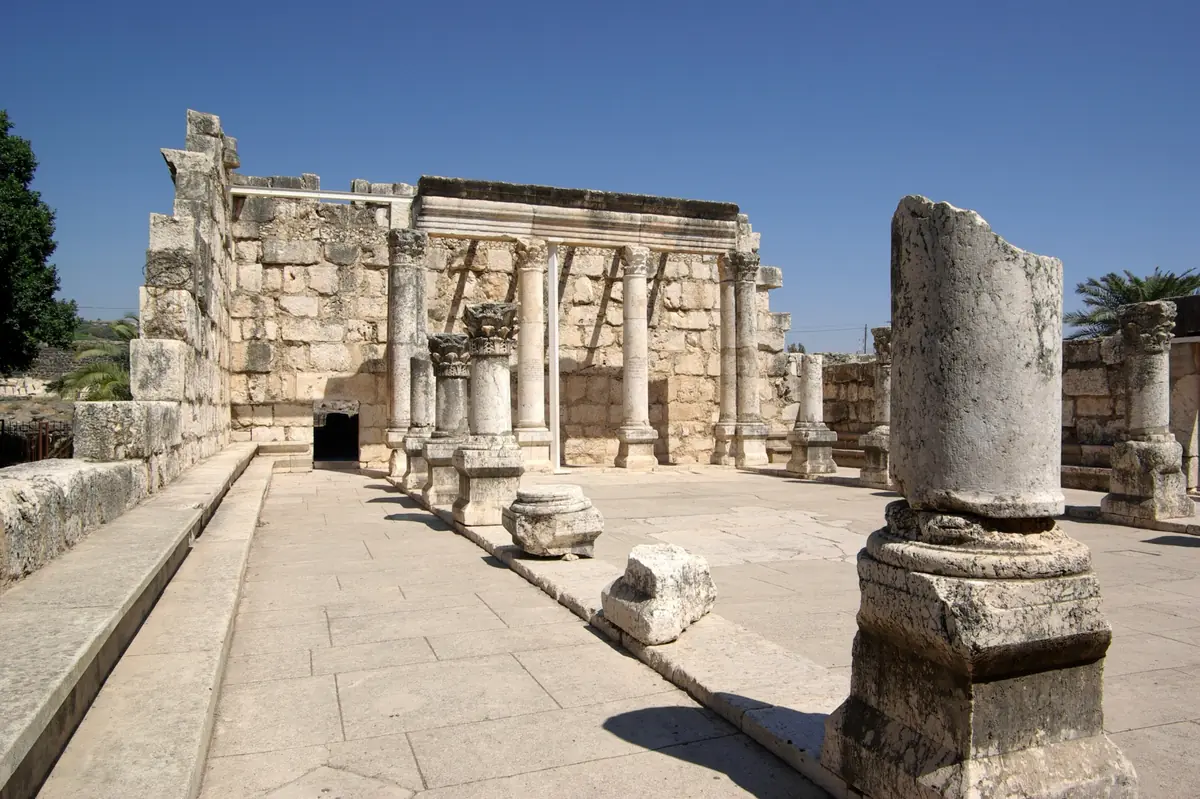
In the middle of a village of black basalt stands a building of white limestone brought from afar: the most richly decorated synagogue found so far in Galilee. Its prayer hall measures about 23 × 17 m, with colonnades on three sides, probably a gallery above and, on the east side, a courtyard lined with porticoes. The façade faces Jerusalem and opens through three doors.
Not the building you see. For a long time it was dated to the 2nd-3rd century on stylistic grounds. But the Franciscan excavators Virgilio Corbo and Stanislao Loffreda found thousands of late 4th-century coins and pottery sealed beneath the paving and in the fills, placing its construction in the late 4th or the 5th century. This late date is now the most widely accepted, though some scholars still question it. It makes the building a remarkable witness to Jewish life in Galilee in the Byzantine period, when churches were multiplying around the lake.
Beneath the white synagogue, soundings exposed older basalt walls and a basalt floor following roughly the same plan. The excavators see them as the remains of a 1st-century synagogue, the one where Jesus taught according to the Gospels and which Luke credits to the centurion. The hypothesis is serious but debated: it is not certain that these remains belong to a public building rather than to houses. You can see them clearly at the base of the walls, where the black stone shows beneath the white.
About thirty metres south of the synagogue, between the main street and the shore, the 1968 excavations uncovered an exceptional complex that archaeologists call the insula sacra, the "sacred block".
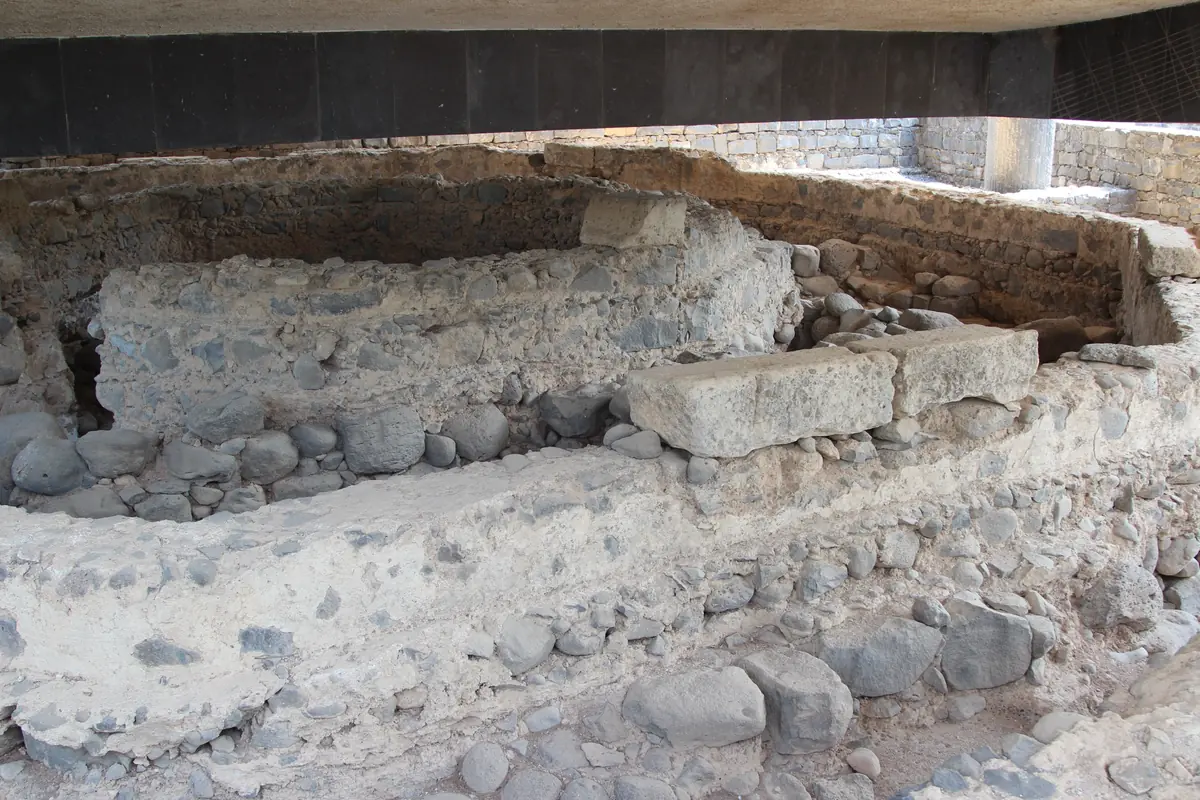
At first nothing sets this dwelling apart from its neighbours: rooms of dry-laid basalt stones grouped around courtyards, with fish hooks and net weights in the floors. But one room later had a different fate. Its walls were plastered and replastered, its floor carefully laid, and fragments of plaster were found covered with graffiti left by visitors in Greek, Syriac, Aramaic and Latin: prayers, crosses, names. Some readers, such as the Franciscan Emmanuele Testa, have identified the name of Peter; these readings remain debated. At a date that is also disputed, between the 1st and the 4th century, the room became a domus ecclesia, a house turned into a place of worship, and was then enclosed by a wall that cut it off from the village.
At the end of the 4th century, a pilgrimage account attributed to the traveller Egeria, preserved by the monk Peter the Deacon, notes that in Capernaum "the house of the prince of the apostles has been made into a church, whose walls still stand as they were".
In the 5th century the house-church was replaced by an octagonal church built directly over the venerated room, with a mosaic floor (the central panel shows a peacock). This centralised plan, typical of shrines marking a holy spot, shows that Christians of the time regarded the place as the house of Peter. Archaeology obviously cannot prove who lived there; what it does establish is a very early and continuous veneration, which is rare in the Holy Land.
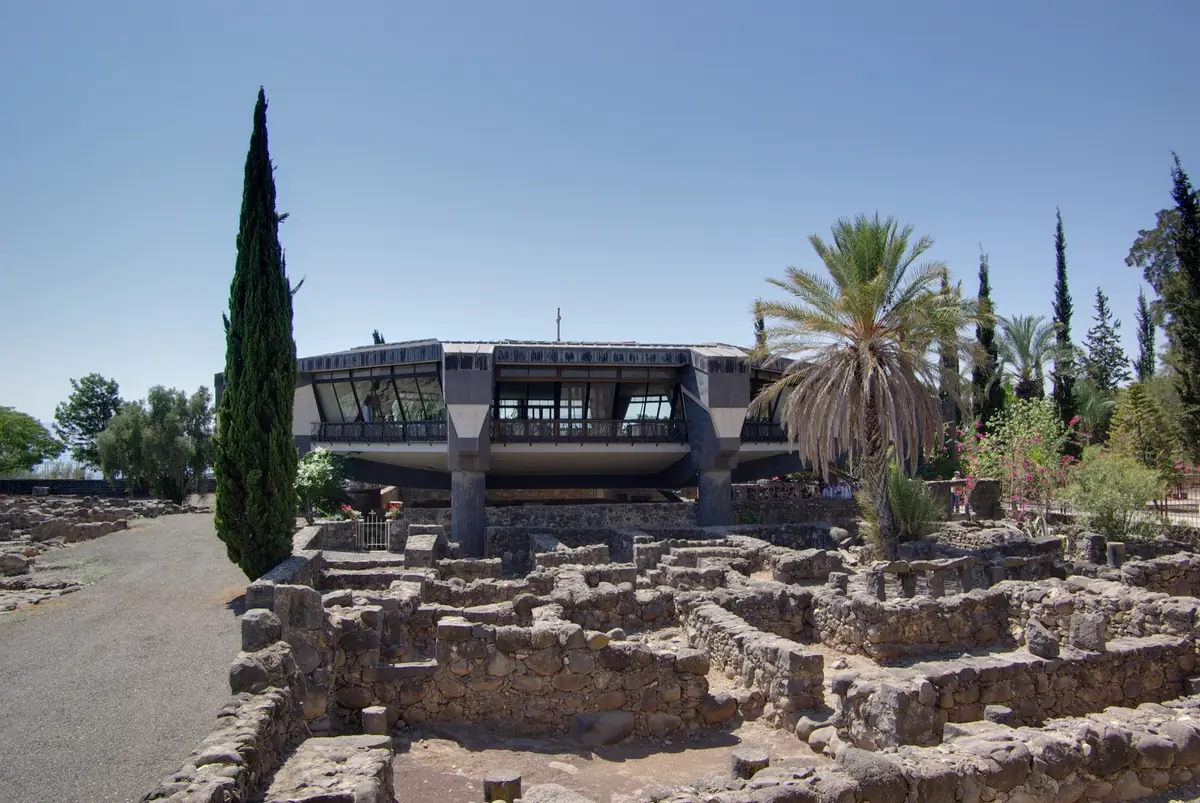
In 1990 the Franciscan Custody inaugurated a modern church above the ruins, designed by the Italian architect Ildo Avetta. Raised on pillars, it evokes a boat hovering over the fisherman's house. In the centre, a glass floor reveals the remains of the house and the Byzantine octagon; from outside, you can also look at them from below, in the shade of the building.
The name Kfar Nahum means "village of Nahum", though no one knows which Nahum; tradition has sometimes linked it to the prophet, without evidence. The 1st-century Jewish historian Flavius Josephus mentions a spring called Capharnaum that waters the nearby plain of Gennesaret (Jewish War 3.519), and says he was carried, injured, to a village he calls Kepharnokos (Life 403). Founded around the 2nd century BC, the village probably had between a few hundred and 1,500 inhabitants in the time of Jesus. It lived from fishing, farming and the road running along the lake towards Damascus.
The Franciscan excavations, published in the Cafarnao series, revealed a dense village of basalt houses grouped in blocks, with no large mansions or lavish public buildings before the Byzantine period. Stanislao Loffreda, who devoted much of his life to the site, died in 2025.
The site is divided into two neighbouring parts, each with its own entrance. It lies within Kfar Nahum National Park, created by the Israel Nature and Parks Authority, which has also landscaped the surroundings and the shore.
The western part, the most visited, belongs to the Franciscan Custody of the Holy Land. You enter through a gate near the car park, where a large statue of Saint Peter greets pilgrims. The visit follows the lanes of the basalt village to the white synagogue, which you can walk through, and then to the memorial church, where the house of Peter can be seen beneath the glass floor. A small garden of carved stones displays decorated blocks from the synagogue (menorah, star, Ark on wheels). Clothing covering shoulders and knees is required.
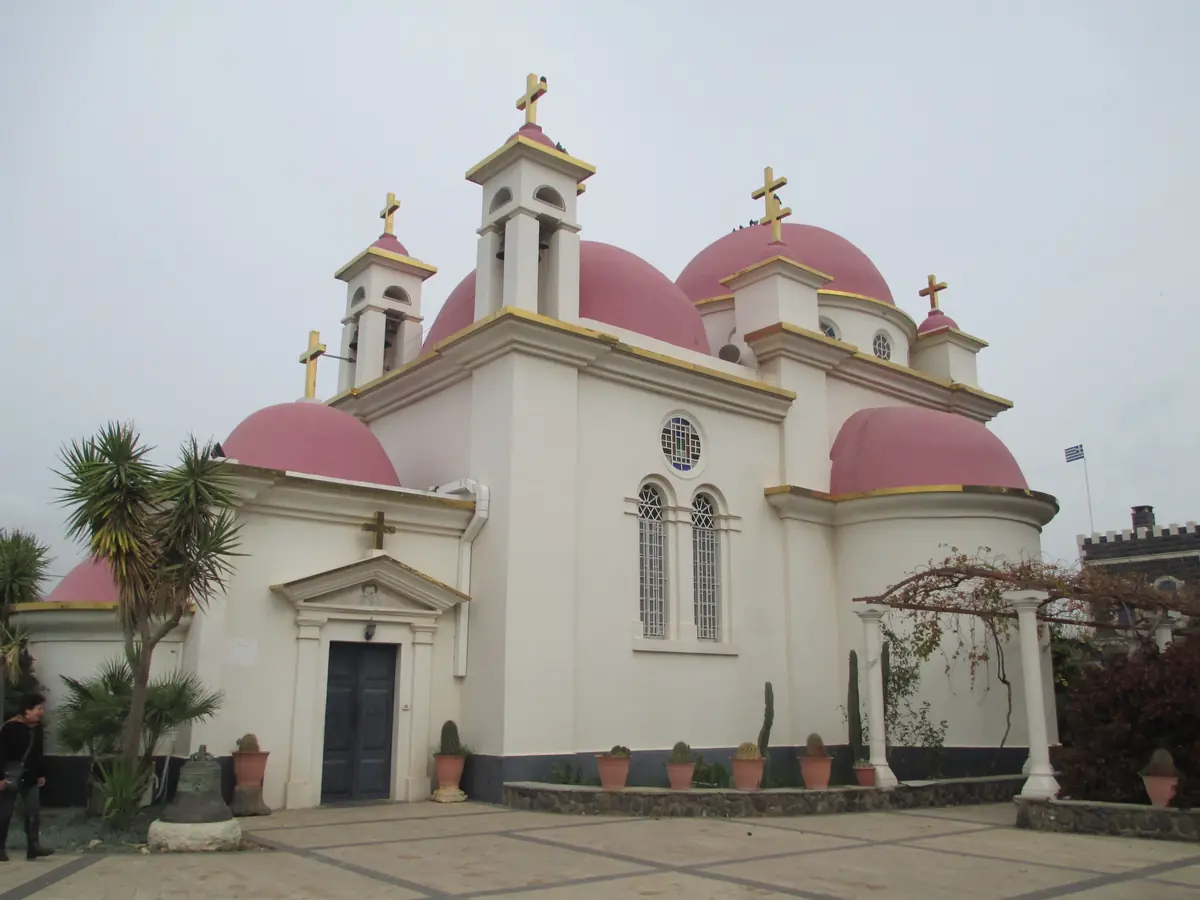
A few hundred metres to the east, the Greek Orthodox Monastery of the Holy Apostles, which belongs to the Greek Orthodox Patriarchate of Jerusalem, is easy to spot from afar thanks to its pink domes. The church, founded in the 1920s and rebuilt in the 1980s, is entirely covered with frescoes painted in the late 1990s. Around it lie ruins of the Byzantine and early Islamic village, where the inhabitants had moved.
Together with its neighbours, Capernaum forms the "evangelical triangle" of the northern shore. About 3 km to the west, Tabgha is home to the Church of the Multiplication, with its famous Byzantine mosaic, and the Church of the Primacy of Peter. Just above, the Mount of Beatitudes commemorates the Sermon on the Mount. These places are presented on the page on the ministry of Jesus in Galilee. Further north, about twenty minutes' drive away, the great Canaanite and Israelite mound of Hazor takes you back a thousand years earlier.
Capernaum, the town of Jesus on the Sea of Galilee
Kfar Nahum National Park, north shore of the Sea of Galilee, off Route 87 (about 16 km north of Tiberias)
GPS coordinates : 32.8811, 35.5750
Start navigation with:
The Galilean village where the Gospels place the Annunciation and the childhood of Jesus, today Israel's largest Arab city: shrines, excavations and visiting tips.
"The head of all those kingdoms": the largest Canaanite city in the land, its destruction by fire and an archaeological debate that is still open.
From Genesis 14 to the "House of David" stele: archaeology, nature and biblical history at the springs of the Jordan.
Capernaum comes from the Hebrew Kfar Nahum, "village of Nahum". In French, "un capharnaüm" has meant a cluttered place since the 19th century: according to the Académie française, the sense comes from the crowd of sick people that besieged Jesus in Capernaum (Mark 1:33 and 2:2). Nadine Labaki's film <em>Capernaum</em> (2018) plays on this figurative meaning.
Capernaum is in Israel, on the north shore of the Sea of Galilee (Lake Tiberias), about 16 km north of Tiberias and an hour's drive from Nazareth. The site is reached by Route 87.
Yes. Kfar Nahum ("village of Nahum") is the Hebrew name, from which the Greek and Latin <em>Capharnaum</em> and the English Capernaum derive. The ruins were known in Arabic as Tell Hum. The site is now Kfar Nahum National Park.
Jesus settled there after leaving Nazareth (Matthew 4:13). He taught in the synagogue, healed Peter's mother-in-law, a paralysed man lowered through the roof and a centurion's servant, called the tax collector Matthew and gave the discourse on the bread of life (John 6). He eventually rebuked the town for failing to repent (Matthew 11:23).
The white limestone synagogue visible today dates from the late 4th or the 5th century, according to the coins found under its floor. Beneath it, older basalt walls and a floor may belong to the 1st-century synagogue where Jesus taught, but this identification is still debated.
The excavations uncovered a 1st-century house turned very early into a place of worship, with Christian graffiti, and later covered by an octagonal church in the 5th century. Archaeology proves a very ancient veneration of this house as Peter's, not the identity of its occupants. It can be seen through the glass floor of the memorial church built in 1990.
Yes. Tabgha (Church of the Multiplication and Church of the Primacy of Peter) is about 3 km to the west, and the Mount of Beatitudes overlooks Tabgha. All three sites can easily be visited in the same half-day.
It is the Greek Orthodox Church of the Holy Apostles, a few hundred metres east of the Franciscan site. It belongs to the Greek Orthodox Patriarchate of Jerusalem and is decorated inside with frescoes.