
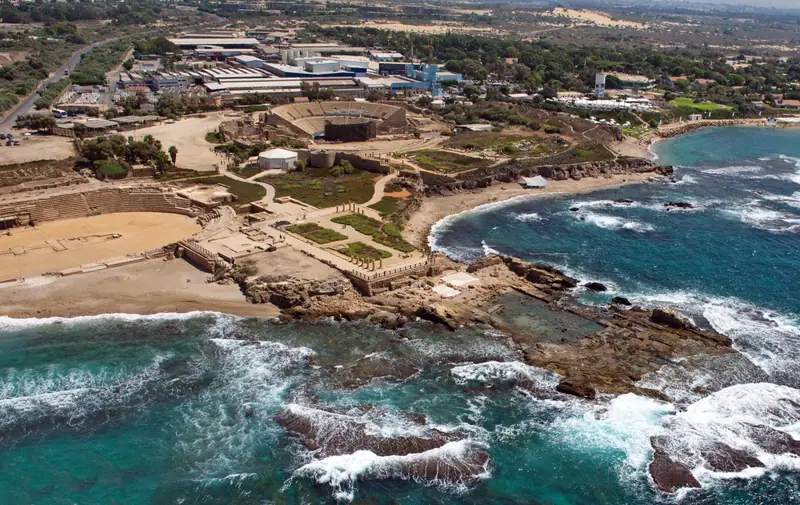
Caesarea Maritima, Herod's city: theatre, aqueduct and visit
Herod's great harbour and the seat of the Roman governors, where Peter baptised Cornelius and Paul was held for two years: an archaeological park on the Mediterranean shore.
AD 30 – 70
From Lebanese cedars landed for the Temple to Peter's vision on the roof of Simon the Tanner: four thousand years of history on a hill above the Mediterranean.
Credit: JRodSilva · CC BY-SA 4.0 · Wikimedia Commons
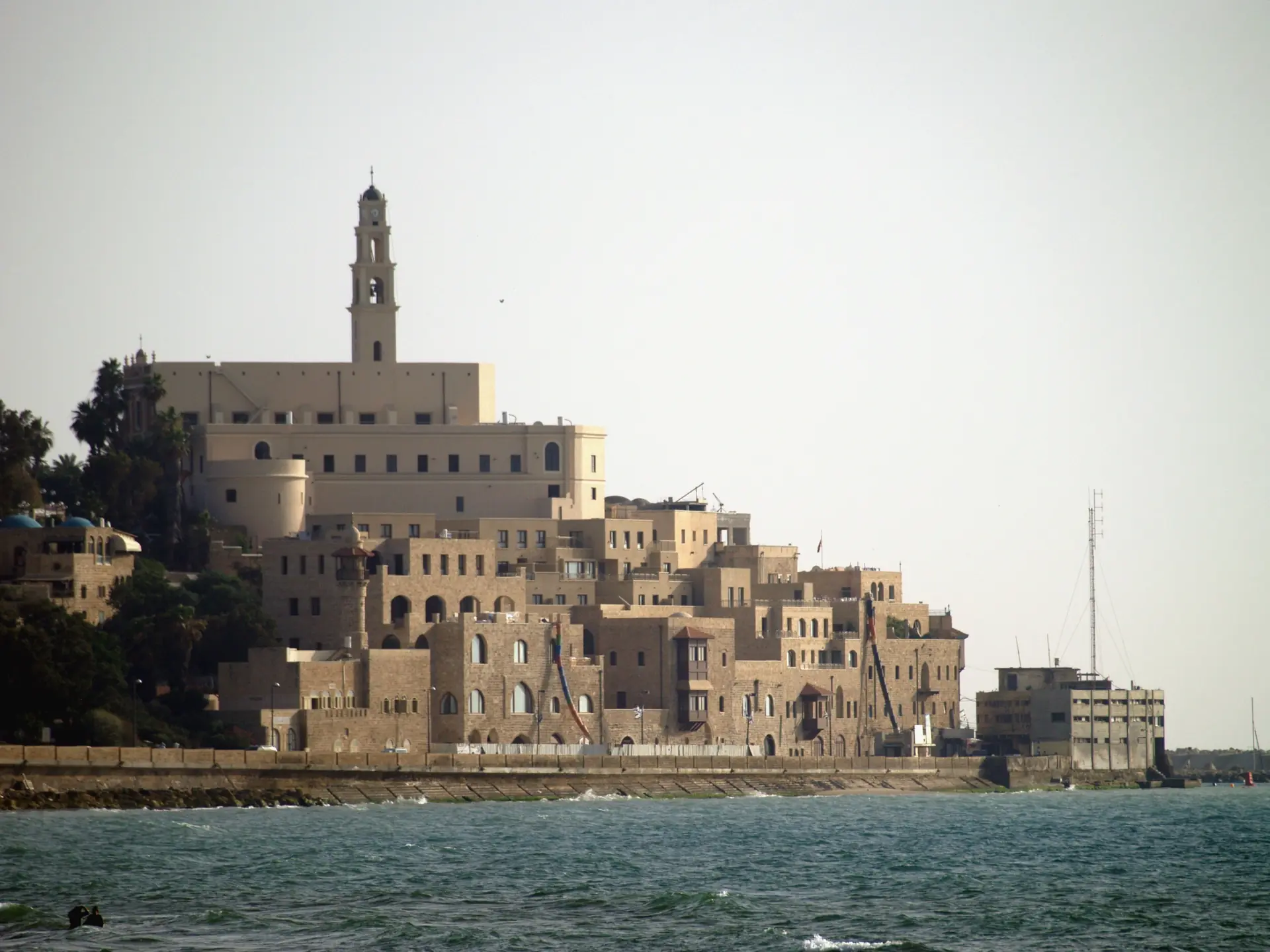
Set on a sandstone hill above the Mediterranean, just south of Tel Aviv, Jaffa is often described as one of the oldest ports in the world still in use. The Hebrew Bible calls it Japho (Yafo), the New Testament Joppa: this is where the prophet Jonah boards a ship to flee to Tarshish, where the cedars of Lebanon for the Temple in Jerusalem were landed, and where the apostle Peter raises Tabitha and stays with Simon the Tanner, receiving the vision that opens the early Church to non-Jews (Acts 9-10).
Now a district of the Tel Aviv-Yafo municipality, Old Jaffa combines restored alleys, galleries, a Franciscan church, mosques and archaeological remains. Beneath the hill, excavations have uncovered an Egyptian fortress and the monumental gate of Ramesses II. This guide sets out what the texts say, what archaeologists have found and what you can see today around Jaffa port.
On a low, sandy coastline with almost no natural shelter between Mount Carmel and Gaza, Jaffa offers a small anchorage protected by a line of reefs. That explains its role: for centuries it was the nearest port to Jerusalem, some sixty kilometres inland.
The first biblical mention comes in the list of tribal territories: the lot of Dan reaches "Me-jarkon, and Rakkon, with the border before Japho" (Joshua 19:46). The text does not say the town itself belonged to Israel; it presents it rather as a landmark on the coast.
To build the Temple, Solomon turns to Hiram, king of Tyre, who promises to ship the timber by sea to Jaffa, from where it will be carried overland to Jerusalem, on Mount Moriah.
"And we will cut wood out of Lebanon, as much as thou shalt need: and we will bring it to thee in floats by sea to Joppa; and thou shalt carry it up to Jerusalem."
2 Chronicles 2:16 (KJV)
The same route is used after the Exile: for the Second Temple, the people of Sidon and Tyre are paid "to bring cedar trees from Lebanon to the sea of Joppa" (Ezra 3:7). A Phoenician inscription on the sarcophagus of Eshmunazar II, king of Sidon (5th century BC), confirms that the coast of Dor and Jaffa had been granted to the Sidonians by the king of Persia.
The best-known story is that of the prophet Jonah. Sent to preach in Nineveh, he heads the opposite way:
"But Jonah rose up to flee unto Tarshish from the presence of the Lord, and went down to Joppa; and he found a ship going to Tarshish: so he paid the fare thereof, and went down into it, to go with them unto Tarshish from the presence of the Lord."
Jonah 1:3 (KJV)
The storm, the great fish and the preaching in Nineveh follow. The Book of Jonah says nothing more about the town, but it made Jaffa, for good, the port of departure and of flight.
🔎 Japho, Joppa, Jaffa, Yafo
All these names refer to the same town. The Hebrew Yafo is often linked to yafeh, "beautiful"; a late Jewish tradition credits its founding to Japheth, son of Noah. The Greeks called it Ioppe, hence "Joppa" in the Acts of the Apostles; the Arabic Yafa gave "Jaffa".
In the Acts of the Apostles, Joppa is home to one of the first communities of disciples outside Jerusalem. Peter is at Lydda (modern Lod, about fifteen kilometres away) when messengers come for him.
"Now there was at Joppa a certain disciple named Tabitha, which by interpretation is called Dorcas" (Acts 9:36): both names, Aramaic and Greek, mean "gazelle". Known for her charity and for the clothes she made for widows, she has just died. Peter goes up to the upper room where her body has been laid.
"But Peter put them all forth, and kneeled down, and prayed; and turning him to the body said, Tabitha, arise. And she opened her eyes: and when she saw Peter, she sat up."
Acts 9:40 (KJV)
The event, the text says, "was known throughout all Joppa", and Peter then "tarried many days in Joppa with one Simon a tanner" (Acts 9:43). A tanner worked animal hides: a foul-smelling trade, usually carried out on the edge of town and near water. Acts indeed notes that his house was "by the sea side" (Acts 10:6).
Around noon, Peter goes up on the roof of Simon's house to pray. He is hungry and falls into a trance: he sees a great sheet let down from heaven, full of every kind of animal, clean and unclean under the Law of Moses.
"And there came a voice to him, Rise, Peter; kill, and eat. But Peter said, Not so, Lord; for I have never eaten any thing that is common or unclean. And the voice spake unto him again the second time, What God hath cleansed, that call not thou common."
Acts 10:13-15 (KJV)
At that very moment the messengers of the Roman centurion Cornelius arrive. Peter follows them to Caesarea Maritima, where he baptises the first Gentile convert in the Acts narrative. This gives Jaffa a special place in Christian history: the town where the mission opened beyond Judaism. For the wider context, see the period of the Apostles and the Early Church.
📍 The tomb of Tabitha
No archaeological evidence identifies Tabitha's house. A Russian Orthodox tradition places her tomb in a burial cave in the Abu Kabir district, east of Old Jaffa, where the Russian Ecclesiastical Mission built the Church of St Peter and St Tabitha at the end of the 19th century. This is a tradition, not a historical identification.
The hill of Old Jaffa is a tell, a mound built up by successive towns. Occupation has been traced from the Middle Bronze Age to the Ottoman period.
Jaffa appears among the towns subdued by Pharaoh Thutmose III in the 15th century BC, and again in the Amarna letters of the following century. An Egyptian tale preserved on Papyrus Harris 500 (British Museum) even describes its capture by the general Djehuty, who is said to have smuggled soldiers into the town hidden in baskets, a ruse reminiscent of the Trojan Horse. The story is literary, but it shows how much Egypt valued this port. Like Gezer further inland, Jaffa was then a relay of Egyptian power in Canaan.
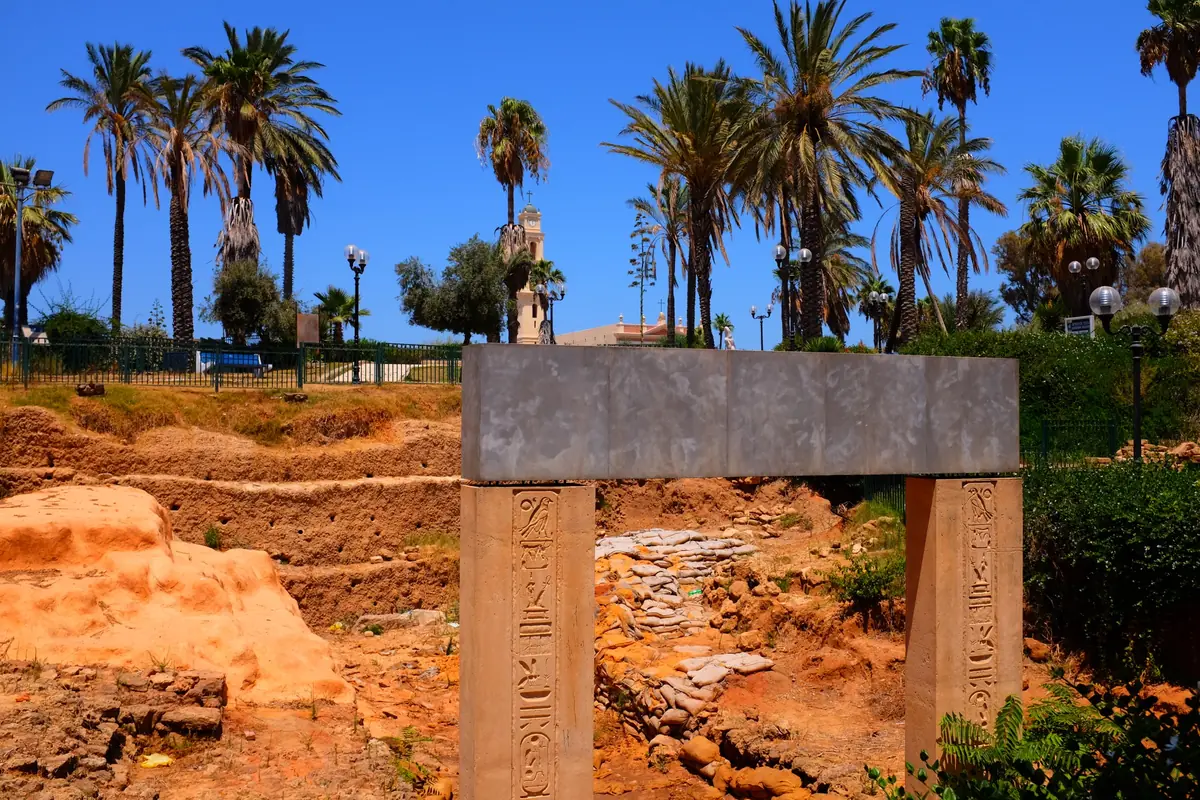
In the 1950s and 1960s the archaeologist Jacob Kaplan uncovered on the hill fragments of a monumental stone gateway inscribed with the titles and name of Ramesses II. He also exposed a building he interpreted as a temple, nicknamed the "Lion Temple" after a lion skull found inside; that interpretation is now debated.
Since 2007 the Jaffa Cultural Heritage Project, directed by Aaron A. Burke (University of California, Los Angeles) and Martin Peilstöcker (Johannes Gutenberg University Mainz), has resumed excavation and published Kaplan's finds. Their work shows that the gate was destroyed and rebuilt, and that the fortress burned twice in the 12th century BC: radiocarbon dates place the last fire around 1125 BC, at the end of Egyptian rule. The excavators see this as evidence of local revolts. A reconstruction of the gate now stands in a small garden on the hill.
In 701 BC the annals of the Assyrian king Sennacherib list Jaffa among the towns taken from the king of Ashkelon. In the Hellenistic period the town is contested by the Maccabees: Jonathan captures it (1 Maccabees 10:75-76), then Simon makes it the port of Hasmonean Judea (1 Maccabees 14:5). During the Great Jewish Revolt it is destroyed by the Romans in AD 66-67, according to Josephus. In the Middle Ages the Crusaders made it the landing port for pilgrims and the seat of the County of Jaffa; Louis IX of France had its fortifications restored in 1252.
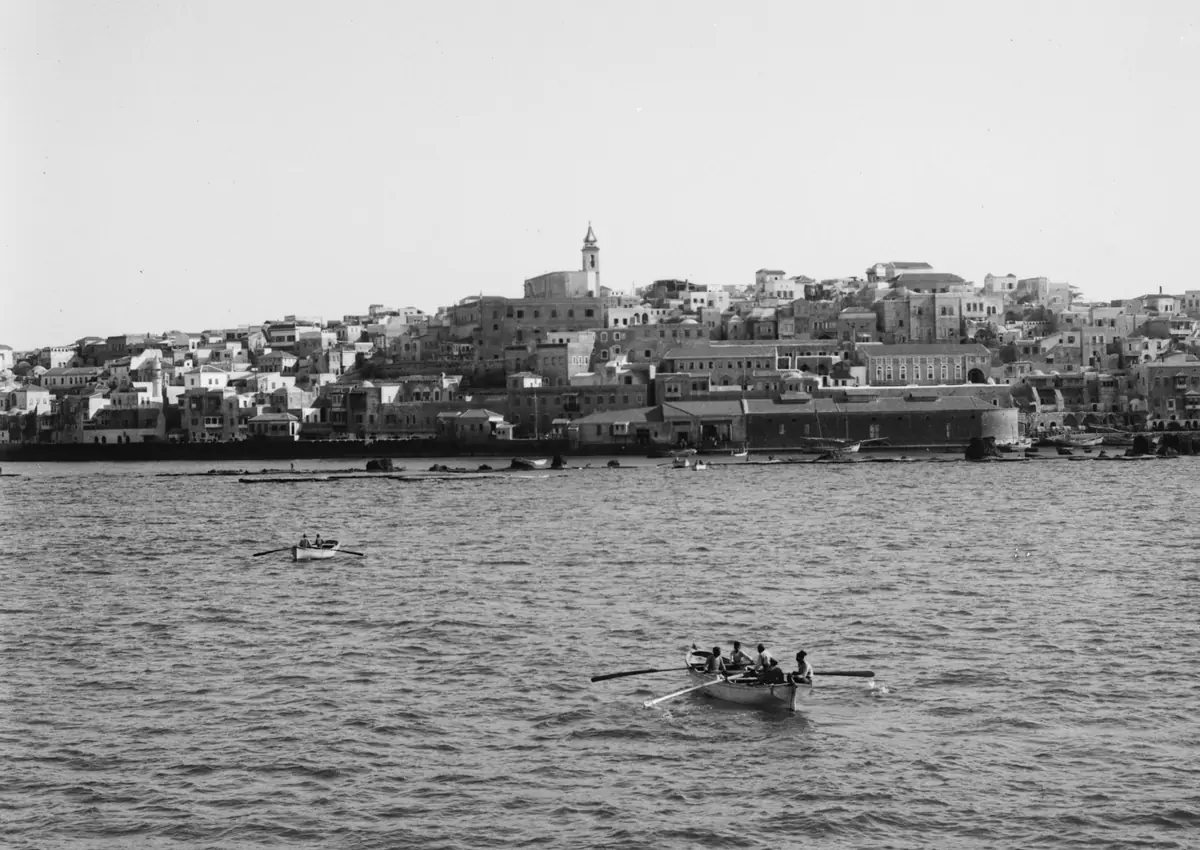
Bonaparte's passage in March 1799 remains one of the darkest episodes in the town's history: the garrison and prisoners were massacred, then plague broke out in the French army, as depicted in Gros's painting Bonaparte Visiting the Plague Victims of Jaffa (1804, Louvre).
Old Jaffa is best explored on foot, in a loop from the Ottoman clock tower (early 20th century) down to the port. Everything is packed onto a hill of just a few hectares.
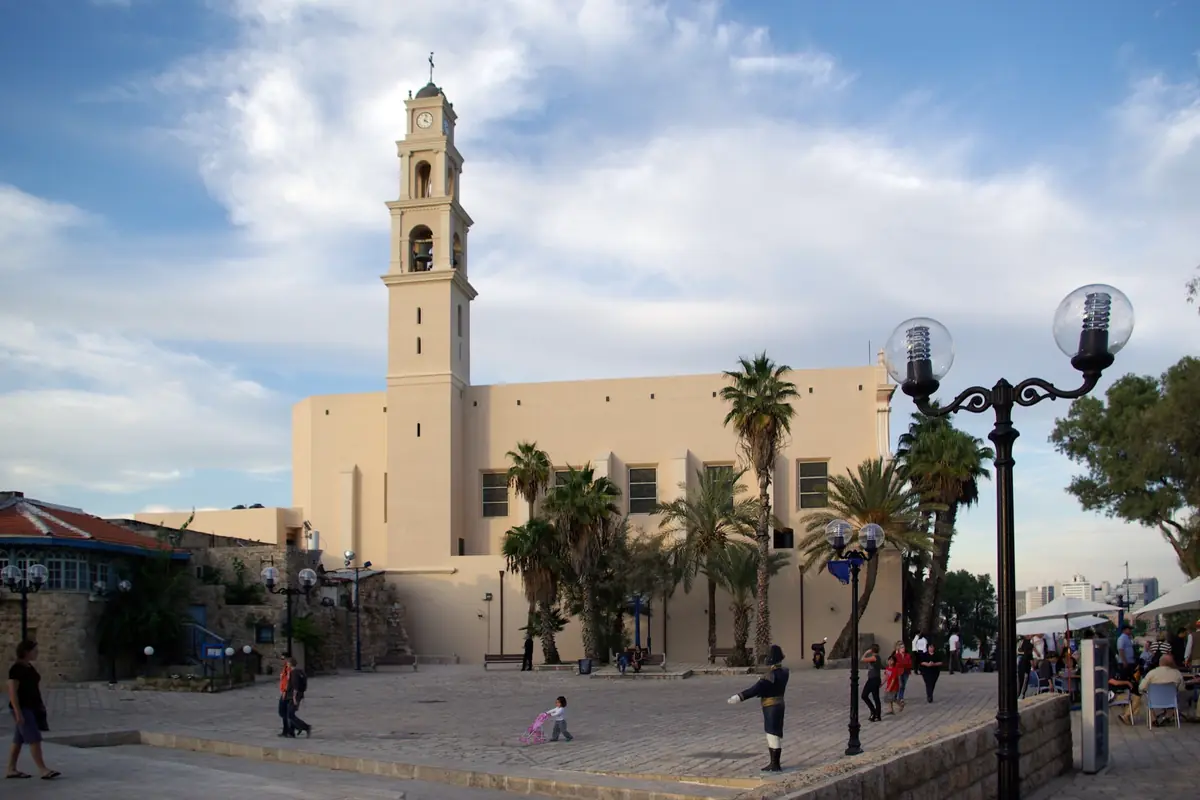
Its bell tower dominates the old town and can be seen from all along the bay of Tel Aviv. The present church, run by the Franciscans of the Custody of the Holy Land, was built between 1888 and 1894 on the remains of a medieval citadel. It commemorates Peter's stay in Joppa; inside, note the stained glass and the pulpit carved in the shape of a tree. Tradition holds that Bonaparte stayed in the friary in 1799.
A few alleys away, near the old lighthouse, a stone house is pointed out by tradition as the House of Simon the Tanner, where Peter had his vision. The property, privately owned by an Armenian family, also contains a small former mosque. It is not normally open to visitors: you stop at the door. Nothing allows the house in Acts to be located here archaeologically, but the setting above the sea matches the description in the text.
At the heart of the old town, Kedumim Square hides beneath its paving an archaeological centre that displays Hellenistic and Roman remains and tells the town's story. The hilltop park (Gan HaPisga) offers the best view of the Tel Aviv coastline; nearby, the Ramesses Gate Garden displays the reconstruction of the Egyptian gate and part of the excavated area.
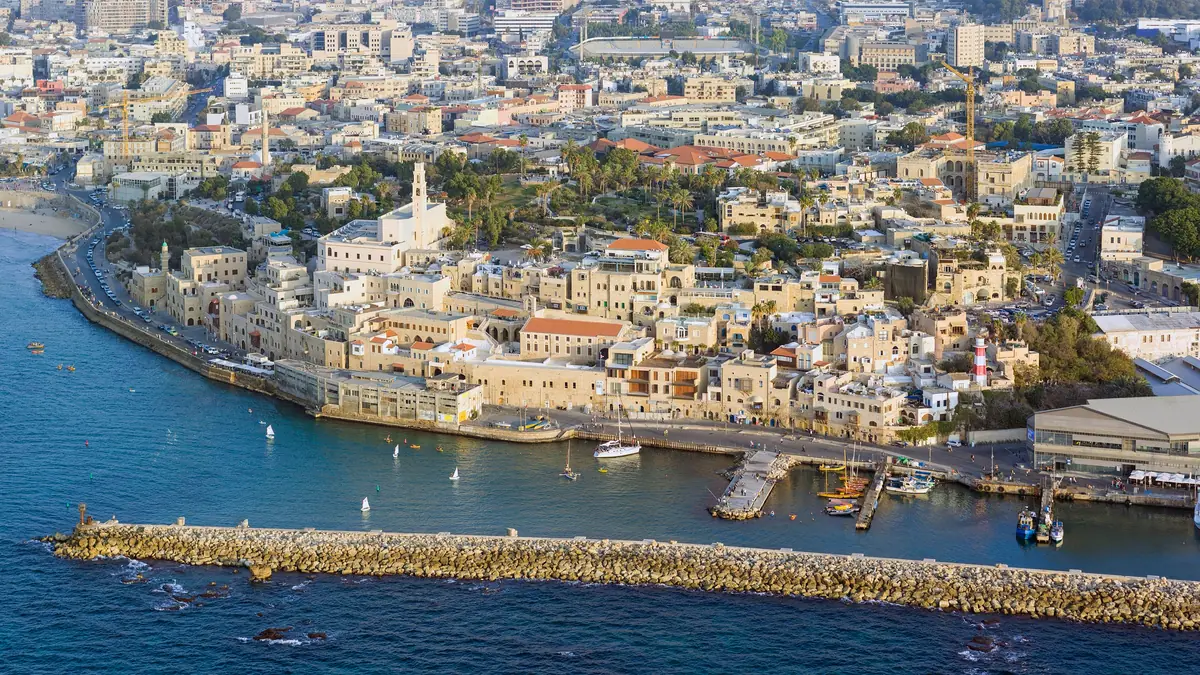
Below, Jaffa port lost its commercial traffic in the 20th century but remains a fishing and leisure harbour, lined with old warehouses turned into restaurants and cultural venues. At the entrance to the anchorage, a cluster of black reefs is known as Andromeda's Rock: ancient authors (Strabo, Pliny the Elder, Josephus) placed at Jaffa the Greek myth of the princess chained to a rock and rescued by Perseus. Greek myth and the story of Jonah thus share the same seascape.
Jaffa, Ancient Joppa: the Port of Jonah and Peter
Old Jaffa, southern Tel Aviv-Yafo: the hill around Kedumim Square and St Peter's Church, with Jaffa port below (≈ 60 km from Jerusalem)
GPS coordinates : 32.0545, 34.7530
Start navigation with:
Herod's great harbour and the seat of the Roman governors, where Peter baptised Cornelius and Paul was held for two years: an archaeological park on the Mediterranean shore.
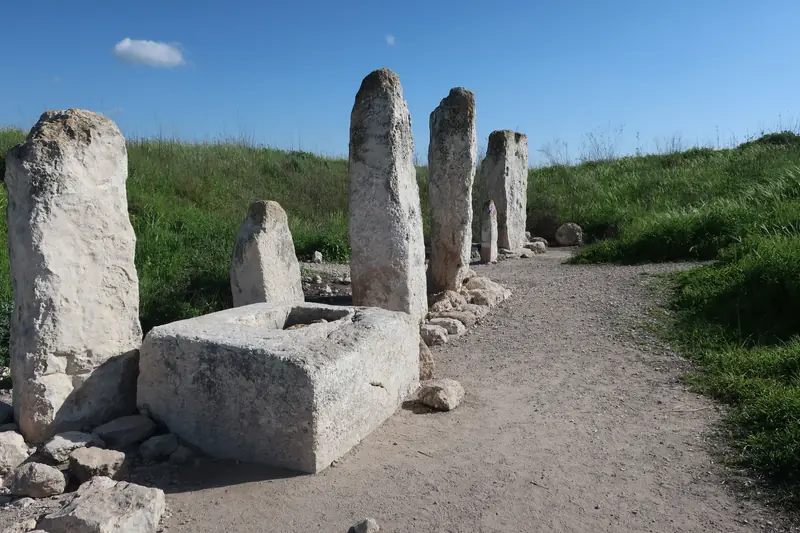
A powerful Canaanite city that the Book of Joshua says was never taken, named by the pharaohs of the Amarna age and by Merneptah, then rebuilt under Solomon.
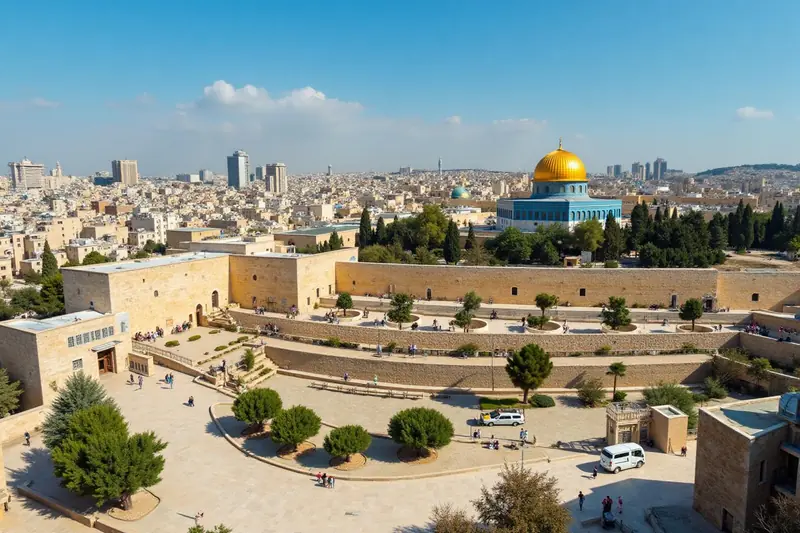
Where tradition places Abraham's test now stands the Temple Mount, one of the holiest sites in Judaism and Islam.
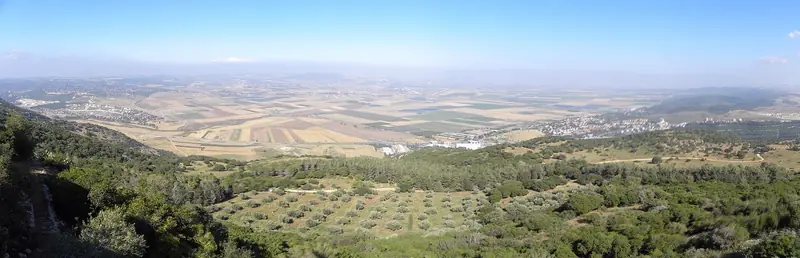
Fire from heaven, a little cloud rising from the sea and the hermits who gave their name to the Carmelite order: a mountain overlooking the Jezreel Valley and Haifa Bay.
Yes. Joppa is the Greek form of the name, used in the Acts of the Apostles and in the King James Version; Hebrew says Yafo (Japho) and Arabic Yafa, hence "Jaffa". All these forms refer to the hill and port now at the southern end of Tel Aviv.
Jaffa marks the edge of the territory of Dan (Joshua 19:46) and is the port for the cedars of Lebanon sent for the Temple (2 Chronicles 2:16; Ezra 3:7). Jonah sails from it to Tarshish (Jonah 1:3). In the New Testament, Peter raises Tabitha there and, at the house of Simon the Tanner, receives the vision that leads him to Cornelius in Caesarea (Acts 9:36 - 10:23).
Jaffa lies south of Tel Aviv and has been part of it since the 1950 merger (Tel Aviv-Yafo municipality). Old Jaffa is about 3 km south of central Tel Aviv: you can walk or cycle there along the seafront promenade.
St Peter's Church, the so-called House of Simon the Tanner (from outside), Kedumim Square and its archaeological centre, the hilltop park and its view, the Ramesses II Gate Garden, the Ottoman clock tower, and the port with Andromeda's Rock.
The Hebrew name Yafo is traditionally linked to <em>yafeh</em>, "beautiful". A late Jewish tradition connects it with Japheth, son of Noah, and the Greeks with Iope (Cassiopeia), mother of Andromeda. The name is in fact much older: Egyptian texts of the 2nd millennium BC already write it Yapu.
The variety, known as Shamouti, appeared in the 19th century in the orchards around Jaffa and was exported through its port, hence the trade name. British Jaffa Cakes are named after these oranges. There is no link with the biblical text.
No. Jaffa Gate is a gate in the walls of the Old City of Jerusalem, some sixty kilometres away. It takes its name from the road that led from there to Jaffa and the coast.
The house traditionally identified as Simon the Tanner's, near the Old Jaffa lighthouse, is private property and not normally open to visitors; you can stop at the entrance. The nearby St Peter's Church, which commemorates the apostle's stay, is open to visitors outside service times.