
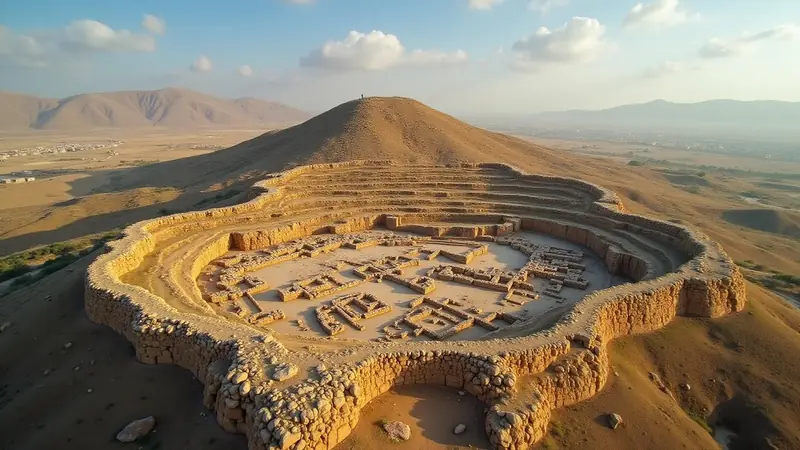
Shechem (Tel Balata) – Abraham's First Altar in Canaan
Between Mount Ebal and Mount Gerizim, the place of God's first promise and Abraham's first altar in the Promised Land (Genesis 12:6-7).
1500–1200 BCE
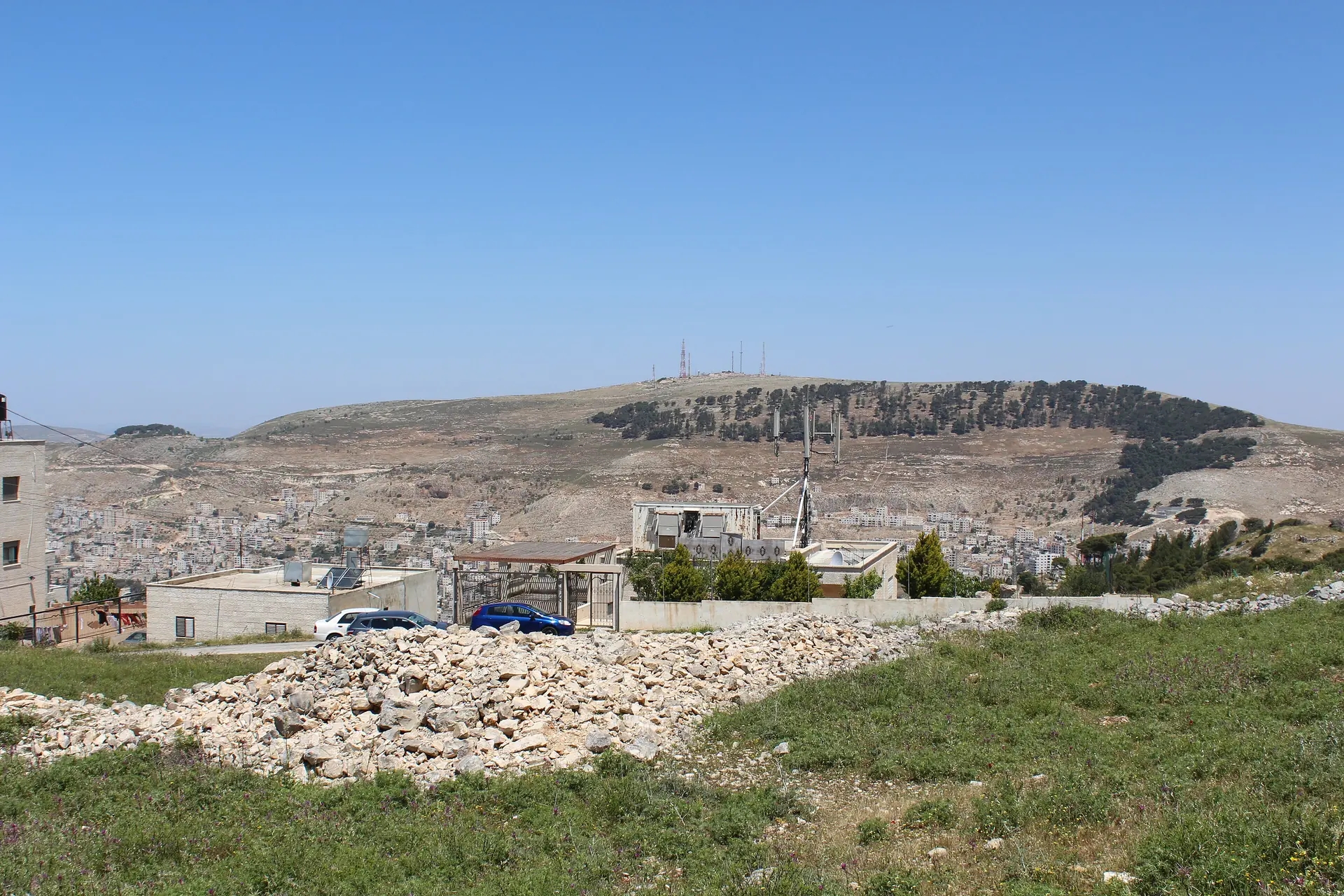
Between Mount Ebal and Mount Gerizim, Joshua has the Law read aloud, then gathers the tribes at Shechem and asks them to choose whom they will serve.
Credit: Deror_avi · CC BY-SA 3.0 · Wikimedia Commons
In the heart of the Samarian hills, the pass between Mount Ebal and Mount Gerizim is the setting of two great scenes in the Book of Joshua. First, Joshua builds an altar on Mount Ebal and has the Law read to the people gathered between the two mountains (Joshua 8:30-35). Then, at the end of his life, he assembles all the tribes at Shechem — today's Tel Balata, on the eastern edge of Nablus — to renew the covenant (Joshua 24).
This page focuses on Joshua at Shechem. The city itself, its ramparts and Abraham's first altar are covered on the Shechem (Tel Balata) page; Jacob's stay, the El-Elohe-Israel altar and the field he bought, on the Shechem in Jacob's time page.
"And Joshua gathered all the tribes of Israel to Shechem, and called for the elders of Israel, and for their heads, and for their judges, and for their officers; and they presented themselves before God."
Joshua 24:1 (KJV)
The scene is prepared in Deuteronomy. Before the entry into the land, Moses prescribes a ceremony between the two mountains overlooking Shechem: the blessing is to be pronounced on Gerizim, the curse on Ebal.
"And it shall come to pass, when the LORD thy God hath brought thee in unto the land whither thou goest to possess it, that thou shalt put the blessing upon mount Gerizim, and the curse upon mount Ebal."
Deuteronomy 11:29 (KJV)
״וְהָיָה כִּי יְבִיאֲךָ יְהוָה אֱלֹהֶיךָ אֶל־הָאָרֶץ אֲשֶׁר־אַתָּה בָא־שָׁמָּה לְרִשְׁתָּהּ וְנָתַתָּה אֶת־הַבְּרָכָה עַל־הַר גְּרִזִים וְאֶת־הַקְּלָלָה עַל־הַר עֵיבָל.״
דברים יא, כט
Deuteronomy 27 spells out the ritual: set up great plastered stones on Mount Ebal and write the Law on them, build an altar of unhewn stones, then divide the tribes. Simeon, Levi, Judah, Issachar, Joseph and Benjamin stand on Gerizim to bless; Reuben, Gad, Asher, Zebulun, Dan and Naphtali on Ebal for the curse (Deuteronomy 27:4-13).
The Book of Joshua tells how this order was carried out, just after the capture of Ai.
"Then Joshua built an altar unto the LORD God of Israel in mount Ebal, as Moses the servant of the LORD commanded the children of Israel, as it is written in the book of the law of Moses, an altar of whole stones, over which no man hath lift up any iron."
Joshua 8:30-31 (KJV)
״אָז יִבְנֶה יְהוֹשֻׁעַ מִזְבֵּחַ לַיהוָה אֱלֹהֵי יִשְׂרָאֵל בְּהַר עֵיבָל.״
יהושע ח, ל
Joshua writes a copy of the law of Moses on the stones. All the people stand on either side of the ark, "half of them over against mount Gerizim, and half of them over against mount Ebal". Joshua then reads "all the words of the law, the blessings and cursings" before the men, women, children and strangers (Joshua 8:32-35).
Ebal (about 940 m) to the north and Gerizim (about 880 m) to the south face each other across a narrow valley, where Nablus lies today. The setting suits a ceremony in which two halves of the people answer each other from one slope to the other. The text nonetheless has a complex history: the Septuagint places this episode a little later (after Joshua 9:2), and a Qumran manuscript puts it right after the crossing of the Jordan. This suggests that tradition hesitated over the moment of the ceremony, if not over its place.
Late in life, Joshua summons the tribes to Shechem. His speech retraces the people's history from Terah, Abraham's father, who "served other gods" beyond the Euphrates. It then recalls the patriarchs, Egypt, the Exodus, the wilderness and the entry into Canaan. The account ends with the gift of a land: "cities which ye built not" and "vineyards and oliveyards which ye planted not" (Joshua 24:2-13).
"And if it seem evil unto you to serve the LORD, choose you this day whom ye will serve; whether the gods which your fathers served that were on the other side of the flood, or the gods of the Amorites, in whose land ye dwell: but as for me and my house, we will serve the LORD."
Joshua 24:15 (KJV)
״בַּחֲרוּ לָכֶם הַיּוֹם אֶת־מִי תַעֲבֹדוּן […] וְאָנֹכִי וּבֵיתִי נַעֲבֹד אֶת־יְהוָה.״
יהושע כד, טו
Three times the people answer that they will serve the LORD. Joshua stresses how demanding this choice is and tells them to put away foreign gods (Joshua 24:16-24). Then he makes a covenant: "So Joshua made a covenant with the people that day, and set them a statute and an ordinance in Shechem" (Joshua 24:25).
"And Joshua wrote these words in the book of the law of God, and took a great stone, and set it up there under an oak, that was by the sanctuary of the LORD."
Joshua 24:26 (KJV)
״וַיִּכְתֹּב יְהוֹשֻׁעַ אֶת־הַדְּבָרִים הָאֵלֶּה בְּסֵפֶר תּוֹרַת אֱלֹהִים וַיִּקַּח אֶבֶן גְּדוֹלָה וַיְקִימֶהָ שָּׁם תַּחַת הָאַלָּה אֲשֶׁר בְּמִקְדַּשׁ יְהוָה.״
יהושע כד, כו
Joshua adds that the stone "shall be a witness", for "it hath heard all the words of the LORD which he spake unto us" (Joshua 24:27). The Hebrew verse speaks of a miqdash, a "sanctuary": Shechem is presented as an already established place of worship.
🌳 Shechem's great tree, from one story to the next
A sacred tree recurs in every era of Shechem's story: the "plain" or oak of Moreh where Abraham builds his altar (Genesis 12:6), the oak under which Jacob buries his household's idols (Genesis 35:4), the oak of Joshua's stone (Joshua 24:26), then "the plain of the pillar that was in Shechem" (in Hebrew, the oak of the pillar) where Abimelech is made king (Judges 9:6). The biblical text thus links the generations through one landmark, which cannot be located.
The Book of Joshua ends with three burials. Joshua dies aged a hundred and ten and is buried at Timnath-serah, in the hill country of Ephraim (Joshua 24:29-30). Eleazar son of Aaron is buried on the hill of his son Phinehas (Joshua 24:33). In between, the text records the burial of Joseph's bones at Shechem (Joshua 24:32).
This detail closes a promise opened at the end of Genesis. Dying in Egypt, Joseph had made his brothers swear: "ye shall carry up my bones from hence" (Genesis 50:25). At the Exodus, "Moses took the bones of Joseph with him" (Exodus 13:19). They now rest in the field Jacob had bought from the sons of Hamor, a story told on the Shechem in Jacob's time page. Tradition places this tomb a few hundred metres from Tel Balata; it is a sensitive site with very restricted access.
A generation later, the Book of Judges shows Shechem in a different light. Abimelech, son of Gideon (Jerubbaal), relies on his mother's family at Shechem to make himself king. The leading citizens give him seventy pieces of silver taken from the local temple.
"And they gave him threescore and ten pieces of silver out of the house of Baal-berith."
Judges 9:4 (KJV)
Made king by the tree at Shechem (Judges 9:6), Abimelech massacres his brothers. Only Jotham escapes: from the top of Gerizim, he calls out to the townspeople the fable of the trees looking for a king (Judges 9:7-15). Three years later the city rebels; Abimelech razes it and sows it with salt (Judges 9:45). The people of the "tower of Shechem" take refuge in the stronghold of the house of the god Berith, which he sets on fire (Judges 9:46-49). The god's name, "Baal of the covenant" or "El of the covenant", ironically echoes the covenant made under Joshua.
In the 14th century BC, Shechem was the capital of a small Canaanite kingdom in the highlands. In the Amarna letters, its ruler Labayu writes to Pharaoh to defend himself against his neighbours' accusations (letters EA 252 to 254). The king of Jerusalem, Abdi-Heba, accuses him of having "given the land of Shechem to the Habiru" (EA 289). The city was therefore an active political centre in the Late Bronze Age, the period in which the conquest is traditionally placed.
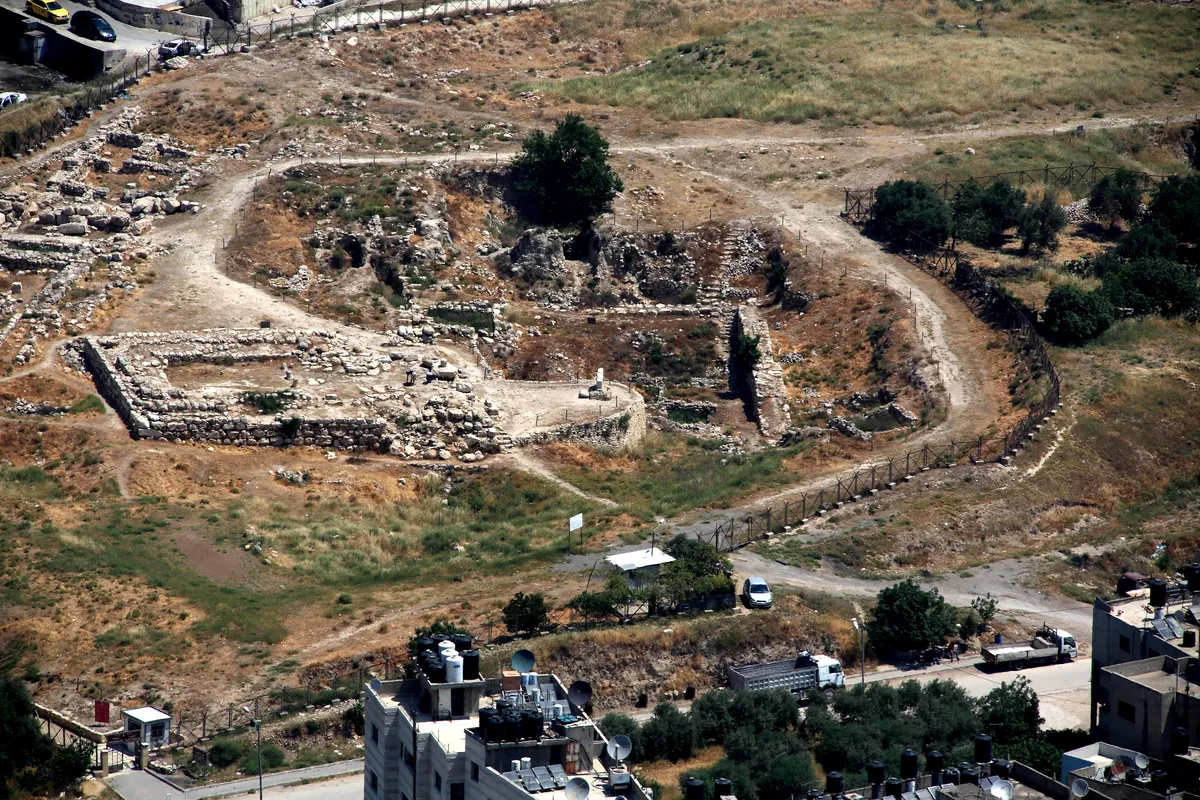
On the acropolis of Tel Balata, a large fortress-temple with thick walls was built in the Middle Bronze Age, around 1650 BC. According to the American expedition led by G. Ernest Wright (1956-1973), it was rebuilt in a more modest form in the Late Bronze Age and used until the beginning of the Iron Age. A large standing stone stood in front of it. Wright linked the building with the "house of the god Berith" (Judges 9:46), and the stone with Joshua's "great stone" (Joshua 24:26). These links remain hypothetical, and the chronology of these phases is being re-examined today.
In 1980, during a survey of the hill country of Manasseh, archaeologist Adam Zertal (University of Haifa) spotted a stone structure on a north-eastern spur of Mount Ebal, a few kilometres from Tel Balata. He excavated it from 1982 to 1989. He uncovered a rectangular building of about 9 × 7 m, with no doorway or floor. It was filled with layers of stones, ash and burnt bones (young bulls, sheep or goats, fallow deer), with two paved courtyards and a ramp. Pottery and two scarabs date it to the late 13th and 12th centuries BC, at the very start of the Iron Age: right around 1200, or just after.
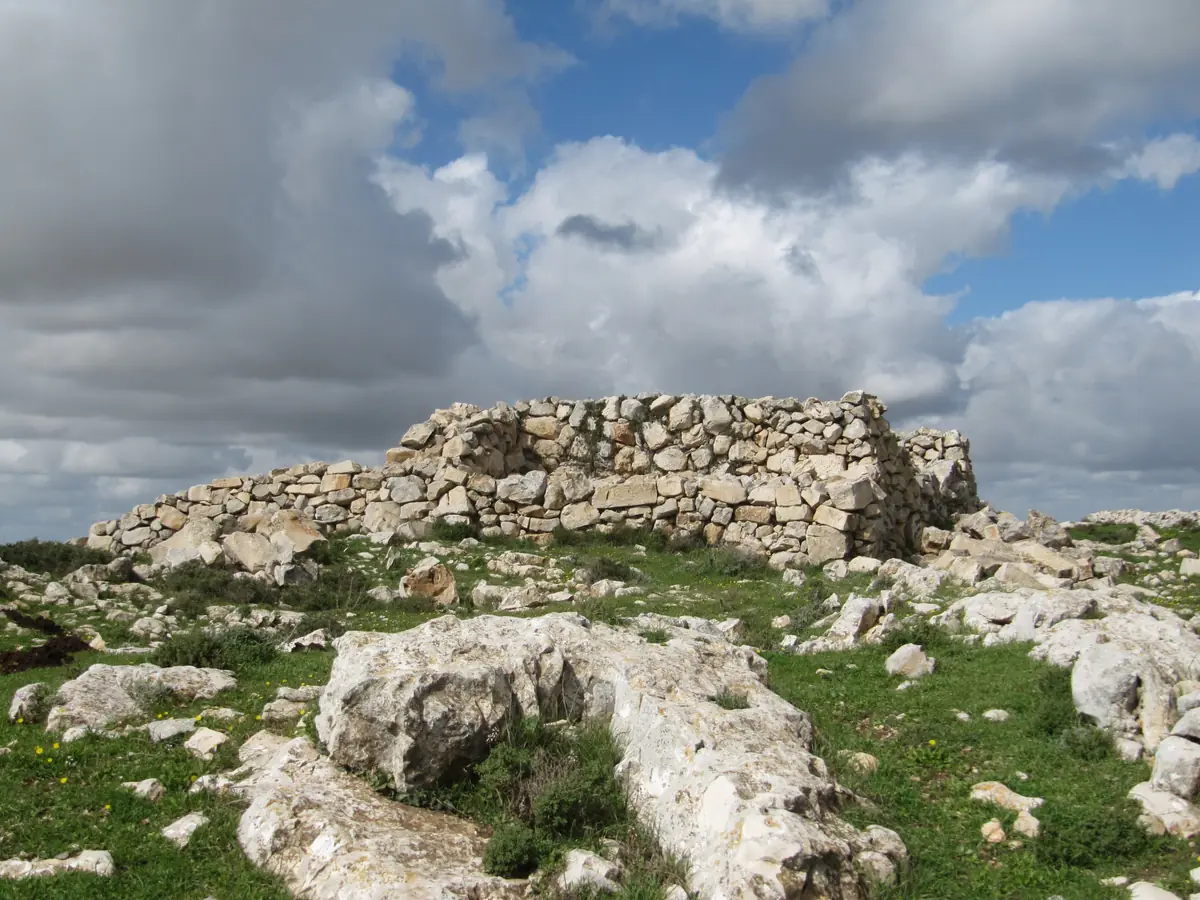
Zertal saw it as Joshua's altar: a filled platform reached by a ramp, in keeping with the altars "without steps" of Exodus (Exodus 20:26). Others, such as Israel Finkelstein, accept an early cult place but dispute that it is an altar or linked to the account in Joshua 8. Aharon Kempinski saw it as a watchtower. Critics also note that the site, facing north, does not face Gerizim.
🔎 A debated identification
Many archaeologists now accept that the Mount Ebal structure had a cultic function at the beginning of the Iron Age. Its identification with Joshua's altar is not a consensus. In 2021, part of its enclosure wall was damaged during road works, which turned the site into a political issue.
In 2022 a team led by Scott Stripling announced that a small folded lead object, found in 2019 in the spoil heaps of Zertal's excavation, bore a curse in the name of the God of Israel. The article published in 2023 has been strongly disputed: several epigraphers see no inscription at all, and some consider it a simple net weight. It cannot be used as evidence.
On the summit of Gerizim, excavations have revealed the sacred precinct of the Samaritans, founded in the Persian period (late 5th century BC). It was enlarged in the 2nd century BC, with a Hellenistic city around it, and later topped by an octagonal Byzantine church. These remains are several centuries later than the period of Joshua. The Samaritan community, which still lives on the mountain, celebrates Passover there every year.
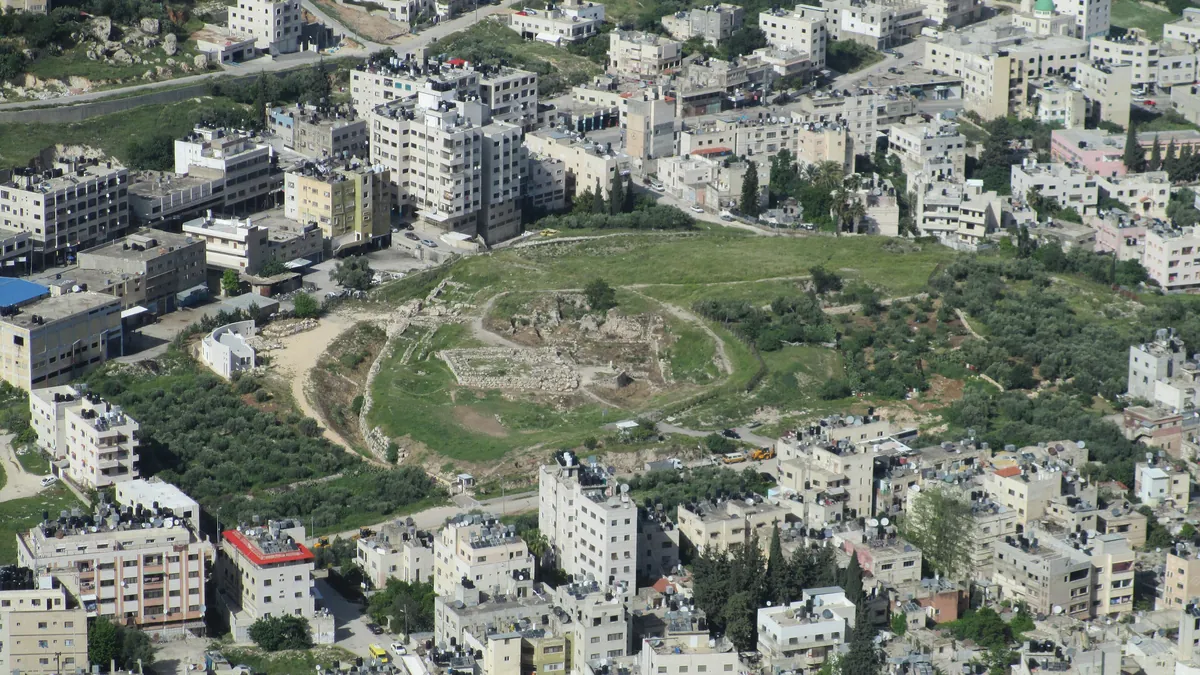
In the order of the biblical narrative, Shechem follows the capture of Jericho and Ai. It precedes the setting up of the ark at Shiloh, where Joshua divides the land among the tribes (Joshua 18). The Shechem (Tel Balata) page describes the mound and its fortifications in more detail.
Shechem: Joshua Renews the Covenant
Tel Balata, eastern edge of Nablus (≈ 50 km north of Jerusalem); Mount Ebal north and Mount Gerizim south of the city
GPS coordinates : 32.2134, 35.2819
Start navigation with:
Between Mount Ebal and Mount Gerizim, the place of God's first promise and Abraham's first altar in the Promised Land (Genesis 12:6-7).
Back from Paddan-aram, Jacob camps before Shechem, buys a field and builds an altar there: a place of faith, covenant and transmission between generations.
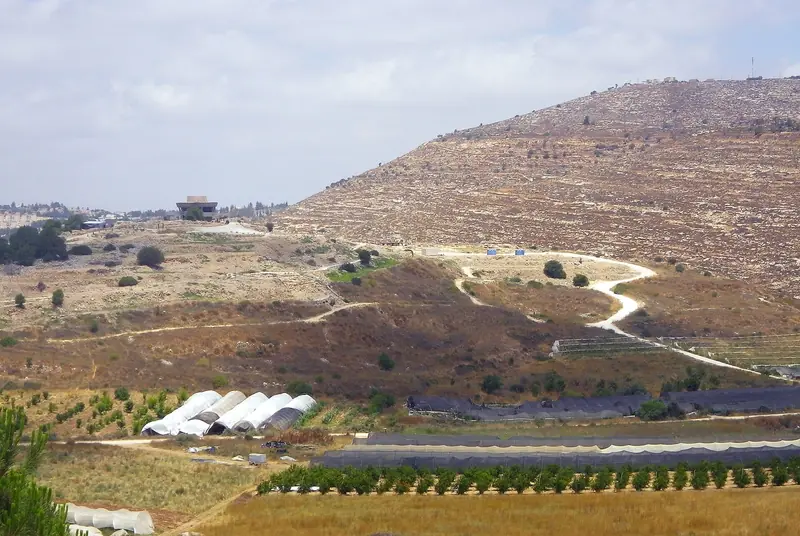
Israel's first great sanctuary according to the Bible: Joshua sets up the Tent of Meeting here, Hannah prays for a son, and Samuel grows up beside the priest Eli.
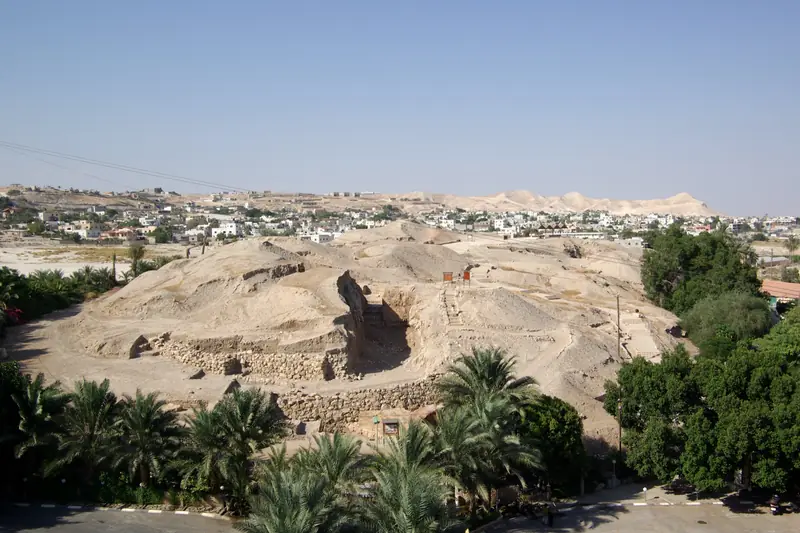
Rahab, the Jordan crossing and the falling walls: the Book of Joshua set against a century of excavation at one of the oldest towns in the world.
At Shechem, according to Joshua 24:1-28. The ancient site is Tel Balata, on the eastern edge of Nablus, between Mount Ebal and Mount Gerizim. GPS coordinates are in the "Access & GPS" section.
This is the order given by Moses (Deuteronomy 11:29; 27:12-13) and carried out by Joshua (Joshua 8:33-34). The text does not explain the division. The landscape explains the staging: two mountains facing each other across a narrow valley.
From 1982 to 1989, Adam Zertal excavated an early Iron Age structure which he identified as Joshua's altar. Many archaeologists recognise an early cult place, but its identification with the altar of Joshua 8 remains debated and is not a consensus.
The site is not developed and lies in Area B, in the West Bank. Visits only take place in an organised framework. Check permits and security conditions at the time of your trip.
A small folded lead object, found in 2019 in excavation spoil and presented in 2022-2023 as an ancient inscription. Its reading is strongly disputed by many epigraphers, who see no writing on it. It is not evidence.
No. A large standing stone stood in front of the fortress-temple of Tel Balata, and some have linked it with the stone of Joshua 24:26. The link remains a hypothesis, with no inscription or direct proof.
No. The Samaritan sacred precinct dates from the Persian period (late 5th century BC) and was enlarged in the Hellenistic period; the octagonal church is Byzantine. Gerizim is a biblical landscape, but its ruins are much later.